Printable children's stories are ready-to-download story files, usually PDFs, that parents can print at home and turn into physical books for young readers. This guide to printable children's stories covers everything you need: how to pick quality titles, what to print them on, how to assemble them, and how to use them to build real reading skills. You will also find honest notes on where free story templates shine and where a personalized storybook from Adventuresofbook fills the gap. Printable kids' books work best as a supplement to your child's core reading program, not a replacement for it.
What makes a high-quality printable kids' storybook?
The best printable storybooks are built around phonics, not just cute pictures. Level 1 printable books use short sentences, specific phonics patterns, and 3–5 sight words per page to build fluency. That structure is what separates a genuinely useful printable from a pretty PDF that sits unread.
Little Lions Literacy is one of the clearest examples of this done right. Their decodable readers use short "a" words like "cat" and "mat" in clean layouts that help beginner readers focus on decoding without visual clutter. The illustrations support the text without overwhelming it. That balance matters because a busy page pulls a new reader's attention away from the words.
Phonics-aligned printables follow a scope and sequence that matches early reading curricula, such as I Can Read! Level 1, with tight sight word controls. When a printable skips that structure, children guess from pictures instead of reading the words. That habit slows fluency development significantly.
Features to check before downloading any children's story printable:
- Short sentences of five words or fewer for Level 1 readers
- One phonics pattern per story, such as short vowel "a" or consonant blends
- 3–5 controlled sight words per page, not a random mix
- Clean, non-distracting illustrations that match the text
- Legible font size, at least 18pt, with generous line spacing
- Print-ready layout that does not require resizing
A printable that checks all six boxes will give your child real practice. One that checks two or three is a coloring sheet with words on it.
Tools and materials you need to print stories at home
Printing quality matters more than most parents expect. A blurry printout with faded text makes decoding harder for a child who is already working hard to read. Select High Quality or Best settings and print at 100% actual size to preserve text size and illustration placement.
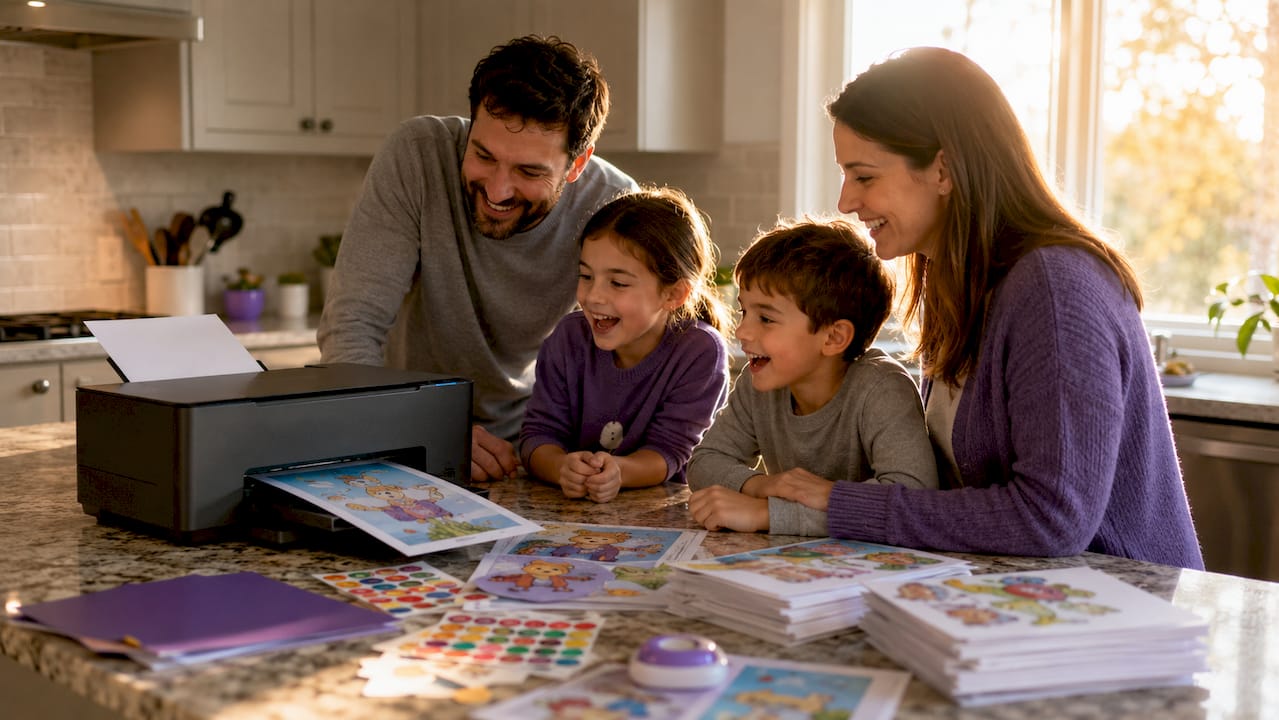
The printer type you use affects the final result. Inkjet printers produce richer colors for illustrated pages but cost more per page in ink. Laser printers are faster and cheaper per page but can look flat on color illustrations. For black-and-white phonics readers, a laser printer is the better value. For full-color picture books, inkjet wins.
| Option | Best for | Drawback |
|---|---|---|
| Inkjet printer | Full-color illustrated stories | Higher ink cost per page |
| Laser printer | Black-and-white phonics readers | Flat color on illustrations |
| Standard copy paper | Quick practice copies | Thin, tears easily when handled by kids |
| Cardstock (65 lb) | Durable booklets kids can handle | Costs more, harder to fold |
| Matte photo paper | Premium color printouts | Expensive for large print runs |
For assembly, you need scissors, a stapler with long-reach capability for saddle-stitching, and coloring supplies if the printable uses black-and-white line art. A bone folder helps create clean folds, though a butter knife works fine.
Pro Tip: Never use "Shrink to Fit" or "Fit to Page" in your printer dialog. Those settings reduce font size and compress illustrations, making the text harder for young readers to decode. Always set scale to 100% or "Actual Size."
How to print, assemble, and use a printable storybook
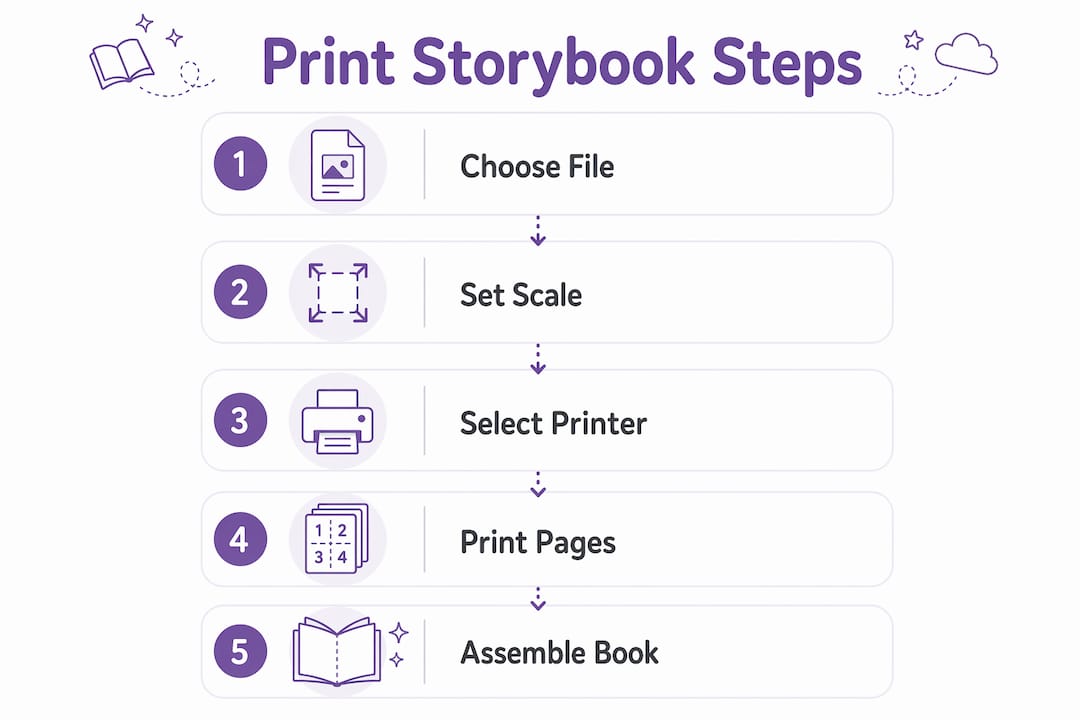
Getting from a downloaded PDF to a finished book your child wants to read takes about 20 minutes. Follow these steps to get it right the first time.
-
Download and check the file. Open the PDF and scroll through every page before printing. Check that text is sharp, illustrations are clear, and the layout looks correct at 100% zoom.
-
Set your printer correctly. Choose your best quality setting, set paper size to Letter (8.5x11 inches), and confirm scale is at 100%. Load the correct paper type for your printer.
-
Print a test page first. Print page one only. Check that text is readable, margins are correct, and the image is not cut off. Fix any issues before printing the full run.
-
Print the full booklet. Most printable storybooks are designed to print double-sided. Follow the file's instructions for page order. Some use a "booklet" layout that folds in half.
-
Cut and fold. Use scissors or a paper trimmer to cut along any marked lines. Fold pages in half with a firm crease. Stack pages in order.
-
Bind the booklet. A long-reach stapler placed along the spine creates a clean saddle-stitch binding. Two staples, one near the top and one near the bottom of the fold, hold the pages securely.
-
Add interactive elements. If the printable includes coloring pages, let your child color before reading. Cutting, coloring, and sequencing activities require active processing of story events, which deepens comprehension and builds fine motor skills. The Johnny Appleseed booklet from Simple Everyday Mom is a good example of this format done well.
-
Read together and extend the story. After reading, try a sequencing activity. The Little Bo Peep sequencing printable from Homeschool Preschool uses labeled flaps to help children order story events, reinforcing cause and effect.
Pro Tip: Let your child handle the finished book independently. The physical act of turning pages, pointing to words, and carrying their own book builds reading confidence faster than screen-based reading apps.
Common mistakes when using children's story printables
The most common mistake is choosing a printable that is too advanced for the child's current reading level. A story with long sentences and unfamiliar vocabulary frustrates a new reader instead of building confidence. Match the printable to your child's phonics stage, not their age.
Printing problems are the second biggest issue. Scaling errors are the most frequent culprit. When a parent prints at 85% to "fit the page," font size drops below what a young reader can comfortably decode. Always verify the scale setting before every print job.
Common pitfalls and how to fix them:
- Wrong reading level: Check the phonics scope before downloading. A Level 1 book should use one phonics pattern and controlled sight words.
- Scaling errors: Set printer scale to 100% every time. Check the first test page before printing the full run.
- Poor paper choice: Thin copy paper tears quickly in small hands. Use 65 lb cardstock for any book your child will handle repeatedly.
- Skipping interactive elements: Interactive activities like coloring and sequencing deepen comprehension by involving multiple senses. Do not skip them.
- Printing without previewing: Always open the PDF at 100% zoom and scroll through before sending to the printer.
- Ignoring ink levels: Low ink produces faded text that is harder to read. Check ink or toner before a print run.
One underrated mistake is treating printables as a standalone reading program. Printable stories supplement, not replace, core reading curricula by providing extended practice time with phonics and sight words. They work best when they reinforce what your child is already learning in school or a structured reading program.
Key takeaways
Printable children's stories work best when they are phonics-aligned, printed correctly at 100% scale, and paired with hands-on activities that deepen comprehension.
| Point | Details |
|---|---|
| Match phonics level | Choose printables with one phonics pattern and 3–5 controlled sight words per page. |
| Print at 100% scale | Always set printer scale to Actual Size to preserve text and illustration quality. |
| Use cardstock for durability | 65 lb cardstock holds up to repeated handling by young children. |
| Add interactive activities | Coloring and sequencing activities improve comprehension and fine motor skills. |
| Supplement, do not replace | Printables extend phonics practice but work best alongside a structured reading program. |
My honest take on printables vs. personalized storybooks
Printable kids' books are genuinely useful. I have seen them work well for targeted phonics practice, especially when a child needs more repetitions with a specific sound pattern than their classroom provides. The best free story templates from sources like Little Lions Literacy are built by people who understand early reading science. That is not nothing.
But printables have a ceiling. They are designed for a general child, which means they are designed for no child in particular. The character in the story is not your kid. The adventure does not reflect your child's name, face, or personality. For skill practice, that is fine. For the kind of reading experience that makes a child feel genuinely seen, it falls short.
That is where a service like Adventuresofbook does something printables cannot. The story is written around your child specifically, and the illustrations are generated from real photos you upload. Your child is not a placeholder. They are the actual hero of the book. For a child who is reluctant to read or who needs a confidence boost, that difference is real.
My recommendation: use quality phonics printables for daily skill practice. Save a personalized storybook for the moments that matter, a birthday, a milestone, or just a night when you want reading to feel like an event.
— Jason
How Adventuresofbook fits into your printable story toolkit
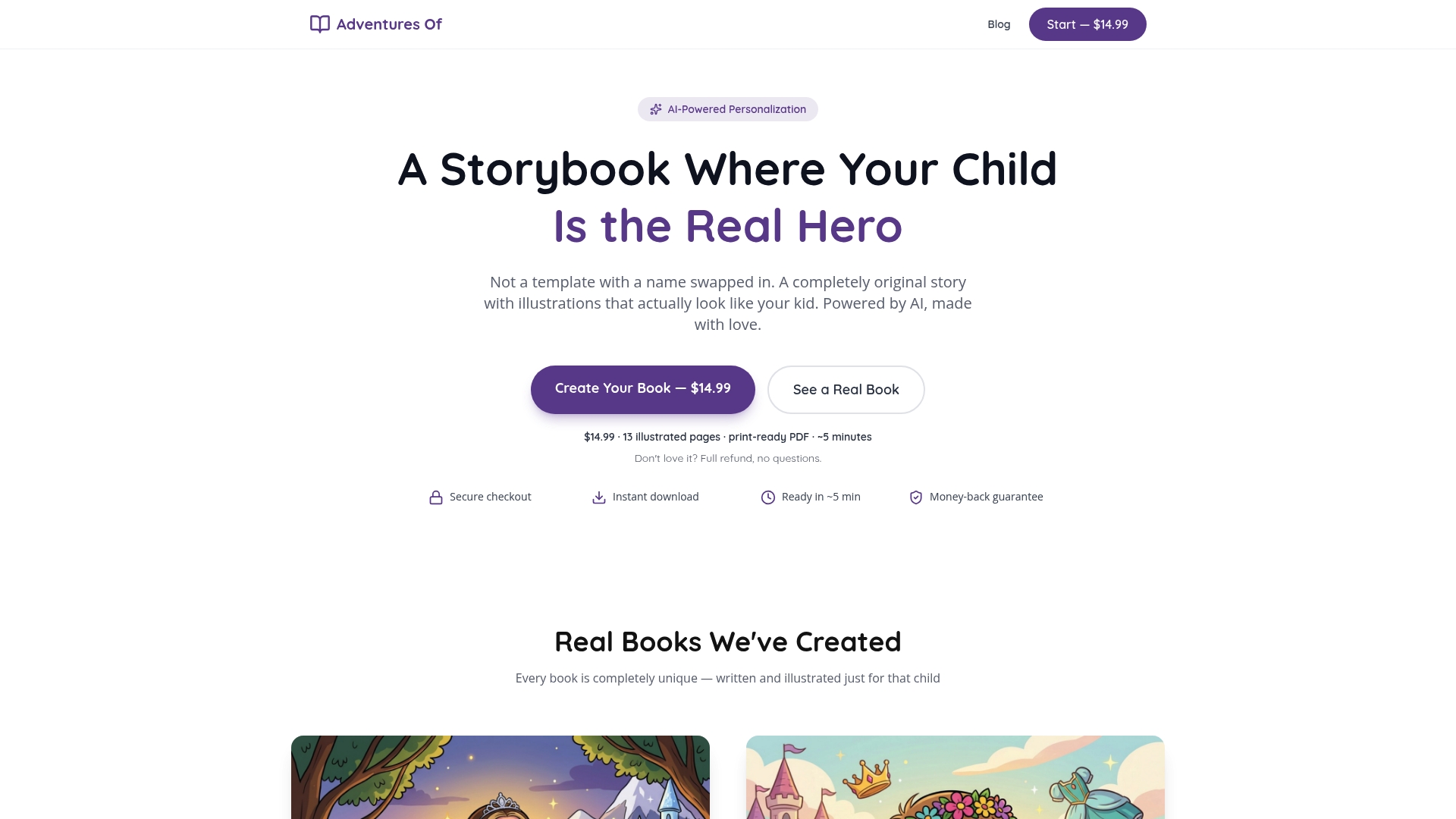
Adventuresofbook creates personalized children's storybooks using AI-generated narratives and illustrations built from photos you upload. Each book features 13 illustrated pages, arrives as an 8.5x8.5 print-ready PDF, and takes about five minutes to generate. The price is $14.99 one-time, with a 7-day refund policy. There are no templates and no generic characters. The story and illustrations are original to your child. If you already use printable phonics readers for daily practice, an Adventuresofbook story works as the reward reading, the book your child asks for by name because the hero looks exactly like them. You can start your book in under five minutes.
FAQ
What are printable children's stories?
Printable children's stories are downloadable PDF files, usually free or low-cost, that parents print at home and assemble into physical booklets. They are designed to support early reading skills through phonics-aligned text and simple illustrations.
How do I print a children's story booklet at home?
Print at 100% scale using your printer's High Quality setting on Letter-size paper or 65 lb cardstock. Fold pages in half and use a long-reach stapler along the spine to bind the booklet.
What reading level should I choose for my child?
Match the printable to your child's current phonics stage. Level 1 readers use short sentences, one phonics pattern per story, and 3–5 sight words per page, making them the right starting point for most early readers.
Are free story templates as good as paid printable kids' books?
Quality free templates from sources like Little Lions Literacy are built on solid phonics principles and work well for skill practice. Paid options sometimes offer more variety or better design, but the phonics structure matters more than the price.
How is a personalized storybook different from a printable story?
A printable story uses a general character designed for any child. A personalized storybook from Adventuresofbook features an original story and AI-generated illustrations based on your specific child's photos, making the child the actual hero of the book.