
Secure data in kids stories means protecting the personal information children share when they use digital storytelling platforms, from their names and photos to their behavioral patterns and voice recordings. The importance of secure data in kids stories has grown sharply as AI-powered apps collect more of this information than ever before. Regulations like COPPA, GDPR, and the UK's Age-Appropriate Design Code now set legal floors for how platforms must handle children's data. Yet 75% of parents fear their children are not making safe choices online, and 46% say they lack confidence in their own ability to protect their child's privacy. That gap between regulation and real-world parental readiness is exactly what this guide addresses.
What kinds of data do kids' storytelling apps collect?
Digital storytelling apps collect far more than a child's first name. The typical data profile built by a personalized story app includes:
- Names and nicknames used to personalize the narrative
- Photos and likenesses uploaded to generate custom illustrations
- Voice recordings captured through microphone access during interactive features
- Device identifiers such as advertising IDs and hardware fingerprints
- Behavioral data including reading speed, tap patterns, and session length
- Location data pulled from device permissions, sometimes without a clear reason
The real risk is not any single data point. Small data points combine to create detailed psychological and behavioral profiles of a child. Turning off location tracking alone is not enough, because device IDs and metadata still allow apps to triangulate behavior and identity.
Children also build digital footprints from a young age, often without realizing it. Data collected through a story app at age four can persist for years, even after the app is deleted. That persistence is what makes choosing a privacy-conscious platform so consequential.

Pro Tip: Before downloading any kids' story app, search the app name plus "privacy policy" and look specifically for clauses about using children's data to train AI models. If you find one, that is a red flag worth taking seriously.
How do privacy laws protect children's data in storytelling apps?
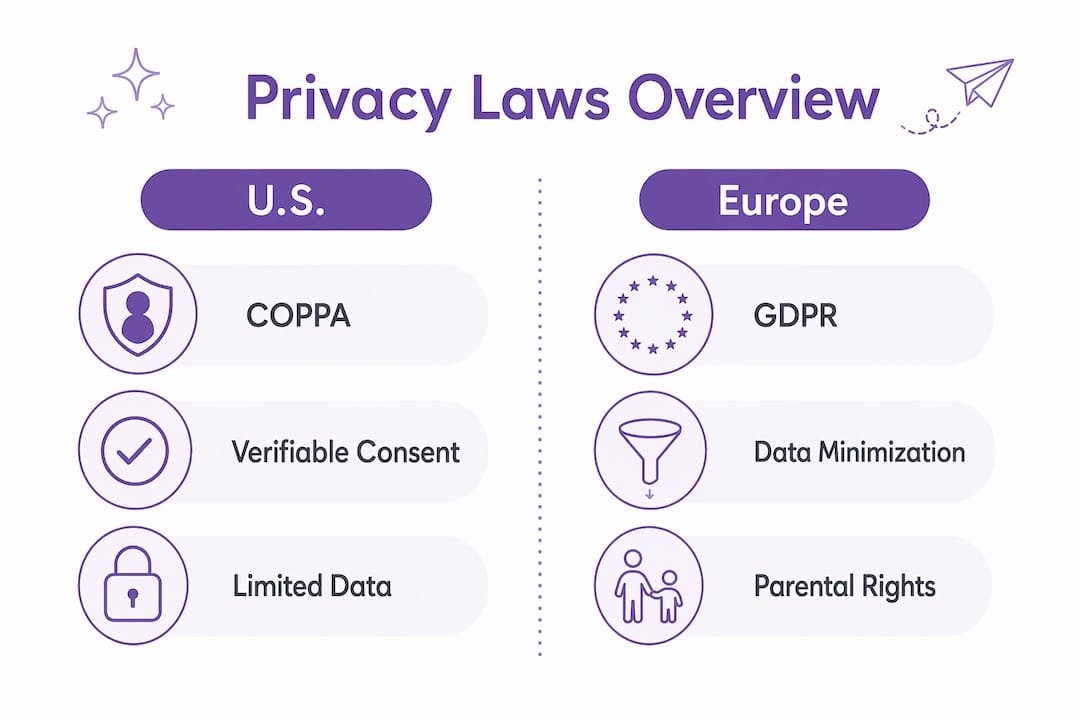
Three major frameworks govern how children's data must be handled in digital media.
| Regulation | Region | Key Requirement |
|---|---|---|
| COPPA (Children's Online Privacy Protection Act) | United States | Requires verifiable parental consent before collecting data from children under 13 |
| GDPR (General Data Protection Regulation) | European Union | Mandates data minimization, purpose limitation, and the right to erasure |
| Age-Appropriate Design Code (AADC) | United Kingdom | Requires privacy by default and prohibits nudging children toward weaker settings |
These regulations require companies to prioritize children's best interests, limit what data they collect, and give parents meaningful control. The practical effect is that compliant platforms must ask for parental consent before collecting names, photos, or behavioral data, and they cannot use that data for ad targeting without explicit permission.
Compliance is not automatic, though. Many apps operate in gray areas, particularly when they are based in countries with weaker enforcement. A platform that claims COPPA compliance may still share anonymized data with third-party analytics providers. Reading the privacy policy, not just the compliance badge, is the only reliable check.
Pro Tip: Look for platforms that state "we do not sell or share children's data with third parties" in plain language. Vague phrases like "we may share data with trusted partners" are a warning sign, not a reassurance.
Can stories teach kids about data privacy?
Stories are one of the most effective tools for teaching children about privacy. Narrative learning builds judgment and resilience in children around AI use, cyberbullying, and data privacy far better than rule-based instructions. A child who hears "don't share your address online" once will forget it. A child who follows a character through the consequences of oversharing will remember the lesson.
This is not just theory. Hong Kong's Privacy Commissioner for Personal Data released a storybook called Adventure in the AI Labyrinth specifically for primary school students. The book uses a fictional scenario to explain how AI collects and uses personal data, making an abstract concept concrete and memorable for young readers.
Carnegie Mellon's Lorrie Cranor took a similar approach for even younger children. Her children's book introduces privacy concepts to kids aged 4–6 using analogies like personal space. The research behind it shows that privacy literacy starts young, and age-appropriate storytelling is the most effective delivery method.
Parents can apply this at home without a formal curriculum. A few practical approaches:
- Read stories that feature characters making choices about what to share and with whom.
- After reading, ask your child: "Would you tell a stranger that?" to connect the story to real life.
- Use the concept of a "personal space bubble" to explain why some information stays private.
- Introduce the idea that apps are like strangers asking questions, and not every question needs an answer.
- Praise children when they ask you before sharing information, reinforcing the habit early.
The goal is not to make children afraid of technology. The goal is to give them a framework for thinking about what they share and why. Stories do that better than any rule list.
What steps can parents take to protect their child's data in story apps?
Protecting your child's data in storytelling apps requires active, ongoing effort. AI story apps carry high data risk because they often collect photos, voice recordings, and behavioral data simultaneously. The Mozilla Foundation's privacy review process flags apps that use children's data to train AI models as particularly high-risk. Here is a practical sequence to follow:
-
Read the privacy policy before you create an account. Look specifically for language about data training, ad tracking, and third-party sharing. If the policy is longer than a few pages with no plain-language summary, treat that as a warning.
-
Deny microphone and location access unless the feature genuinely requires it. A story app that reads text aloud does not need your child's microphone. Revoke permissions you granted during setup by checking your phone's app settings.
-
Use a pseudonym for your child's in-app profile. Most story apps personalize the narrative using a name you provide. Using a nickname instead of your child's legal name limits the data value of that profile if it is ever exposed.
-
Review and update privacy settings after every major app update. App updates frequently reset permissions or introduce new data collection features. Parents often overlook this step, but it is one of the most consequential.
-
Delete apps your child no longer uses and request data deletion. Deleting an app from a device does not delete the data the company holds. Most COPPA-compliant platforms must honor a deletion request. Send one in writing.
-
Use a strong, unique password for each storytelling platform and enable two-factor authentication. A compromised parent account gives bad actors access to everything the platform holds about your child.
-
Check subscription status quarterly. Forgotten subscriptions keep accounts active, which means data collection continues. Cancel anything your child has stopped using.
The underlying principle is that digital hygiene requires active maintenance, not a one-time setup. Data persists, platforms change their policies, and children's usage habits shift. Staying current is the only way to stay protected.
Key Takeaways
Protecting children's data in storytelling apps requires understanding what is collected, choosing compliant platforms, and maintaining active privacy habits over time.
| Point | Details |
|---|---|
| Data collection is broader than most parents realize | Story apps collect names, photos, voice data, and behavioral patterns that combine into detailed profiles. |
| Three regulations set the legal standard | COPPA, GDPR, and the UK's AADC require parental consent, data minimization, and privacy by default. |
| Stories teach privacy better than rules | Narrative-based learning, as shown by Carnegie Mellon and Hong Kong's PCPD, builds lasting privacy judgment in children. |
| Active parental steps are non-negotiable | Reading privacy policies, revoking unnecessary permissions, and deleting unused apps are ongoing responsibilities, not one-time tasks. |
| Platform choice matters as much as settings | Choosing a platform that does not sell or share children's data is the single most effective privacy decision a parent can make. |
What I've learned about privacy and personalized stories
I've spent a lot of time thinking about what makes a children's story platform genuinely trustworthy, not just legally compliant. The honest answer is that compliance and trustworthiness are not the same thing. A platform can check every COPPA box and still use your child's photo to improve its AI model. The policy language is what separates the two, and most parents never read it.
The thing that strikes me most is how the personalization model itself changes the risk profile. A template book that swaps a name into a pre-written story collects almost nothing meaningful. A platform that generates an original story from your child's uploaded photos and personal details collects something genuinely sensitive. That is a real tradeoff, and parents deserve to understand it before they upload anything.
What I believe works best is a platform that uses photos and personal details only to generate the book, stores nothing beyond what is needed for that transaction, and gives parents a clear, short privacy policy they can actually read. That is a higher bar than most platforms clear. But it is the right bar, and I think parents who understand the difference will start demanding it.
Privacy is not a one-time setting. It is an ongoing conversation between parents, platforms, and eventually the children themselves. The earlier kids understand that their information has value and that sharing it is a choice, the better equipped they will be. Stories are the best place to start that conversation, which is why the platform behind those stories matters so much.
— Jason
How Adventuresofbook approaches secure, personalized storytelling
Parents who want a personalized story without the data risk have a specific set of things to look for. Adventuresofbook creates one original storybook per child, generated from uploaded photos and personal details, with no template characters and no generic plots.
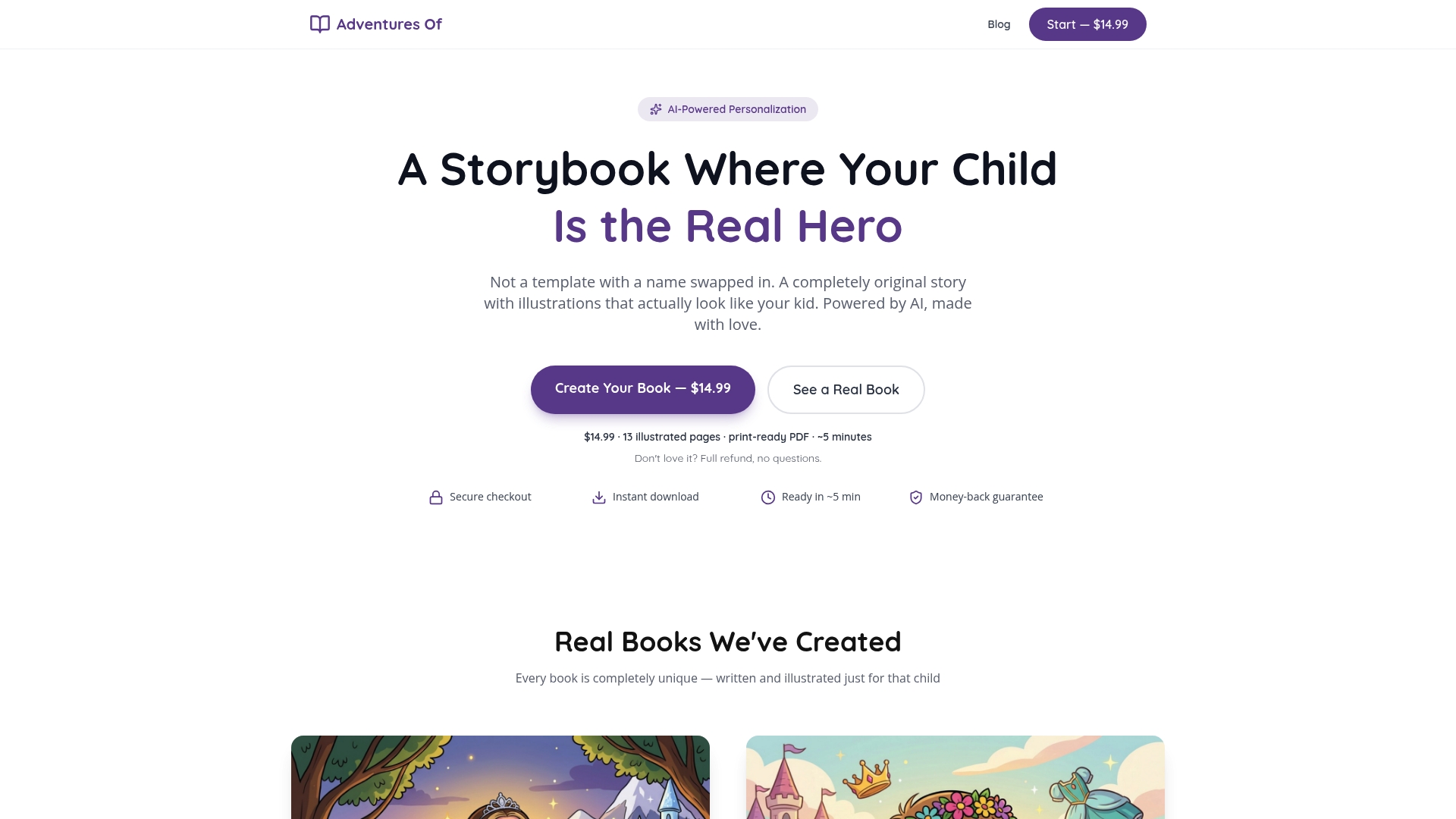
Each book is a one-time creation: 13 illustrated pages, an 8.5x8.5 print-ready PDF, generated in about five minutes for $14.99. Adventuresofbook does not build ongoing behavioral profiles or use children's photos to train future AI models. The personalized children's books Adventuresofbook produces are designed to be a gift, not a subscription that keeps collecting data in the background. If you want to understand how the AI illustration process works before you upload anything, the AI illustration explainer on the Adventuresofbook blog walks through it in plain language. A 7-day refund policy covers every order.
FAQ
What is secure data in kids' stories?
Secure data in kids' stories refers to the responsible collection, storage, and use of children's personal information by digital storytelling platforms. It means platforms collect only what is necessary, protect it from unauthorized access, and do not sell or misuse it.
What does COPPA require from children's story apps?
COPPA requires apps targeting children under 13 to obtain verifiable parental consent before collecting personal data, including names, photos, and location information. Non-compliant apps face significant regulatory penalties.
How can I tell if a kids' story app is safe?
Read the privacy policy for language about data training, third-party sharing, and ad tracking. AI story apps that use children's data to improve their models or serve targeted ads carry the highest risk.
At what age should I start teaching my child about data privacy?
Research from Carnegie Mellon shows that privacy concepts for children aged 4–6 can be introduced effectively through analogies like personal space. Starting early builds habits that persist into adolescence.
Does deleting an app remove my child's data?
Deleting an app from a device does not delete the data the company holds. You must submit a formal data deletion request to the platform directly, which COPPA-compliant services are required to honor.