
Secure book creation is the practice of safeguarding personalized children's books through advanced privacy protocols and digital protections that keep your child's identity, photos, and story data out of the wrong hands. When you upload your child's face, name, and personal details to generate a custom storybook, you are sharing some of the most sensitive data a family has. The role of security in digital book creation is not a technical afterthought. It is the foundation that determines whether a platform deserves your trust. This article explains the real risks, the key technologies that address them, and exactly what to look for when choosing a platform for your child.
Why secure book creation is a real privacy concern
Personalized children's books require more sensitive input than almost any other digital product you buy for your family. You are not just entering a credit card number. You are uploading photos of your child, entering their name, age, and sometimes their interests or physical traits. That combination of data is exactly what identity thieves and data brokers want.

The stakes are measurable. Data breach costs in the content sector reached $4.88 million on average in 2025, according to an IBM report. That figure reflects the real financial damage when platforms fail to protect user data, and it signals that even mid-sized digital publishing services are high-value targets.
Beyond financial exposure, there are three specific threats parents should understand:
- Account takeovers. Weak passwords or absent multi-factor authentication let attackers access your account, download your child's photos, and potentially access stored payment details.
- AI scraping. Uploaded child photos and original story content can be harvested by malicious bots and fed into unauthorized AI training datasets without your knowledge.
- Insecure cloud storage. Platforms that store your files without encryption expose your child's likeness and personal details to anyone who breaches their servers.
Casual sharing of personal materials in generic or unsecured tools is a documented security risk. Security researchers advise separating files by sensitivity level, a principle that applies directly to the photos and personal details you submit to any book creation platform.
What security technologies actually protect your child's data
Understanding the tools behind a secure platform helps you ask better questions before you hand over your child's photo. These are the four technologies that matter most.
Zero-knowledge encryption is the gold standard. Platforms using zero-knowledge encryption encrypt your data locally on your device before it ever reaches their servers. The service provider holds no decryption key. That means even if the company is subpoenaed or breached, your child's data remains unreadable. Most popular platforms, including Google Docs and Notion, use server-side encryption instead, which means the provider can access your content. For a service holding your child's photos, that distinction matters enormously.
Multi-factor authentication (MFA) is the second layer every parent should activate. Hardware keys and authenticator apps provide superior protection against phishing and SIM-swapping attacks compared to SMS codes. Your email account is the recovery key for every linked service, so a compromised email means a compromised book account. Enabling an authenticator app like Google Authenticator or Authy takes under two minutes and closes one of the most common attack vectors.
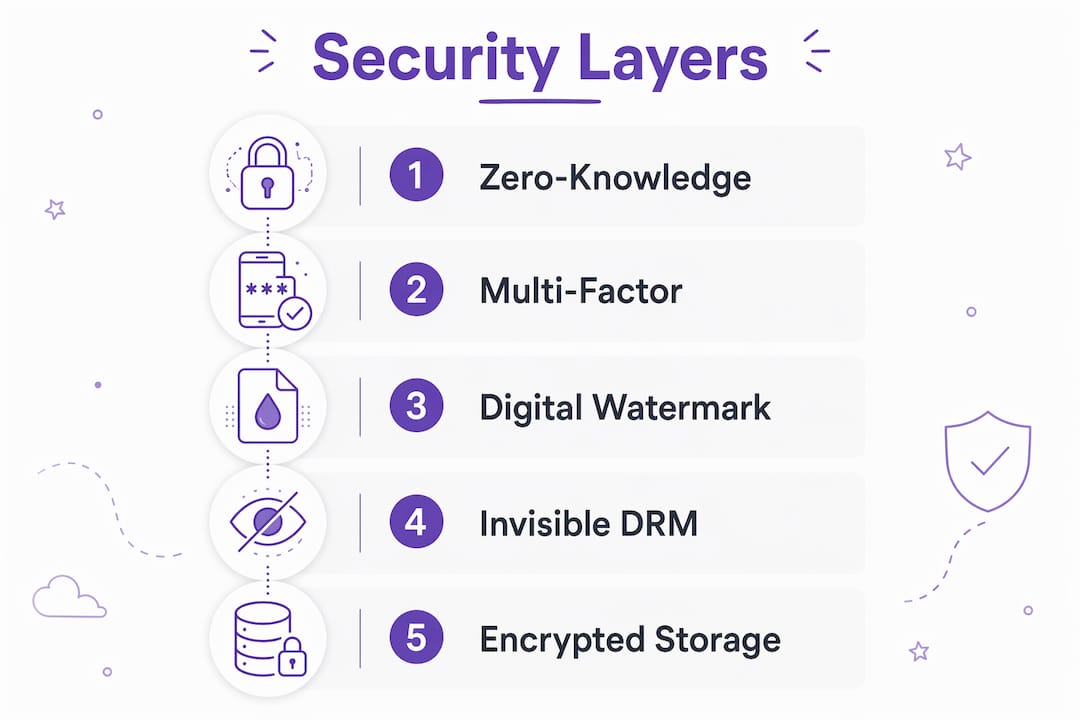
Digital watermarking protects the creative output itself. Invisible watermarking is the primary method used to trace unauthorized sharing of personalized book content back to its source. If your child's custom story is copied and distributed without permission, a watermark embedded in the file identifies exactly where the leak originated.
Digital Rights Management (DRM) controls who can open, copy, or print your downloaded book file. The table below compares the main approaches:
| DRM type | How it works | Best for |
|---|---|---|
| Hard DRM | Locks file to a specific device or account | High-value commercial ebooks |
| Soft DRM | Embeds owner info without restricting access | Personalized print-ready PDFs |
| Invisible watermark | Embeds traceable data without visible marks | Custom children's books |
| No DRM | Open file, no restrictions | Free or low-sensitivity content |
Overly restrictive DRM frustrates customers and can actually increase piracy, while invisible DRM infrastructure offers effective protection without reducing accessibility. For a personalized children's book you want to print and share with grandparents, soft DRM or invisible watermarking is the practical choice.
Pro Tip: Before uploading any child photos to a book creation platform, check their privacy policy for the phrase "zero-knowledge" or "client-side encryption." If neither appears, your data is likely stored in a readable format on their servers.
What to look for when choosing a secure platform
Not every platform that calls itself "secure" has done the work. Here is how to evaluate a service before you commit.
The privacy policy is your first checkpoint. Look for explicit statements about whether child photos are used to train AI models. Many platforms bury this in their terms of service. If a platform retains your child's photos after the book is generated, that is a red flag worth taking seriously.
Check for MFA availability. A platform that does not offer two-factor authentication is treating account security as optional. Enabling hardware security keys or authenticator apps significantly reduces the risk of phishing and account hijacking. If a platform only offers SMS-based verification, that is better than nothing but not the current best practice.
Ask about data retention. Does the platform delete your child's photos after the book is generated? Does it store the final file in an encrypted backup? Encrypted timestamped backups create verifiable proof of creation and protect ownership rights if a dispute arises. A platform that offers this is thinking about your long-term interests, not just the transaction.
Look for transparent breach protocols. Reputable platforms publish what they will do if a breach occurs, including how quickly they will notify users and what data was exposed. The absence of any breach response policy is a signal that security is not a priority.
- Does the platform use client-side or zero-knowledge encryption?
- Is multi-factor authentication available and encouraged during signup?
- Are child photos deleted after book generation, or stored indefinitely?
- Does the privacy policy explicitly exclude child data from AI training?
- Is there a published data breach notification policy?
- Does customer support respond to security questions within 24 hours?
Pro Tip: Run a quick search for "[platform name] data breach" before signing up. If a service has had a documented breach and handled it transparently, that is actually a better sign than a platform with no breach history and no published security policy.
How good security works without getting in your way
The best security on a personalized book platform is the kind you never notice. Effective security infrastructure is invisible to users and should not impede access. That principle shapes how responsible platforms design their protections.
Here is how a well-designed secure platform handles the creation process without frustrating you:
- Invisible watermarking at download. Your PDF arrives with an embedded identifier tied to your account. You print it, share it with family, and never think about it. If the file is ever copied without permission, the platform can trace it.
- One-tap MFA prompts. Authenticator apps like Google Authenticator generate a six-digit code in seconds. The friction is minimal compared to the protection gained.
- Automatic photo deletion after generation. A platform that deletes your child's uploaded photos once the book is created removes the risk of those photos being exposed in a future breach. You get the book. The photos are gone.
- HTTPS encryption in transit. Every page of the ordering process, from photo upload to payment, should run over HTTPS. This protects your data while it travels between your browser and the platform's servers.
- Clear data controls in your account. You should be able to view, download, and delete your data at any time. Platforms that make this difficult are not designed with your privacy in mind.
The Author Vault mindset applies here too. Think of your child's photos and personal details as protected assets, not casual inputs. A platform that treats them the same way earns your trust. One that does not is asking you to take a risk you do not need to take.
Key takeaways
Secure book creation protects your child's photos, identity, and story content through zero-knowledge encryption, multi-factor authentication, and invisible watermarking working together.
| Point | Details |
|---|---|
| Zero-knowledge encryption | Choose platforms that encrypt data locally so the provider cannot read your child's information. |
| Multi-factor authentication | Enable an authenticator app to block account takeovers from phishing and SIM-swap attacks. |
| Invisible watermarking | Watermarks in your downloaded file trace unauthorized sharing without restricting how you use the book. |
| Data retention policy | Platforms that delete child photos after generation remove the biggest long-term privacy risk. |
| DRM balance | Soft DRM or invisible watermarking protects personalized books without locking you out of your own file. |
Why I think security should be your first filter, not your last
I have reviewed a lot of personalized book platforms, and the pattern I keep seeing is the same. Security features get buried in the FAQ or the fine print, while the homepage leads with cute illustrations and fast turnaround times. That ordering tells you something about what the platform actually prioritizes.
Here is the uncomfortable truth: when you upload a photo of your child to any platform, you are making a trust decision with consequences that outlast the transaction. A book you order today might be forgotten in six months. The data you submitted could sit on a server for years. If that server is breached and your child's face, name, and age are exposed together, the harm is real and lasting.
The parents I respect most treat this the same way they treat car seat ratings or sunscreen SPF. They do not assume the product is safe because it looks good. They check. They ask questions. They read the privacy policy even when it is boring.
My practical advice: make security your first filter when comparing platforms, not an afterthought after you have already fallen in love with the illustrations. A beautiful book from an insecure platform is not worth the risk. A beautiful book from a platform that uses zero-knowledge encryption, deletes your photos after generation, and gives you full data control? That is the one worth ordering.
If you want to see how the personalized book creation process works when security is built in from the start, that is the standard to hold every platform to.
— Jason
Create a secure personalized book with Adventuresofbook
Adventuresofbook builds privacy into every step of the creation process, not as a feature you have to find, but as the default. Your child's uploaded photos are used to generate original AI illustrations and a story written specifically for them. No templates. No generic characters with a name swapped in.
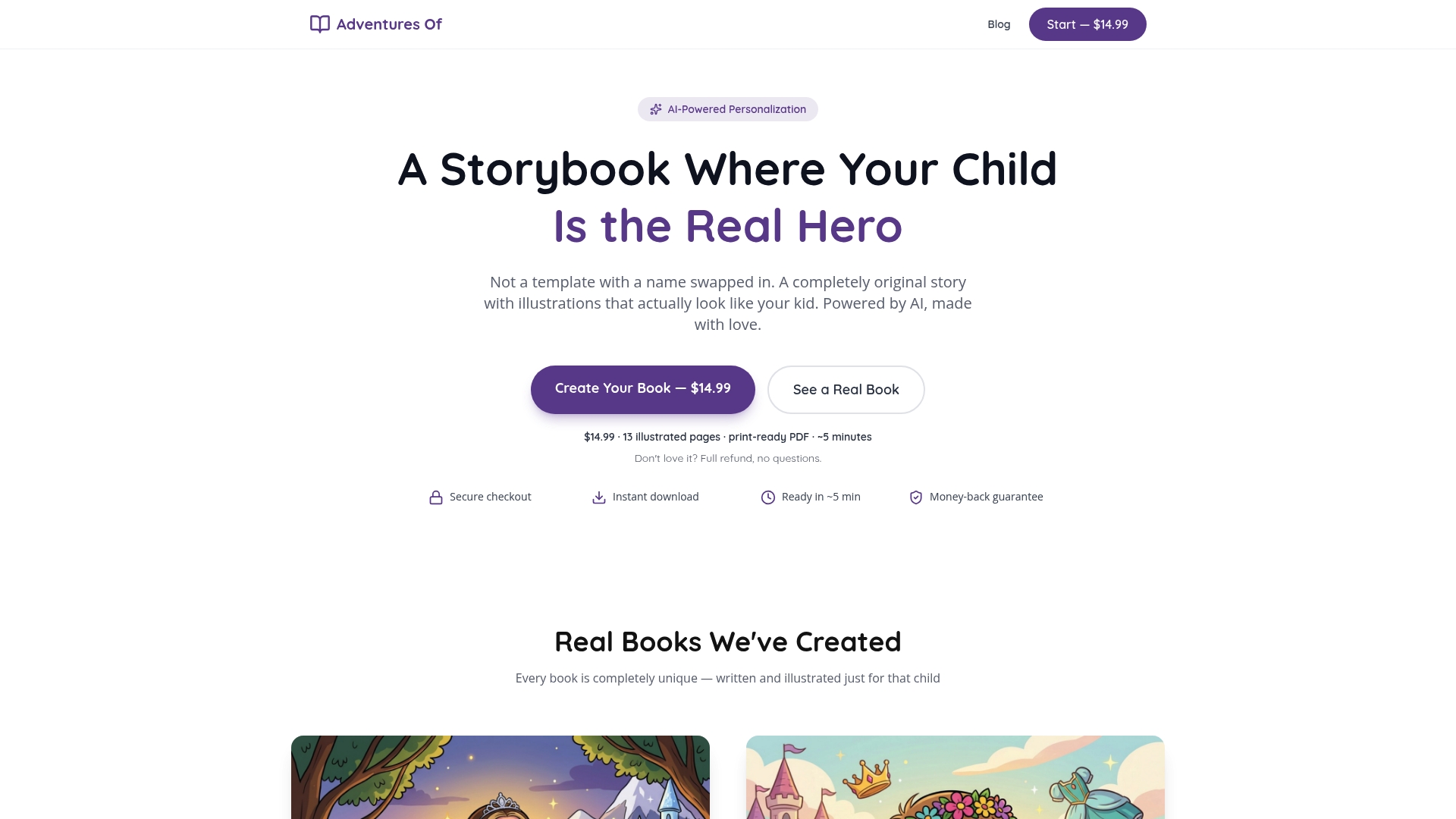
The platform uses HTTPS encryption throughout the ordering process, and the final product is a print-ready 8.5x8.5 PDF with 13 illustrated pages, available for instant download at $14.99. A 7-day refund policy backs every order. If you want a personalized children's book that treats your child's data with the same care it puts into the story, Adventuresofbook is worth your time.
FAQ
What is secure book creation?
Secure book creation is the practice of protecting personalized children's book content and the sensitive data used to create it, including child photos and personal details, through encryption, authentication, and digital rights controls.
Why does book security matter for personalized children's books?
Personalized books require uploading a child's photo, name, and personal details. Without proper security, that data can be exposed in breaches, scraped by AI systems, or accessed through compromised accounts.
What is zero-knowledge encryption in a book platform?
Zero-knowledge encryption means the platform encrypts your data on your device before it reaches their servers, so the company itself cannot read or access your child's information, even if their systems are compromised.
How do I know if a platform deletes my child's photos?
Check the platform's privacy policy for explicit language about data retention. A trustworthy platform states clearly whether uploaded photos are deleted after the book is generated or stored for any additional purpose.
Is DRM necessary for a personalized children's book PDF?
Hard DRM is not necessary and can make printing difficult. Invisible watermarking or soft DRM is the better choice. It protects the file from unauthorized copying while letting you print and share it freely with family.