
Non-generic story characters are defined as multi-dimensional, distinctive personas whose traits, backgrounds, and roles are specific enough that no other character could replace them in the story. The case for choosing them over flat, interchangeable figures is not a matter of taste. Research from BYU published in april 2026 shows that children's spontaneous engagement with books is measurably higher when characters mirror their own identities rather than serving as token additions. For parents and educators, understanding why choose non-generic story characters is the first step toward putting better books in children's hands.
Why non-generic story characters drive deeper engagement
The connection between character authenticity and child engagement is direct and well-documented. A BYU study found that dark-skinned children benefited most from personalized character representation in learning contexts, showing higher verbal and behavioral involvement when story characters resembled their own identities. That finding matters because it tells us representation is not a nice-to-have. It is a driver of how much a child actually participates in a story.

Authentic representation goes beyond putting a character of a certain background on the page. UCLA research shows that culturally grounded relationships make diverse characters feel real to young audiences, and that authenticity is what they respond to most. A character who shares a child's cultural context, family structure, or daily experience creates a point of recognition that generic characters simply cannot.
The benefits extend beyond the child who sees themselves in the story. Diverse characters on the page create what researchers describe as a safe space for controlled exposure, where readers encounter unfamiliar identities without pressure. According to Writer's Digest, diversity in storytelling increases openness and empathy by giving audiences time to process unfamiliar experiences and reduce instinctive biases. For a child reading at home or in a classroom, that is a real social skill being built one page at a time.
The importance of diverse characters also shows up in measurable outcomes beyond children's books. UCLA found that franchises scoring 4 out of 5 or higher on representation earn $175.5 million more on average than those rated 3 out of 5. That gap reflects how strongly young audiences respond to characters who feel real rather than assembled from a checklist.
Here is what authentic representation actually looks like in practice:
- A character has a specific cultural tradition that shapes how they solve problems, not just how they look.
- The character holds a meaningful role in the plot, not a supporting cameo that could be removed without changing the story.
- Their relationships reflect real family or community dynamics, not a generic "best friend" placeholder.
- Their emotional responses are specific to their background, not a universal reaction that any character could have.
"Diverse characters emotionally connect with readers by portraying multifaceted humanity, fostering empathy and relief in seeing real people in stories." — Writer's Digest
How generic characters fail children's imagination
Generic characters are the storytelling equivalent of furniture with dialogue. They occupy space, they speak, but they do not drive anything forward. The Art of Character Surgery describes generic personalities as story killers because they fail to function as problem-solving lenses with internal contradictions. Without those contradictions, a character has no real reason to exist.
Cognitive science explains why this matters at the memory level. Human brains filter out average visual and personality input. A character who looks and acts like every other character in the genre registers as background noise. The brain does not store what it cannot distinguish. This is why a child can finish a book and remember the plot but not the main character's name.
Generic characters also reduce the emotional stakes of a story. When a character could be swapped out for any other without changing the outcome, readers sense it. That sense of interchangeability is what makes a child put a book down and not pick it up again. The story feels like it does not need them as a reader, because it does not need its own character either.
The solution is not complexity for its own sake. It is specificity. Here is how to recognize the difference between a generic and a non-generic character:
- Indispensability test. Remove the character from the story. If the plot still works, the character is optional. A non-generic character makes the story impossible without them.
- Archetype collision test. A character built from a single archetype (the brave hero, the wise mentor) is a template. Combining incompatible archetypes creates internal friction that feels real. A timid inventor who is also the group's protector is more interesting than a straightforward brave hero.
- Dialogue test. Read the character's lines aloud. Could any other character in the book say the same words? If yes, the voice is not distinct enough.
- Motivation test. Does the character want something specific, or do they just want to "help" or "be good"? Specific desires create specific choices, and specific choices create memorable characters.
- Visual recognition test. Cover the character's name in an illustration. Can you still tell who it is? A strong silhouette and color identity make a character instantly recognizable.
Pro Tip: When evaluating a children's book, flip to a random page and cover the character's name. If you cannot identify who is speaking or acting from context and visual cues alone, the character lacks the distinctiveness that makes stories stick.
Design and voice techniques that make characters unforgettable
Visual identity is the first thing a child processes, and it does most of the work before a single word is read. Cognitive research on character design confirms that strong silhouettes and bold color choices contribute to instant recognition. A character whose shape reads clearly even in shadow, and whose color palette is not shared by any other character in the book, registers in memory immediately.
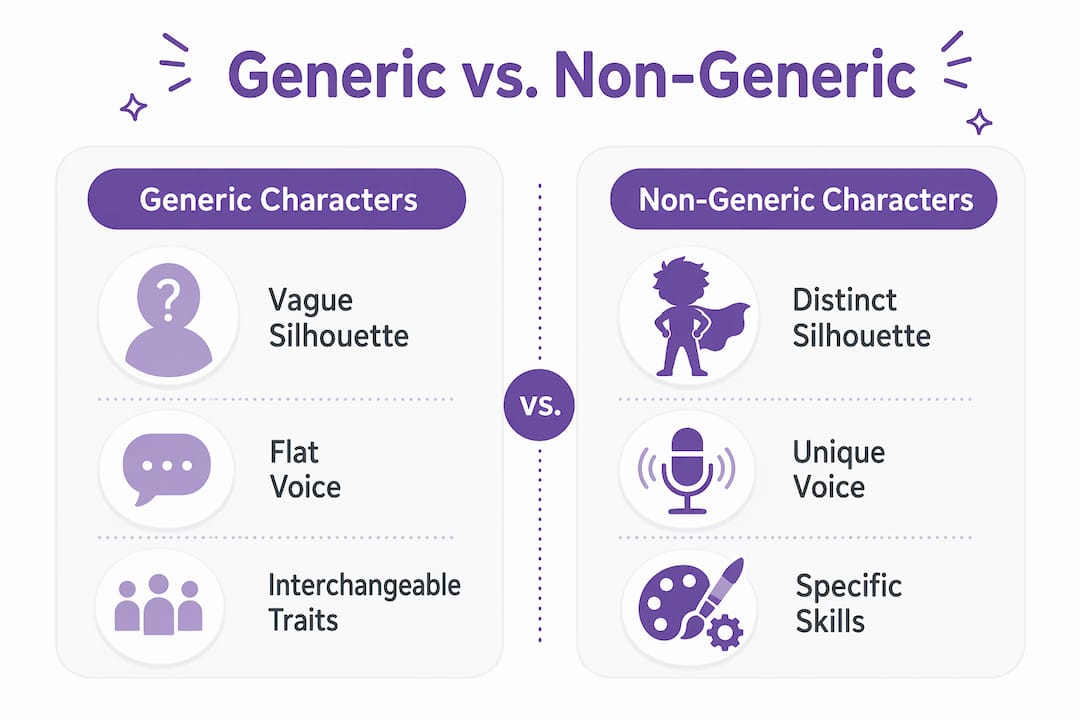
The same principle applies to voice. A character's way of speaking is as much a part of their identity as their appearance. Researchers note that distinct character voice requires enforcement across vocabulary register, sentence structure, emotional tone, and content focus. A seven-year-old who grew up near the ocean and loves marine biology does not speak the same way as a seven-year-old who grew up on a farm and loves horses. Both can be brave, curious, and kind. Their voices should still sound nothing alike.
| Design element | Generic approach | Non-generic approach |
|---|---|---|
| Visual silhouette | Interchangeable with other characters | Readable in shadow, unique shape |
| Color palette | Shared or neutral tones | Specific, purposeful, not repeated |
| Vocabulary | Age-appropriate but uniform | Reflects background, interests, region |
| Sentence structure | Standard for age group | Varies by character's personality |
| Core skill or trait | Broad (brave, kind, smart) | Specific (can navigate by stars, fixes engines) |
| Story role | Could be replaced | Indispensable to the plot's resolution |
Pro Tip: Give your character one skill that is so specific it could only belong to them. Not "good at science" but "can identify any bird by its call." That specificity is what children remember, and it is what makes the character feel like a real person.
A character's relationships also define their uniqueness. The Art of Character Surgery notes that a character should possess unique relationships that no other character in the story shares. Those relationships create the emotional stakes that keep children invested from the first page to the last.
How parents and educators can choose better storybooks
Recognizing non-generic character traits in a book takes about two minutes of deliberate attention. You do not need a literature degree. You need a short checklist and the willingness to look past the cover.
When you pick up a children's book, ask these questions:
- Does the main character have a specific background, skill, or perspective that shapes the story?
- Does the character make choices that only this character would make, based on who they are?
- Are diverse characters given meaningful roles, or do they appear briefly and then disappear?
- Does the character's voice sound different from every other character in the book?
- Would your child recognize this character in an illustration without reading the name?
Personalized storybooks take this a step further by making the child the character. When a child sees their own face, name, and interests reflected in the protagonist, the engagement is not just higher. It is qualitatively different. The child is not observing a story. They are inside it. That shift in perspective is what builds a lasting reading habit, because the book feels like it was written specifically for them. Because it was.
For educators, the benefits of unique characters extend into classroom discussion. A character with internal contradictions and a specific worldview gives children something to debate. Why did she make that choice? Would you have done the same? Those conversations build critical thinking alongside empathy. A generic character offers no such entry point because there is nothing specific enough to push back against.
Pro Tip: When selecting books for a classroom read-aloud, choose one where the main character's decision in the final chapter could reasonably have gone the other way. That ambiguity is a sign of a well-built, non-generic character, and it generates the best post-reading discussions.
You can find more guidance on building this kind of reading experience in our post on how to make a personalized children's book without spending a full weekend on it.
Key Takeaways
Non-generic story characters are the single most reliable factor in whether a child stays engaged with a book from cover to cover.
| Point | Details |
|---|---|
| Representation drives engagement | Children show measurably higher verbal and behavioral involvement when characters reflect their own identities. |
| Generic characters reduce stakes | A character who can be removed without changing the plot fails to create the emotional investment children need. |
| Specificity beats broad traits | One precise skill or relationship makes a character more memorable than a dozen generic virtues. |
| Visual identity matters first | A strong silhouette and distinct color palette register before a child reads a single word. |
| Personalized books deepen connection | When a child is the protagonist, they move from observing the story to living inside it. |
What I've learned from watching kids meet their story selves
I have spent years paying attention to the moment a child opens a book and either leans in or checks out. The pattern is consistent. Generic characters produce polite attention. Specific, recognizable characters produce something closer to recognition, the kind where a child points at the page and says "that's me" or "that's exactly what I would do."
The research backs this up, but you do not need a study to see it. Hand a child a book where the hero shares their hobby, their hair, their neighborhood, and watch what happens to their posture. They sit up. They slow down. They start asking questions about what comes next instead of waiting to be told.
What I find undervalued in most conversations about children's books is the role of internal contradiction in a character. We talk a lot about diversity and representation, which matter enormously. But a diverse character who is also flat is still a flat character. The child who sees themselves in a story deserves a version of themselves that is complex, surprising, and capable of making the wrong choice for the right reason. That is what makes a character feel true.
Parents sometimes worry that a highly specific character will not resonate with their child. My experience is the opposite. The more specific a character is, the more universal the emotional truth they carry. A girl who is afraid of the dark but also the bravest person in the room speaks to every child who has ever felt two contradictory things at once. Specificity is not a barrier to connection. It is the path to it.
— Jason
Adventuresofbook brings your child's character to life
Every book from Adventuresofbook starts with your child's actual photo. The AI generates an original story and illustrations that look like your child, built around their name and interests. There are no templates, no name-swap-ins, and no generic protagonists standing in for your kid.
The result is a 13-page, 8.5x8.5 print-ready PDF that takes about five minutes to create and costs $14.99 as a one-time purchase. Your child is not a supporting character in someone else's adventure. They are the specific, indispensable hero of their own. If you want to see what that looks like, the personalized children's books page shows you exactly how it works. For younger readers, the custom baby books option applies the same approach from the very first story.
FAQ
Why do non-generic characters matter for children's reading?
Non-generic characters give children a specific, recognizable figure to connect with emotionally. Research shows that children show higher verbal and behavioral engagement when story characters reflect their own identities and backgrounds.
What makes a character non-generic?
A non-generic character is indispensable to the plot, has a distinct voice and visual identity, and possesses specific skills or relationships that no other character in the story shares. Generic characters can be removed without changing the story. Non-generic ones cannot.
How does character diversity affect empathy in children?
Diverse characters on the page give children controlled exposure to unfamiliar identities, which builds openness and reduces bias over time. Writer's Digest notes that this kind of representation fosters empathy by letting readers process real human complexity at their own pace.
Can a personalized book really improve a child's engagement?
Yes. When a child is the protagonist, their engagement shifts from passive observation to active participation. BYU research confirms that children's spontaneous interaction with books is measurably higher when characters mirror their own identities rather than serving as background figures.
How can I tell if a book has a non-generic main character?
Cover the character's name on a random page and ask whether you can still identify who is acting or speaking. If the answer is no, the character lacks the visual and narrative distinctiveness that makes stories memorable. A strong character is recognizable by their choices, voice, and appearance alone.