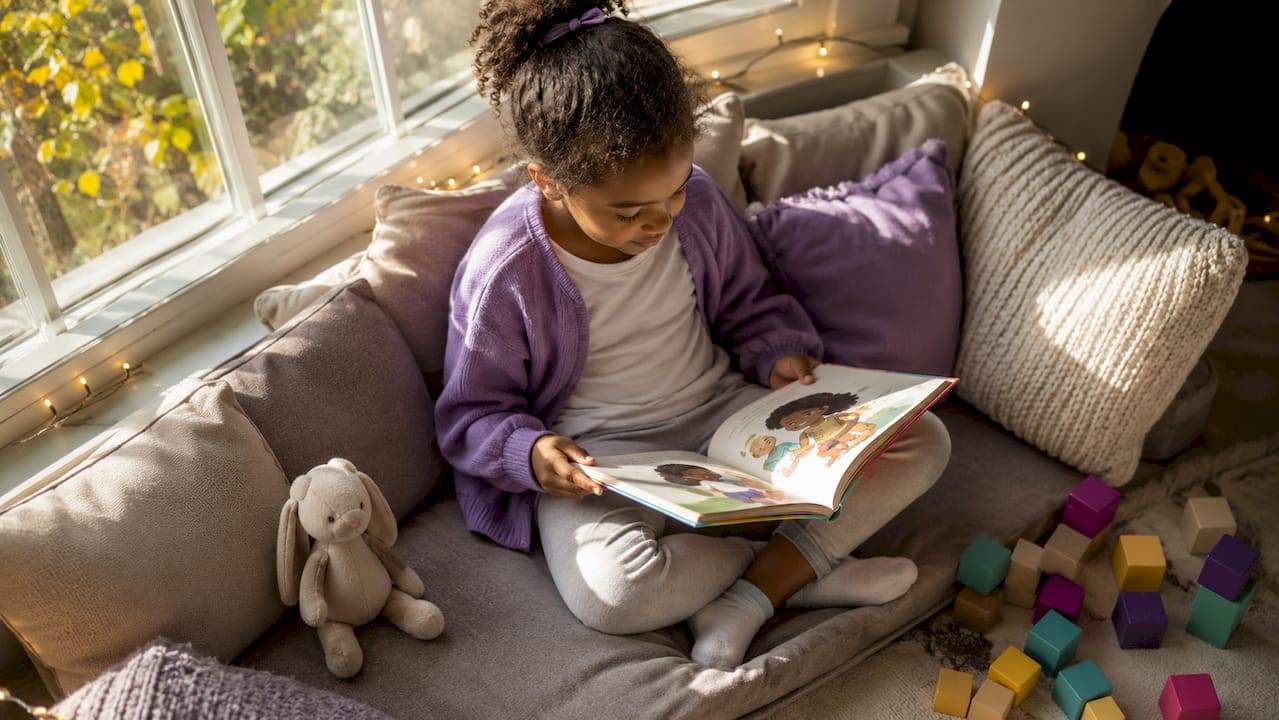
Child likeness in storybooks is the deliberate inclusion of characters who physically and emotionally resemble the young reader, acting as mirrors to their own experiences and identities. Research confirms this is not a cosmetic feature. A 2026 F1000Research study found that personalized fables boost recall 2 to 3 times compared to generic stories, driven by the self-reference effect. The importance of child likeness in storybooks extends well beyond a child seeing their name in print. It shapes how deeply they connect with a narrative, how much they learn from it, and how confidently they see themselves in the world. For parents and educators, understanding this distinction changes how you choose and use books.
Why child likeness in storybooks builds emotional connection
The psychological term for this is the self-reference effect. When children encounter a character who looks, feels, or thinks like them, their brain processes that information more personally and stores it more durably. The F1000Research study confirms that personalization selectively boosts emotional and relational engagement without reducing narrative complexity. That means a child can follow a rich, layered story and feel it more deeply, simply because the main character mirrors their reality.
Literacy experts at The Storyteller's Shelf Podcast describe children as wired to feel seen and understood. Their research with young readers shows that relatable characters create safe spaces where children can rehearse social responses, including how to handle anxiety, conflict, and disappointment, before facing those situations in real life. This is not passive entertainment. It is active emotional practice.
"Children's inner complexity and social stakes must be respected in characters to truly resonate." — The Storyteller's Shelf Podcast
The benefits of child perspective in storytelling also extend to empathy. When a child sees a character navigate a hard moment and come out the other side, they internalize that arc. They learn that feelings are manageable and that other people have them too. That is the foundation of social-emotional learning, and it starts with a character who feels real.
Pro Tip: When reading with a child, pause at moments where the character faces a challenge and ask, "Have you ever felt like that?" This simple question turns a story into a conversation and deepens the emotional connection the book already started.

Generic characters vs. child-like characters: what actually changes
The difference between a generic storybook character and one with genuine child likeness is not just visual. It runs through every layer of the reading experience.
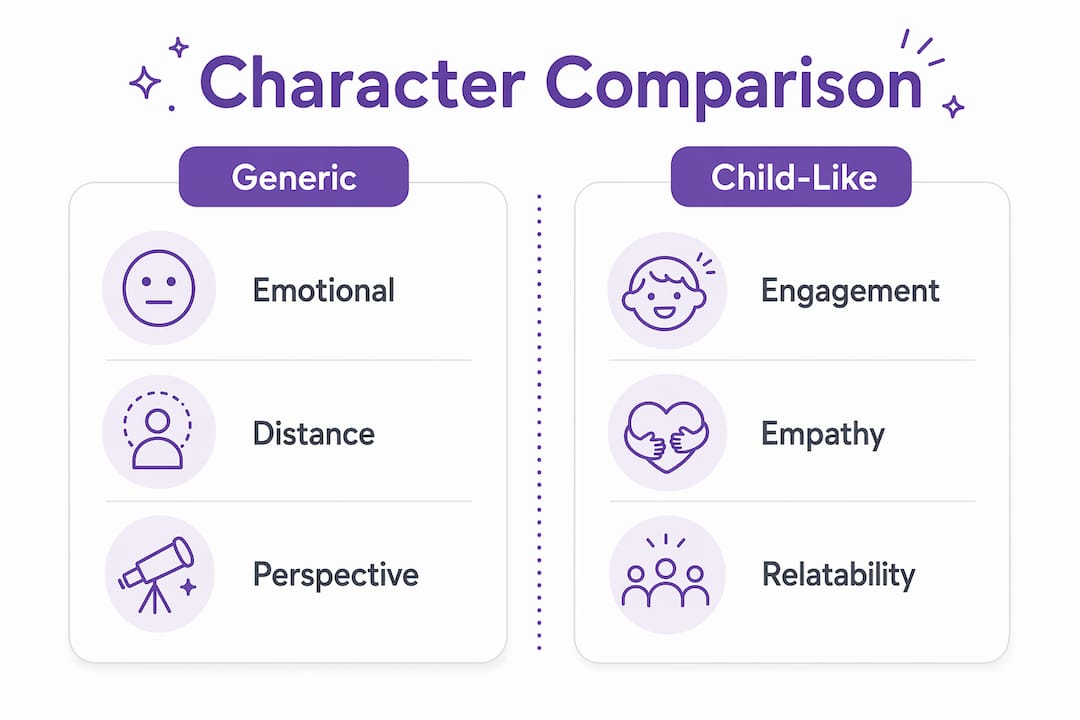
| Feature | Generic character | Child-like character |
|---|---|---|
| Emotional engagement | Low. Child observes from a distance. | High. Child identifies and participates emotionally. |
| Recall and retention | Standard narrative recall. | 2 to 3 times higher due to self-reference effect. |
| Emotional safety | Character is a stranger. | Character mirrors the child's own feelings and situations. |
| Representation | Often reflects a narrow default. | Reflects the child's appearance, culture, and experience. |
| Character complexity | Flat, idealized, or perfect. | Flawed, growing, and realistic. |
Generic characters are not without value. They introduce children to new worlds and perspectives. But they ask the child to do all the work of connection. Child-like characters meet the reader halfway.
Children's Book Mastery notes that children relate more to flawed characters than perfect ones. A character who hesitates, makes a mistake, or feels scared is far more useful to a child than one who breezes through every challenge. Imperfect characters teach coping skills. They model resilience. They show that growth is possible, which is a message a flat, idealized figure simply cannot deliver.
Template-based personalized books, where a generic story swaps in a child's name, fall into the same trap as generic characters. The name changes, but the emotional architecture of the story does not. The child is still watching a stranger's adventure with their name attached. The difference between personalized and template books is worth understanding before you buy, because not all "personalized" products deliver the same depth of connection.
Representation also matters here. Humanium's research on children's representation in literature shows that mirrors and windows in books help children understand their own reality and discover others'. A child who never sees their hair, skin tone, or family structure in a book receives a quiet but persistent message that stories are not for them. Child likeness corrects that.
Why familiar scenarios matter as much as familiar faces
Appearance is one part of child likeness. The other part is emotional and situational familiarity. A child who sees a character who looks like them but lives in a world with no recognizable feelings or moments will still feel disconnected from the story.
Research from Bulletin Africa confirms that relatable everyday adventures make the best picture books because they meet children where they already are. A story about the first day at a new school, the nervousness before a recital, or the excitement of finding a bug in the backyard carries more developmental weight than an elaborate fantasy with no emotional anchor. Simple, familiar moments evoke curiosity, decision-making, and confidence in children.
Here is what to look for in the scenarios a storybook presents:
- Does the character face a moment the child has actually experienced, like feeling left out, trying something new, or making a mistake?
- Does the story show the character feeling uncertain before acting, rather than jumping straight to heroism?
- Are the emotions named or shown clearly, so a younger child can identify them?
- Do the illustrations support the emotional cues in the text, rather than just decorating the page?
- Does the story end with growth rather than perfection?
Illustrations carry more weight than most parents realize. STORYVOR's research found that over 80% of parents value high-quality illustrations that enhance storytelling rather than simply decorate it. A child who cannot yet read fluently reads the pictures first. If the illustration shows a character's face mid-worry or mid-wonder, that emotional signal lands before a single word is processed.
Pro Tip: After finishing a picture book, flip back through the illustrations without reading the text. If the story still makes emotional sense from the pictures alone, the illustrations are doing their job.
How to choose or create storybooks that reflect your child
Knowing the theory is one thing. Applying it at the bookstore or online is another. Here is a practical framework for parents and educators.
- Check the character's appearance. Does the character share visible traits with your child? Hair texture, skin tone, body type, and clothing style all contribute to recognition. This is the starting point for child likeness.
- Assess emotional depth. Does the character experience doubt, fear, or excitement in ways that feel true? Characters who are emotionally complex teach more than characters who are always confident and capable.
- Evaluate scenario relevance. Is the story set in a world your child recognizes? School, home, friendships, and family are more connective than abstract kingdoms, unless the emotional stakes mirror real ones.
- Look at the illustrations closely. Do they show facial expressions and body language that match the emotional content of the text? STORYVOR's data on illustration quality is a useful benchmark here.
- Consider minimal personalization as a starting point. Even using a child's name and gender in a story significantly increases engagement, according to F1000Research. Full personalization, where the character resembles the child physically and the story reflects their interests, goes further.
- Apply the mirrors and windows test. Does this book serve as a mirror, reflecting your child's own experience? Or is it a window into someone else's? Both have value, but a child who only ever gets windows and never mirrors misses out on the identity-affirming power of representation.
- Discuss the story together. The connection a book creates is deepened by conversation. Ask your child what the character was feeling, what they would have done differently, and whether any part of the story reminded them of their own life.
For parents who want to go beyond selecting from existing options, personalized children's books that generate original stories and illustrations from a child's actual photos represent the most direct application of child likeness. The character is not a generic figure with a name attached. It is a story built around your specific child.
Diversity toys and books that reflect a range of appearances and experiences, like those discussed in ToylandEU's guide to inclusive play, reinforce the same principle across different media. Representation in books and play materials works together to build a child's sense of identity and empathy.
Key takeaways
Child likeness in storybooks is the single most direct way to increase a child's emotional engagement, recall, and sense of identity through reading.
| Point | Details |
|---|---|
| Self-reference effect | Children recall personalized stories 2 to 3 times better than generic ones. |
| Emotional safety | Relatable characters give children a safe space to practice handling real emotions. |
| Flawed characters teach more | Imperfect characters build resilience and coping skills that idealized figures cannot. |
| Illustrations matter | Over 80% of parents value illustrations that actively support emotional understanding. |
| Minimal personalization works | Even a child's name and gender in a story measurably increases affective engagement. |
What I've learned from watching kids meet themselves in a book
I have seen the moment a child realizes the character in the story looks like them. It is not subtle. Their posture changes. They lean in. They start pointing at the page and saying "that's me." That reaction is not just cute. It is the clearest evidence that something real is happening in their brain and their heart.
What strikes me most is how rarely it happens with off-the-shelf books. Most children spend their entire early reading lives watching other people's adventures. They learn to enjoy stories, but they learn them as observers. The shift from observer to participant is what child likeness creates, and it is a fundamentally different reading experience.
I also think we underestimate how much children notice when they are not represented. A child who never sees their hair or their family structure in a book does not always say so out loud. But the absence registers. It shapes what they think stories are for and who they think stories are about.
The practical takeaway for parents and educators is this: do not treat representation as a bonus feature. Treat it as a baseline requirement. A book that reflects your child's appearance, emotional reality, and everyday world is not a luxury. It is the most effective reading tool you have.
— Jason
See your child as the hero of their own story
Adventures Of builds original storybooks around your specific child, not a template with a name swapped in. You upload a photo, share a few details about your child's interests, and the AI generates a 13-page illustrated story where the character actually looks like your kid. The whole process takes about five minutes. The result is an 8.5x8.5 print-ready PDF you can download immediately or print into a physical book. At $14.99 with a 7-day refund policy, it is a low-risk way to put the research into practice. If you want to see what genuine child likeness in a storybook looks like, start your child's book at Adventures Of.
FAQ
What does child likeness in storybooks mean?
Child likeness refers to characters who physically and emotionally resemble the young reader, including appearance, feelings, and everyday experiences. It goes beyond using a child's name and includes visual representation and emotionally true scenarios.
Why does child likeness improve reading engagement?
The self-reference effect causes children to process and retain information more deeply when it relates to themselves. Research from F1000Research shows children recall personalized stories 2 to 3 times better than generic ones.
Are template personalized books the same as child-likeness books?
No. Template books swap a child's name into a pre-written story but keep the generic character and plot intact. True child likeness means the character's appearance, personality, and story reflect the specific child.
How do I know if a picture book has good child likeness?
Look for a character who shares visible traits with your child, faces emotionally familiar situations, and shows realistic flaws and growth. Strong illustrations that reflect emotional cues are also a reliable indicator of quality.
Can even small amounts of personalization make a difference?
Yes. F1000Research found that minimal personalization, such as including a child's name and gender, significantly increases emotional engagement with a story. Full personalization with matching illustrations amplifies that effect further.