
Most parents searching for a personalized children's book assume the process works like this: you type in your child's name, pick a hair color, and the book ships. That's it. But what is parent-driven book customization, really? It goes much further than that. True parent-driven customization means you are actively shaping the story, the themes, the character traits, and sometimes the actual illustrations based on what makes your child uniquely themselves. This guide explains exactly what that process looks like, why it matters for your child's development, and how to do it well.
Table of Contents
- Key takeaways
- What parent-driven book customization actually means
- Why personalized books genuinely help kids
- How the customization process works in practice
- Template books vs. parent-driven customization
- How to get started with your first custom book
- My honest take on why this actually matters
- Start your child's story with Adventuresofbook
- FAQ
Key takeaways
| Point | Details |
|---|---|
| More than a name swap | Parent-driven customization shapes storylines, themes, and visuals, not just a child's name. |
| Real developmental benefits | Personalized stories tied to a child's life boost engagement, language skills, and self-confidence. |
| AI assists, parents lead | Technology generates illustrations and text, but your input as a parent drives the creative direction. |
| Template books have limits | Fixed story structures cap how meaningful a book can feel to your specific child. |
| Starting is straightforward | Gather your child's interests, a few photos, and choose a platform that supports genuine customization. |
What parent-driven book customization actually means
Parent-driven book customization is a creative process where you, the parent, provide the context, preferences, and personal details that shape a storybook built around your child. It is not a fixed template with a blank where a name gets dropped in. You are the creative director. The technology, whether AI-powered software or a design platform, handles execution based on what you feed it.
AI tools in this context serve as scaffolds supporting parental creativity rather than replacing the parent's role. That distinction matters. You decide what goes into the book. The tool brings it to life.
Here is what you can typically shape in a parent-driven custom children's book:
- Story theme and plot direction. Does your child love space adventures? Dinosaur rescues? Baking competitions with talking animals? You choose the premise.
- Character personality and appearance. Beyond hair and eye color, some platforms let you upload real photos so the illustrated character actually looks like your child.
- Values and messages. You can emphasize bravery, kindness, curiosity, or whatever your family cares about most.
- Supporting characters. Friends, siblings, pets, and family members can often be worked into the narrative.
- Age-appropriate language and complexity. You can specify whether the book is for a toddler who loves rhythm or a six-year-old ready for a longer plot.
This is where parent-led book design separates from a simple personalization service. A template book fills pre-written slots. A parent-driven book starts with your child and builds outward.
Pro Tip: Before you start any customization platform, write down three things your child is obsessed with right now and one thing they are working through emotionally. Those five details will make your story feel real.
Why personalized books genuinely help kids
The benefits of book personalization are not just feel-good marketing. There is research backing what most parents intuitively sense: a child pays more attention to a story when they recognize themselves in it.
Tailoring books beyond inserting names fosters higher engagement and deeper developmental benefits. When a child sees their actual interests, challenges, and world reflected in a story, reading stops feeling like a task and starts feeling like an event.
Here is what the research and child development community point to:
- Language development. When stories connect to a child's own experiences, they generate more conversation. Parental scaffolding during shared reading directly encourages language development and strengthens family connections.
- Emotional identity. Seeing yourself as the hero of a story tells a child something important: your life is worth telling. That quietly builds self-concept and confidence.
- Stronger reading habits. Kids ask to reread books they love. A book starring them, with their dog and their best friend's name worked in, is a book they will ask for again.
- Parent-child bonding. The act of reading together is powerful on its own. When the story contains family details you intentionally put there, it becomes a shared memory, not just a bedtime routine.
"Books customized with real photos and authentic stories boost engagement and create lasting memories." — Head Topics
Parent-driven book customization builds on dialogic reading, an approach where parents actively engage children through questions and discussion during storytime. A book built around your child naturally sparks that conversation because the material is already connected to their life.
How the customization process works in practice
Understanding what parent-driven book customization involves conceptually is one thing. Seeing how it works step by step is another. The process varies by platform, but here is how genuine parent-led book design typically flows from start to finish.
- Upload photos of your child. On AI-powered platforms, these photos train the illustration style so the character actually resembles your kid, not a stock illustration with similar hair.
- Enter personal details. Name, age, favorite things, a pet's name, a hobby, a fear they are overcoming. The more specific you go, the more the story feels written for them.
- Choose a theme or adventure type. This is your creative direction. Pick something your child will recognize and care about.
- Set the tone and values. Some platforms ask what lesson or message you want the story to carry. Use that. It is the difference between a fun book and a meaningful one.
- Review what the AI generates. Good platforms give you a draft to look over. You are not rubber-stamping an output. You are checking that the story reflects what you put in.
- Download or order the final book. Print-ready files can be taken to a local printer or ordered directly through the platform.
AI tools that support parents work best when parents stay engaged throughout the process rather than treating it like a vending machine. Your input quality directly affects the story quality.
Pro Tip: If the platform asks open-ended questions, do not write one-word answers. Write two sentences. "She loves dinosaurs" becomes "She loves dinosaurs, especially T. rex, and always pretends she is a paleontologist discovering new species." That sentence gives an AI model something real to work with.

Combining parent interaction with digital features requires some intentional mediation, but the output is worth it. A five-minute investment in detail pays off across every reading session.
Template books vs. parent-driven customization
This is where many parents get tripped up. Both types of books call themselves "personalized," but they are built on different foundations. Here is a straightforward comparison.
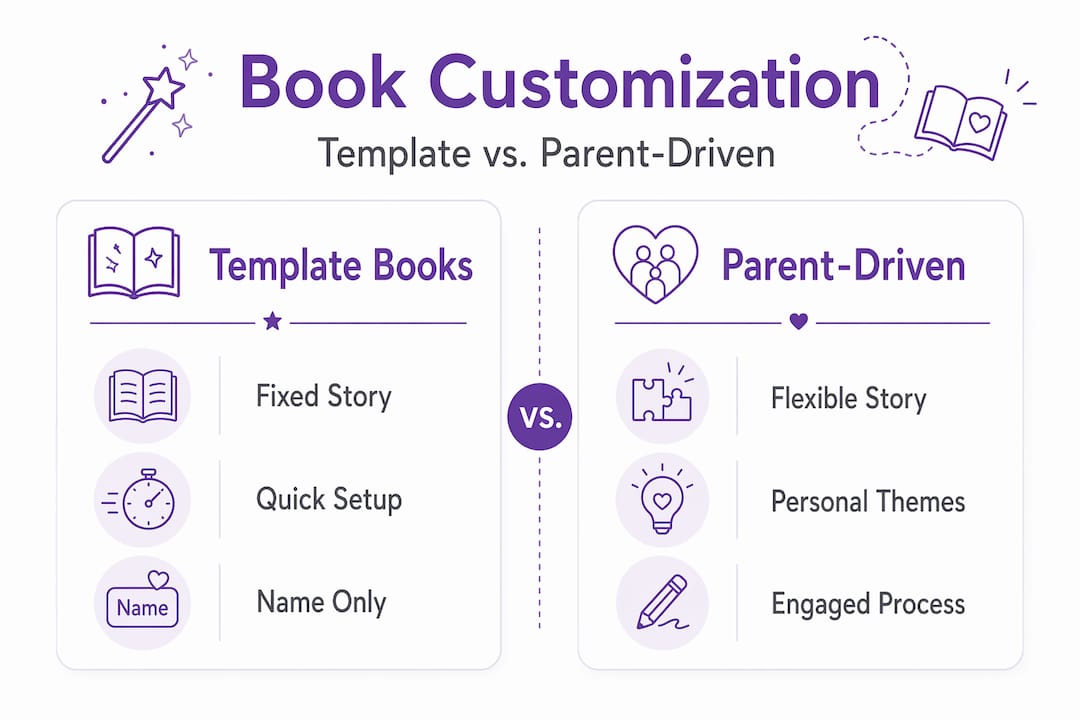
| Feature | Template-based books | Parent-driven custom books |
|---|---|---|
| Story structure | Fixed, pre-written | Built from your input |
| Child's appearance | Stock illustrations, limited options | Based on real photos (on AI platforms) |
| Themes and values | Selected from a fixed list | Parent-defined |
| Emotional uniqueness | Moderate, name recognition only | High, reflects actual personality |
| Time to create | Very fast | Fast to moderate depending on platform |
| Cost | Low to moderate | Moderate to slightly higher |
| Rereadability | Fades after novelty wears off | Tends to stay relevant longer |
Template books are not bad. They are quick, affordable, and genuinely charming for younger children who light up seeing their name on a page. But they hit a ceiling. The story was written for any child, with a slot left open for a name. A parent-driven book starts with your child and builds the story outward from there.
You can read a deeper breakdown of how these two approaches differ if you want to get into the specifics before choosing a platform.
How to get started with your first custom book
You do not need design skills, a big budget, or a lot of time. Here is what actually matters when you are getting started.
- Know your child's current obsessions. Not their phase from six months ago. Right now. What are they drawing, talking about, and dragging you to watch on repeat? Use that.
- Pick a platform that supports real customization. Look for platforms that ask for photos, let you describe personality traits, and generate original content rather than filling in a template. Check whether the story is unique to your child or shared with thousands of others.
- Gather two or three clear photos. For AI-illustrated books, photo quality matters. A well-lit face photo gives the model enough to work with. Blurry or heavily filtered images produce weaker results.
- Think about the message, not just the adventure. The best custom children's books carry something under the surface: a lesson about courage, a celebration of curiosity, a reassurance during a hard transition. Decide what you want your child to feel after hearing this story.
- Set a realistic budget. Most parent-driven custom books fall in the $15 to $40 range for a digital file, with printing costs on top. Knowing this upfront helps you compare platforms fairly.
For a practical walkthrough of the full process, this guide on making a personalized book covers the specific steps without the fluff.
My honest take on why this actually matters
I've seen a lot of parents treat personalized books as a novelty gift. Something cute for a birthday that gets a laugh when the child's name appears on page one. And that is fine. But I think it undersells what this format can actually do.
What I've learned from watching how kids respond to genuinely personalized stories is that the name is the least important part. The part that makes a child go quiet and wide-eyed is when the story gets something right about them. When the character in the book is afraid of the same thing they are, or loves the exact dinosaur they love, or has the same silly habit. That is when a book stops being entertainment and starts being something a child holds onto.
The mistake I see most often is parents who either over-engineer it (trying to fit every detail of their child's life into a single story) or under-personalize it (filling out the minimum fields and hoping the platform does the rest). Neither extreme works well.
What actually works is being specific in the right places. One or two strong details that the child will instantly recognize. A personality trait that is genuinely theirs. A challenge or fear they are working through right now. Give the story those anchors, and the rest takes care of itself.
My take: do not be a passive consumer of this process. You are not ordering a pizza. You are giving a child a story that tells them their world is worth writing about. That deserves thirty minutes of thought.
— Jason
Start your child's story with Adventuresofbook
If you are ready to try parent-driven book customization, Adventuresofbook was built specifically for this. You upload photos of your child, share a few details about their personality and interests, and the AI generates an original story and illustrations based on what you provide. Not a template. Not a name swap. An original book for one child.
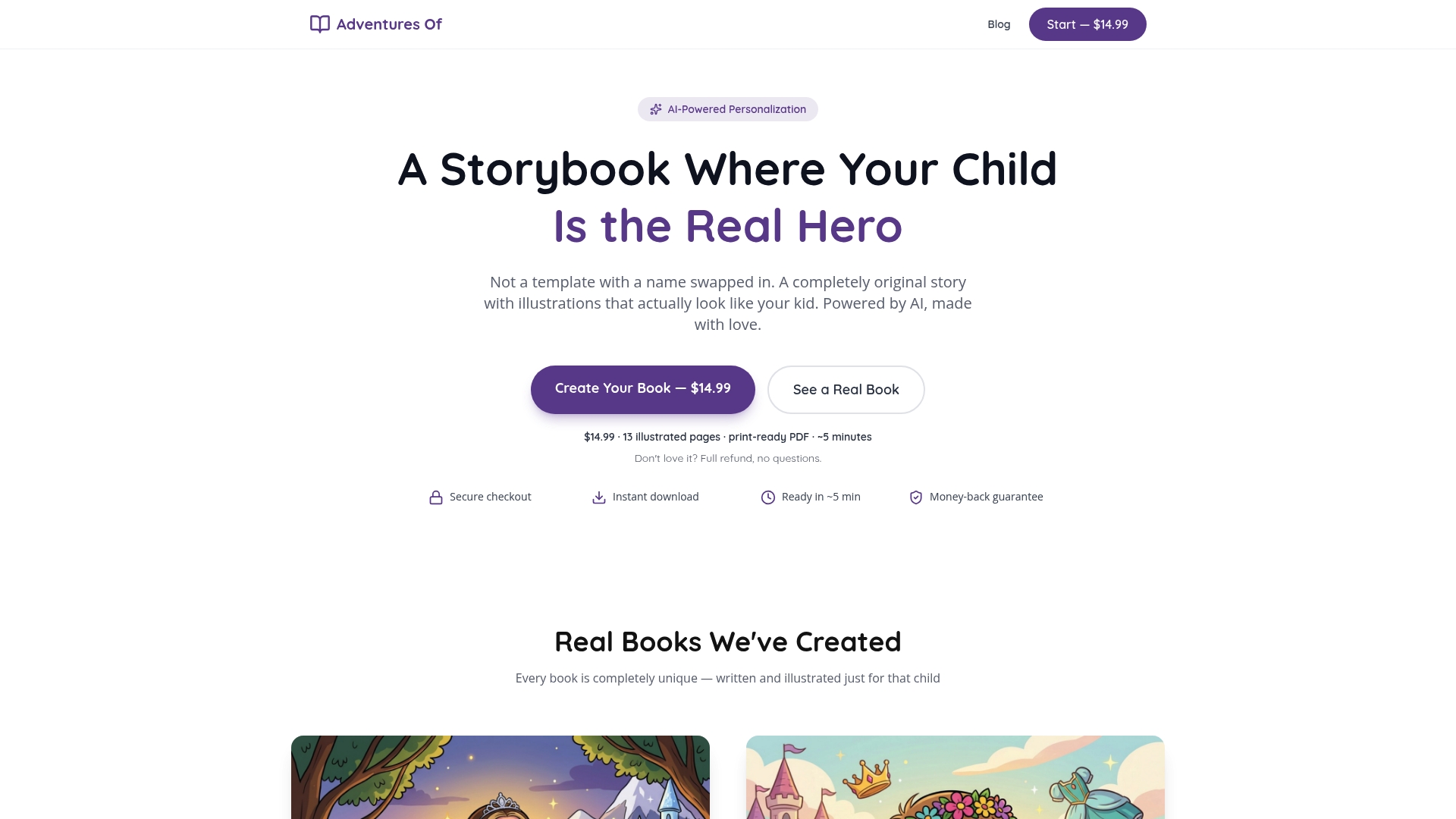
Each book includes 13 illustrated pages in an 8.5x8.5 print-ready PDF format. The whole process takes about five minutes, costs $14.99 as a one-time purchase, and comes with a seven-day refund policy if you are not happy with the result. You can download the file immediately and print it locally or through any print-on-demand service.
If you have a baby or toddler, the custom baby book option is a good starting point. Or browse the full range of personalized storybook options to find what fits your child best. When you're ready, create your book at adventuresofbook.com/create.
FAQ
What is parent-driven book customization?
Parent-driven book customization is a process where parents actively supply personal details, photos, and preferences that shape an original storybook for their child. It goes beyond name insertion to include themes, character traits, and story direction.
How is it different from a regular personalized book?
A regular personalized book inserts a child's name into a fixed, pre-written story. Parent-driven customization uses the parent's specific input to build a story from scratch, resulting in a book that reflects the child's actual personality and interests.
Do I need any design skills to customize a kids' book?
No design skills are needed. Modern platforms handle all illustration and story generation based on the details you provide. Your job is to give specific, thoughtful input about your child.
How long does it take to create a custom children's book?
On AI-powered platforms like Adventuresofbook, the generation process takes about five minutes after you submit your child's details and photos. Reviewing and downloading adds a few minutes more.
What details should I have ready before I start?
Bring two or three clear photos of your child, a list of their current interests and personality traits, and a sense of the story theme or message you want the book to carry. The more specific your input, the stronger the final story.