
Educational storytelling is defined as a deliberate, structured instructional method that uses narrative elements — character, conflict, and resolution — to deliver curriculum content and activate emotional memory and critical thinking. This is not the same as reading a bedtime story for fun. The formal term used by instructional designers and educators is narrative pedagogy, and it describes a specific approach to teaching where the story structure itself carries the learning. Research from Oswaal Books confirms that educational storytelling improves retention by connecting abstract concepts to relatable human experiences. If you are a parent, teacher, or caregiver wondering why some lessons stick and others vanish by morning, the answer almost always comes back to whether the information was wrapped in a story.
What is educational storytelling and why does it work in the brain?
The brain does not treat stories the same way it treats facts. Stories trigger dopamine and oxytocin, two chemicals that improve focus, empathy, and long-term memory. Dopamine sharpens attention and signals that something matters. Oxytocin builds emotional connection to the characters and events in the story.
The result is measurable. Students recall story-based information 22 times more effectively than fact-based delivery. That gap is not a small rounding difference. It means a child who hears a math concept explained through a character's problem is far more likely to remember it a week later than a child who heard the same concept listed on a whiteboard.
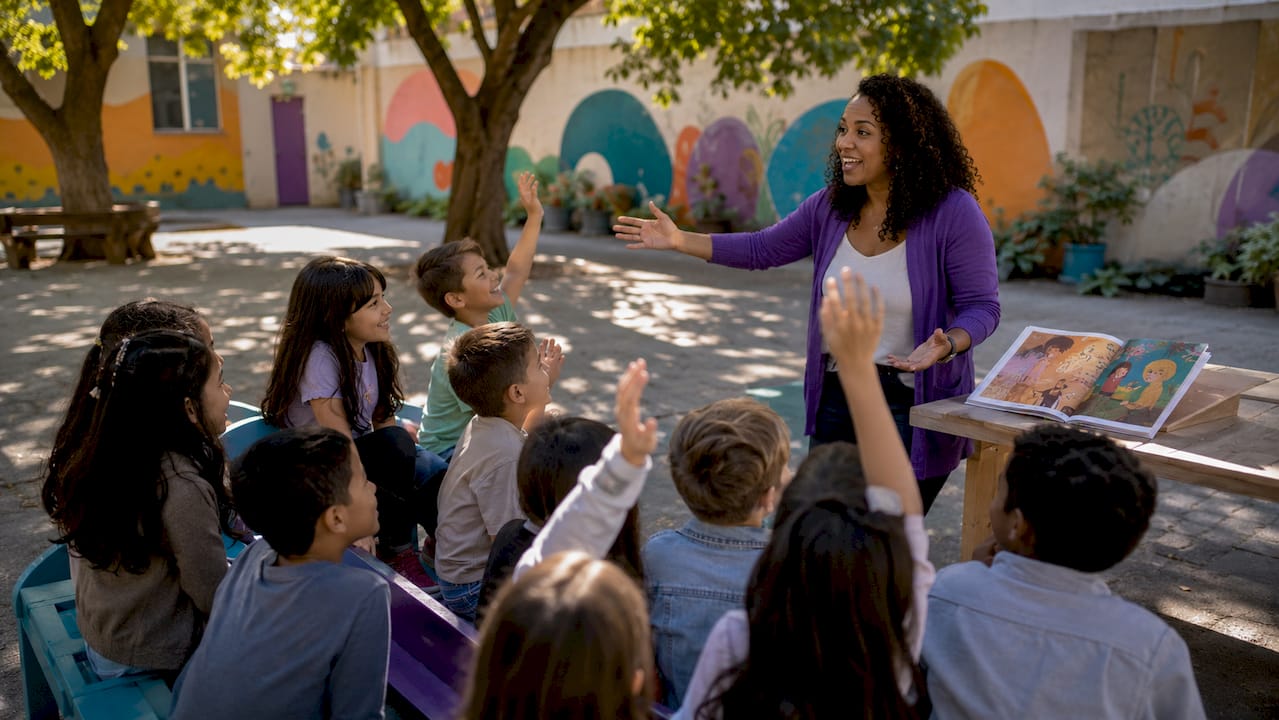
Narrative pedagogy also builds what educators call schema, the mental framework that connects new knowledge to what a child already understands. According to instructional design research, storytelling's primary goal is schema building. Without that connection, a story is just decoration. With it, the child has a mental hook to hang new information on.
The emotional layer matters too. Tone, mood, and voice act as critical metacommunication, meaning they signal to the child's brain whether the content is worth processing deeply. A flat, emotionless delivery blocks that gate. An engaging, character-driven story opens it.
Here is what this looks like in practice:
- Dopamine response: A child hears a story about a girl who cannot figure out how to share her toys fairly. The conflict creates tension. The brain pays attention.
- Oxytocin response: The child connects emotionally with the character. They care about the outcome.
- Schema building: The resolution ties back to a concept the child already knows, making the new idea feel familiar and logical.
- Long-term retention: The emotional memory of the story anchors the lesson for weeks, not hours.
Pro Tip: Focus your stories on meaningful content tied to a specific learning goal. A funny story with no clear connection to the lesson entertains but does not teach. The emotional hook only works when it points somewhere.
How does educational storytelling differ from traditional lecturing?
Lecturing deposits facts into a child's short-term memory. Storytelling creates an experience that engages emotion, imagination, and reasoning at the same time. That is not a small distinction. Brain imaging studies show that narratives activate multiple brain areas simultaneously, including regions tied to sensory experience, emotion, and language. A lecture activates primarily the language-processing areas.
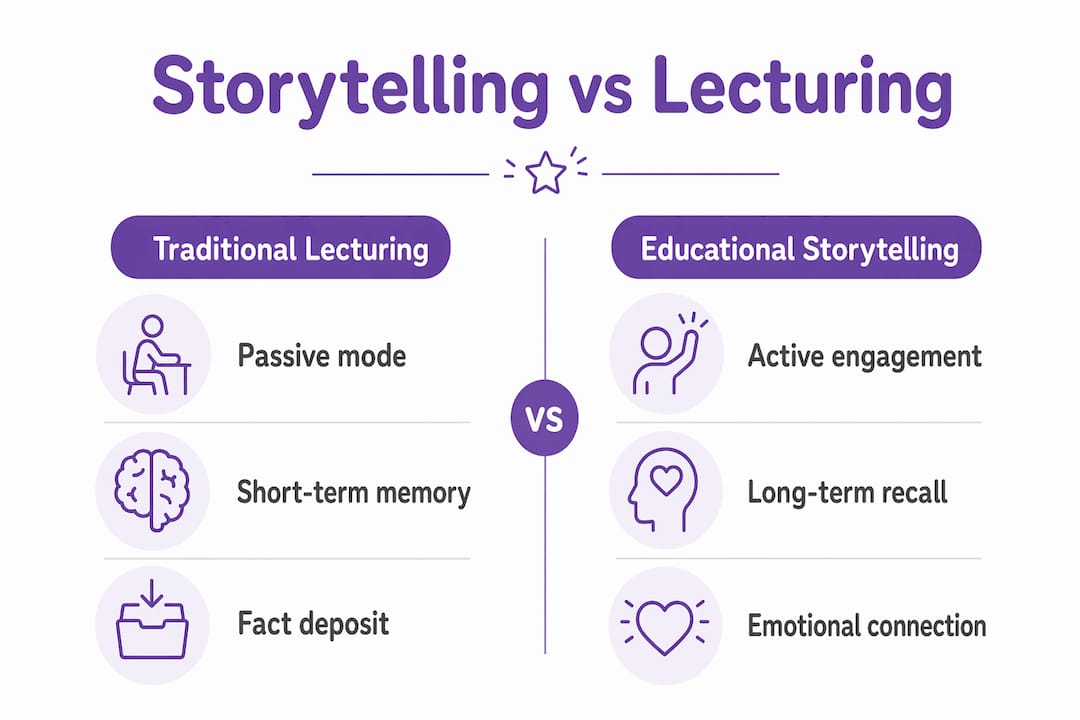
The structural difference comes down to what educators call the Four Cs: causality, conflict, complication, and character. These four elements are the key ingredients for schema building and coherence in a story. They must map directly to learning objectives. A story about a brave explorer works for teaching geography. That same story fails for teaching fractions unless the conflict and resolution are explicitly tied to the math.
One common mistake is letting the story wander. Rambling narratives without clear connection to objectives reduce effectiveness and can actually confuse learners. The fix is a S.T.A.R. moment, a Situation, Task, Action, and Result conclusion that explicitly ties the narrative back to the learning goal. Think of it as the moment the story lands. Without it, children enjoy the ride but miss the destination.
| Feature | Traditional lecturing | Educational storytelling |
|---|---|---|
| Primary cognitive mode | Passive listening | Active emotional processing |
| Memory impact | Short-term retention | Long-term retention via emotional memory |
| Brain areas activated | Language processing | Language, emotion, sensory, and reasoning areas |
| Student engagement | Low to moderate | High, especially with conflict and character |
| Risk of failure | Boring delivery | Unfocused story with no learning tie-in |
Pro Tip: Before you tell a story in a lesson, sketch a quick story map. Write the learning goal at the top, then plan your character, conflict, and resolution to point directly at that goal. Tools like Canva's story-mapping templates make this fast and visual.
What practical techniques can educators and parents use?
The most reliable framework for applying narrative pedagogy is a three-step process: tell, discuss, then create. This three-step approach first presents a story aligned to the learning goal, then opens discussion to check understanding, and finally asks the learner to create their own narrative to demonstrate mastery.
Here is how to put that into practice at home or in the classroom:
-
Start with a micro-story. Micro-stories of 30–60 seconds avoid cognitive overload while keeping focus on the core concept. Introduce a character with a problem that mirrors the lesson. Keep it short and specific.
-
Ask two or three discussion questions. "Why did the character struggle?" "What would you have done?" These questions check comprehension and push the child to connect the story to their own experience.
-
Invite the child to retell or extend the story. Ask them to change the ending, write a diary entry from the character's perspective, or act out a different solution. This is where real mastery shows up.
-
Use role play for social and emotional learning. Role play is one of the most direct examples of educational storytelling. A child playing the role of a character who faces a moral dilemma practices empathy and reasoning in real time.
-
Try digital storytelling for older children. Tools like Canva let children build illustrated story sequences that combine writing, visual design, and narrative structure. The process of creating the story is itself a learning activity.
-
Adapt stories to the child's real interests. A child obsessed with dinosaurs will engage far more deeply with a story about a paleontologist solving a mystery than with a generic tale about "a student." Authentic relevance is not optional. It is the mechanism that makes the story work.
-
Use personalized children's storybooks as a starting point. Books where the child is the main character give you a ready-made emotional hook. The child is already invested before the first page.
Storytelling also bridges social and linguistic divides that lecture-based learning often reinforces. A child who struggles with reading fluency may still engage deeply with an oral story or an illustrated narrative. This makes narrative pedagogy one of the more inclusive teaching tools available.
How do children's books support educational storytelling?
Children's books are the most accessible delivery format for narrative pedagogy at home. A well-crafted picture book uses character, conflict, and resolution to teach concepts and values without the child realizing they are in a lesson. Storytelling in children's books supports moral reasoning, empathy, and identity formation, three outcomes that no worksheet can replicate.
The details inside the book matter more than most parents realize. Tone, mood, voice, and illustration style all function as emotional signals. A book with warm, expressive illustrations and a character who looks and acts like the child reading it creates a much stronger emotional connection than a generic story with a placeholder name. That connection is what drives retention and engagement.
There is a real difference between personalized storybooks and template books. Template books swap a child's name into a pre-written story with stock illustrations. Personalized storybooks, by contrast, generate an original story and illustrations based on the specific child. The distinction matters for educational storytelling because the emotional hook depends on authentic recognition. A child who sees a character that genuinely resembles them, with their own features and interests reflected in the story, processes that narrative differently.
| Feature | Template storybook | Personalized storybook |
|---|---|---|
| Story originality | Pre-written, name swapped in | Original story per child |
| Illustrations | Generic stock art | Based on real child photos |
| Emotional connection | Moderate | High |
| Educational storytelling value | Low to moderate | High, due to authentic identity mirror |
| Reread value | Low | High |
Pro Tip: When selecting or creating a book for a child, look for stories where the conflict directly reflects something the child is working through, whether that is sharing, fear, or a new social situation. The closer the story mirrors real life, the stronger the learning transfer.
Key takeaways
Educational storytelling is the most research-supported method for improving children's retention, empathy, and motivation because it activates emotional memory and schema building simultaneously.
| Point | Details |
|---|---|
| Core definition | Educational storytelling uses character, conflict, and resolution to deliver curriculum content and activate memory. |
| Brain science backing | Stories trigger dopamine and oxytocin, making information 22 times more memorable than fact-based delivery. |
| Four Cs framework | Causality, conflict, complication, and character must align with learning goals to avoid distraction. |
| Three-step technique | Tell a story, discuss for understanding, then ask the child to create their own narrative to show mastery. |
| Personalization effect | Books with original stories and real-photo illustrations create stronger emotional hooks than template alternatives. |
Why I think we underestimate the power of a child seeing themselves in a story
I have watched parents hand a child a book where the character shares their name but looks nothing like them, and the child flips through it politely and sets it down. Then I have seen a child receive a book where the character genuinely looks like them, faces a problem they recognize, and solves it in a way that feels real. That second child reads the book three times before bed.
The mistake most people make with educational storytelling is treating it as a delivery method rather than an experience. They focus on the content and forget the emotional architecture. A story without a character the child cares about is just information with a plot. The caring is the mechanism.
Generic templates are not bad. They are just limited. They can introduce a child to the idea of being a character in a story, but they rarely go deep enough to create the kind of emotional engagement that drives real learning. The conflict in a story has to feel real to the child for the resolution to mean anything.
My honest advice: start small. Tell a two-sentence story at dinner about a character who faced the same problem your child faced today. Ask what the character should do. You will learn more about your child's reasoning in that two-minute exchange than in a week of worksheets. Build from there.
— Jason
Bring educational storytelling home with Adventuresofbook
Adventuresofbook puts your child at the center of an original story, not a template with their name dropped in. Using AI and photos you upload, it generates 13 illustrated pages where the character looks like your child and the story is written specifically for them. The whole process takes about five minutes and delivers an 8.5x8.5 print-ready PDF for $14.99, with a 7-day refund if it does not land the way you hoped.
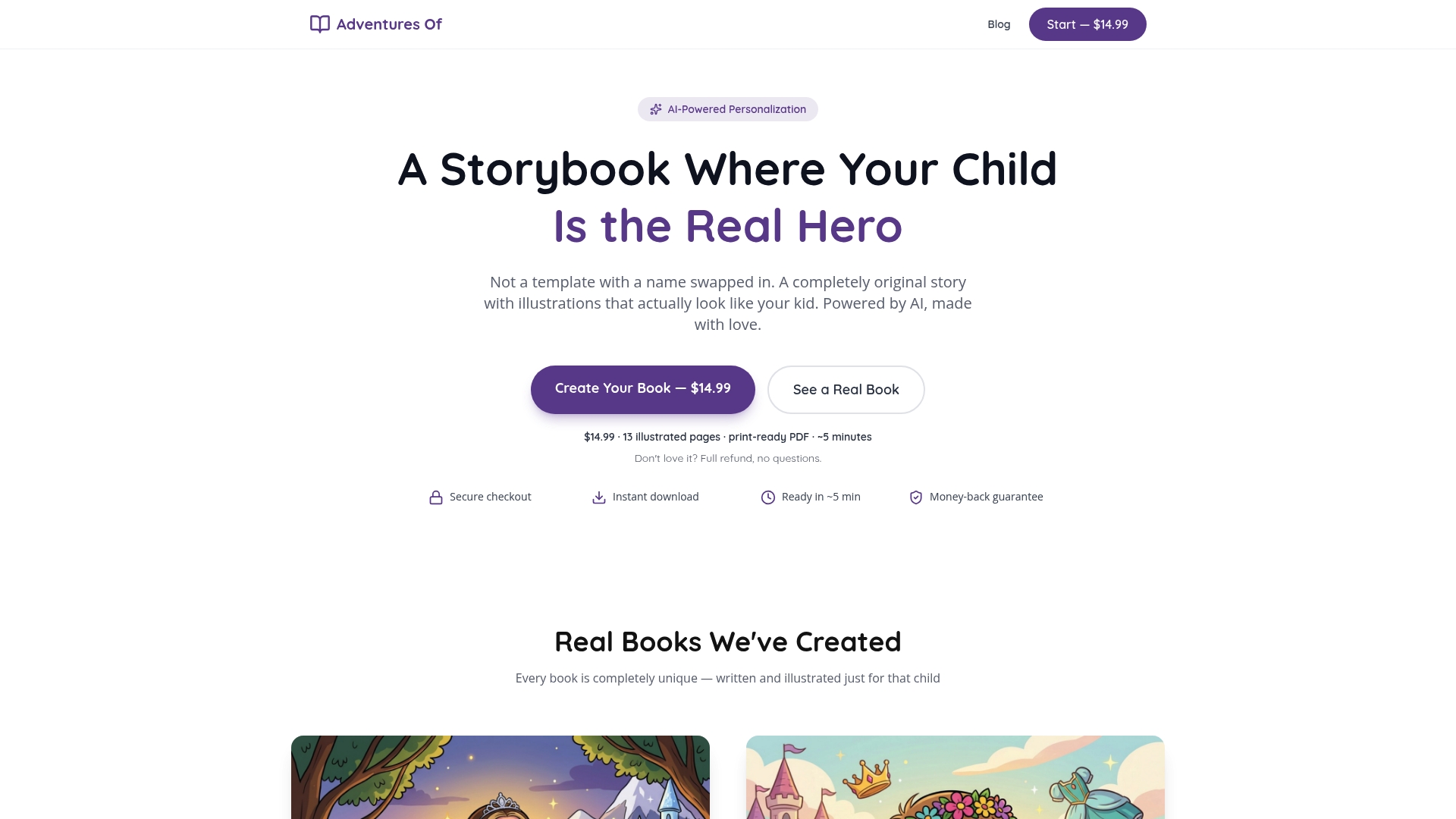
For parents who want to put the principles of narrative pedagogy into practice at home, this is one of the most direct ways to do it. Your child sees themselves as the hero, faces a real conflict, and watches it resolve. That is educational storytelling in its most personal form. Create your child's book and see what sticks.
FAQ
What is educational storytelling in simple terms?
Educational storytelling is a teaching method that uses character, conflict, and resolution to deliver a lesson. It works because stories activate emotional memory, making information far easier to retain than facts presented in isolation.
What are the main benefits of storytelling in learning?
The core benefits include stronger long-term retention, improved empathy, and deeper engagement with complex concepts. Research shows students recall story-based information 22 times more effectively than fact-based delivery.
How can parents use storytelling techniques at home?
Start with a micro-story of 30–60 seconds tied to something your child is learning or experiencing. Ask two discussion questions, then invite your child to retell or change the story. This three-step process builds comprehension and creative reasoning without requiring any special materials.
What makes a children's book an educational storytelling tool?
A children's book functions as an educational storytelling tool when its conflict and resolution map to a specific concept or value the child is developing. Books with authentic illustrations and original stories create stronger emotional connections than generic alternatives, which increases both engagement and retention.
How is educational storytelling different from just telling a story?
The difference is intent and structure. A casual story entertains. Educational storytelling uses the Four Cs, causality, conflict, complication, and character, mapped directly to a learning goal. It ends with a clear resolution that ties back to what the child is meant to understand or practice.