
AI-generated books are works where artificial intelligence produces most or all of the text, illustrations, or both, with minimal human authorship. The types of AI generated books now span practical guides, fiction, children's personalized stories, and more. Knowing the differences between these categories helps you pick the right format for your creative goal, whether you want a fast how-to guide or a one-of-a-kind storybook starring your child.
1. What are the main types of AI generated books by genre?
AI-generated books cover a broad range of genres, with practical guides leading at 19.1%, fiction at 15.3%, and self-help at 7.4% across a sample of 33,549 AI books analyzed by Inkfluence AI. That distribution tells you something real: AI performs best when structure matters more than voice.
The most common AI book genres break down like this:
- Practical guides and how-to books (19.1%): Step-by-step formats suit AI well. The content is predictable, factual, and easy to verify.
- Fiction (15.3%): AI can generate plot outlines, dialogue, and full chapters. Literary fiction and comedy require the most human editing afterward.
- Self-help and personal development (7.4%): Motivational frameworks and habit guides are popular AI outputs, though they often sound generic without heavy rewriting.
- Romance: Short-form romance is one of the fastest-growing AI book categories, largely because the genre follows recognizable story beats.
- Children's books: A smaller share overall, but growing fast due to personalization demand.
- Cookbooks and workbooks: Highly structured formats that AI handles with minimal errors.
- Study guides: AI excels at summarizing and organizing educational content into digestible formats.
Structured non-fiction genres align well with AI strengths and need less editing compared to creative fiction. That gap in editing effort is the single biggest factor in deciding which genre to pursue with AI tools.
Pro Tip: If you are new to AI book creation, start with a how-to guide or workbook. The format is forgiving, the output is easier to fact-check, and you will spend far less time rewriting.

2. How do AI-assisted and AI-generated books differ?
These two terms get used interchangeably, but they describe very different products. AI-assisted books involve high human control with AI helping the writing process, while AI-generated books have AI producing most or all of the content with minimal human authorship.
| Feature | AI-assisted | AI-generated |
|---|---|---|
| Human involvement | High | Low to minimal |
| Content source | Human-led, AI-supported | AI-led, human-reviewed |
| Amazon KDP disclosure | Not required | Required |
| Editing intensity | Moderate | Heavy |
| Copyright eligibility | Stronger | Weaker without human input |
Amazon KDP requires detailed disclosure about AI-generated text, images, and translations, with clear penalties for nondisclosure. Authors must keep prompt logs and editing records to answer KDP's disclosure form accurately. That is not optional paperwork. It is the difference between a live listing and a suspended account.
The U.S. Copyright Office does not grant copyright protections for fully AI-generated works lacking human authorship. Partial human creativity must be declared for any protection to apply. This matters most if you plan to sell or license your AI-generated book commercially.
Pro Tip: Even if your book qualifies as AI-assisted, document every edit you make. A clear editing record strengthens your copyright claim and simplifies any future KDP disclosure.
3. What innovative types of AI-generated children's books exist?
Children's books represent the most personal category in AI-driven book creation. The range of formats is wider than most parents realize.
AI-generated children's books differ by interaction model, falling into three main types:
- Text-only personalization: The AI swaps a child's name and basic details into a pre-written story. Fast and cheap, but the child is not really the hero. The story would work for any kid with the same name.
- Template-based personalization: The story structure is fixed, but details like the child's hometown, favorite animal, or sibling's name get inserted. Services like Wonderbly and Hooray Heroes use this approach well. The books are polished and reliable, but every child with similar details gets a nearly identical story.
- Template-free, photo-based personalization: AI generates an original story and original illustrations based on uploaded photos of the child. No two books share the same plot or artwork. This is the approach Adventuresofbook uses, and it is the most technically demanding format to produce.
- Multimodal books: These combine AI-generated text, images, and sometimes audio into a single reading experience. They are still emerging as a format but show strong potential for early literacy engagement.
Personalized children's books vary in complexity, from simple name swaps in templates to fully customized multimodal experiences leveraging photo-based artwork. The gap in quality between a name-swap book and a photo-generated one is significant. A child who sees their own face in the illustrations connects with the story differently than one who just sees their name in the text.
Matching learning and engagement structure to AI's strengths drives better outcomes in children's AI-generated content. Age-appropriate vocabulary, pacing, and illustration style all require human editorial review, even when the AI handles the heavy lifting. You can learn more about how AI illustration works in children's books if you want to understand what goes on behind the scenes.
4. Which AI tools match which types of AI-generated books?
The terminology around AI book tools is genuinely confusing. AI ebook creation tools vary by focus: writers prioritize prose quality, generators prioritize speed, creators handle end-to-end production including cover design and export, and makers aim for quick, free, frictionless output.
Here is how those tool types map to book formats:
- AI ebook writer: Best for fiction and self-help where prose quality matters. Tools in this category produce more natural-sounding text but require more time and prompting skill.
- AI ebook generator: Best for practical guides, study guides, and workbooks. Speed is the priority. Output is structured but often needs fact-checking.
- AI ebook creator: Best for authors who want a finished product fast, including cover art and formatted export. Suited to non-fiction and short-form books.
- AI ebook maker: Best for beginners who want a free or low-cost starting point. Output quality varies widely and usually requires significant editing.
For children's books specifically, none of these standard tool categories fully apply. Photo-based personalization requires a specialized pipeline that combines image generation, story generation, and layout design in one workflow. Adventuresofbook is built specifically for that use case, generating an original 13-page illustrated story from a child's photos in about five minutes.
Pro Tip: Blending tool types often produces the best results. Use a generator for a fast first draft, then run it through a writer-focused tool or human editor to improve the prose before publishing.
5. How to choose the right type of AI-generated book for your goals
Choosing the right AI book format comes down to four practical questions.
- What is your genre? Match your genre to AI's strengths. Structured non-fiction needs the least editing. Literary fiction needs the most. If you have limited editing time, start with a how-to guide or workbook.
- Who is your audience? Children's books require age-appropriate language, consistent illustration style, and emotional resonance. Adult non-fiction readers tolerate more generic prose. Know what your reader expects before you choose a tool.
- How much editing can you do? Creators often mix AI-generated workflows with substantial human rewriting to ensure voice consistency, factual accuracy, and narrative quality. If you cannot commit to editing, choose a more structured genre where AI output is more reliable out of the box.
- What are your disclosure and legal obligations? If you plan to sell on Amazon KDP, you must disclose AI-generated content. If you want copyright protection, you need documented human creative input. Both factors should shape which creation method you choose before you start writing.
For parents specifically, the choice is simpler. A personalized children's book starring your child is not a publishing project. It is a gift. The right format is the one that puts your child's face, name, and personality at the center of an original story. You can read more about how to make a personalized children's book if you want a step-by-step walkthrough.
Key takeaways
AI-generated books span multiple genres and creation workflows, and matching the right format to your audience and editing capacity is the single most important decision you will make before starting.
| Point | Details |
|---|---|
| Genre shapes editing effort | Structured non-fiction needs minimal edits; literary fiction needs heavy rewriting. |
| Disclosure is mandatory on KDP | AI-generated books require formal disclosure on Amazon KDP; keep prompt logs as proof. |
| Children's books vary widely | Template name-swaps and photo-based original stories are fundamentally different products. |
| Tool type affects output quality | Match your tool to your goal: writers for prose, generators for speed, creators for full production. |
| Human input protects copyright | The U.S. Copyright Office requires documented human creativity for any copyright protection. |
What I actually think about AI-generated books in 2026
The market is moving faster than most people's ability to evaluate what they are buying. I have watched the AI book space grow from a niche experiment into a genuine publishing category, and the honest truth is that most AI-generated books are not very good. Not because the technology fails, but because creators skip the editing step.
The genres where AI genuinely delivers are the ones where structure does the heavy lifting: how-to guides, workbooks, study materials. In those formats, a well-prompted AI with a human fact-checker produces something genuinely useful. Fiction is harder. The market treats AI-written books differently depending on human involvement, and readers are developing a sensitivity to AI prose even when they cannot name exactly what feels off.
Where I think AI-generated books are genuinely exciting is in personalized children's storytelling. A child who sees their own face illustrated across 13 pages of an original adventure responds to that book differently than to anything off a shelf. That is not a small thing. It is the kind of reading experience that builds a real connection to books at an age when that connection matters most. The technology is finally good enough to deliver on that promise without looking like a cheap novelty.
My advice: be honest about what you are making and why. If you are publishing for profit, edit heavily and disclose fully. If you are making a gift for a child, find a tool that puts that child at the center of something genuinely original. The difference between a name-swap template and a photo-generated story is the difference between a child recognizing themselves and a child seeing themselves.
— Jason
A personalized AI storybook for your child, made in minutes
If you have been reading about AI-generated children's books and wondering what the best version of that actually looks like, Adventuresofbook is worth seeing firsthand.
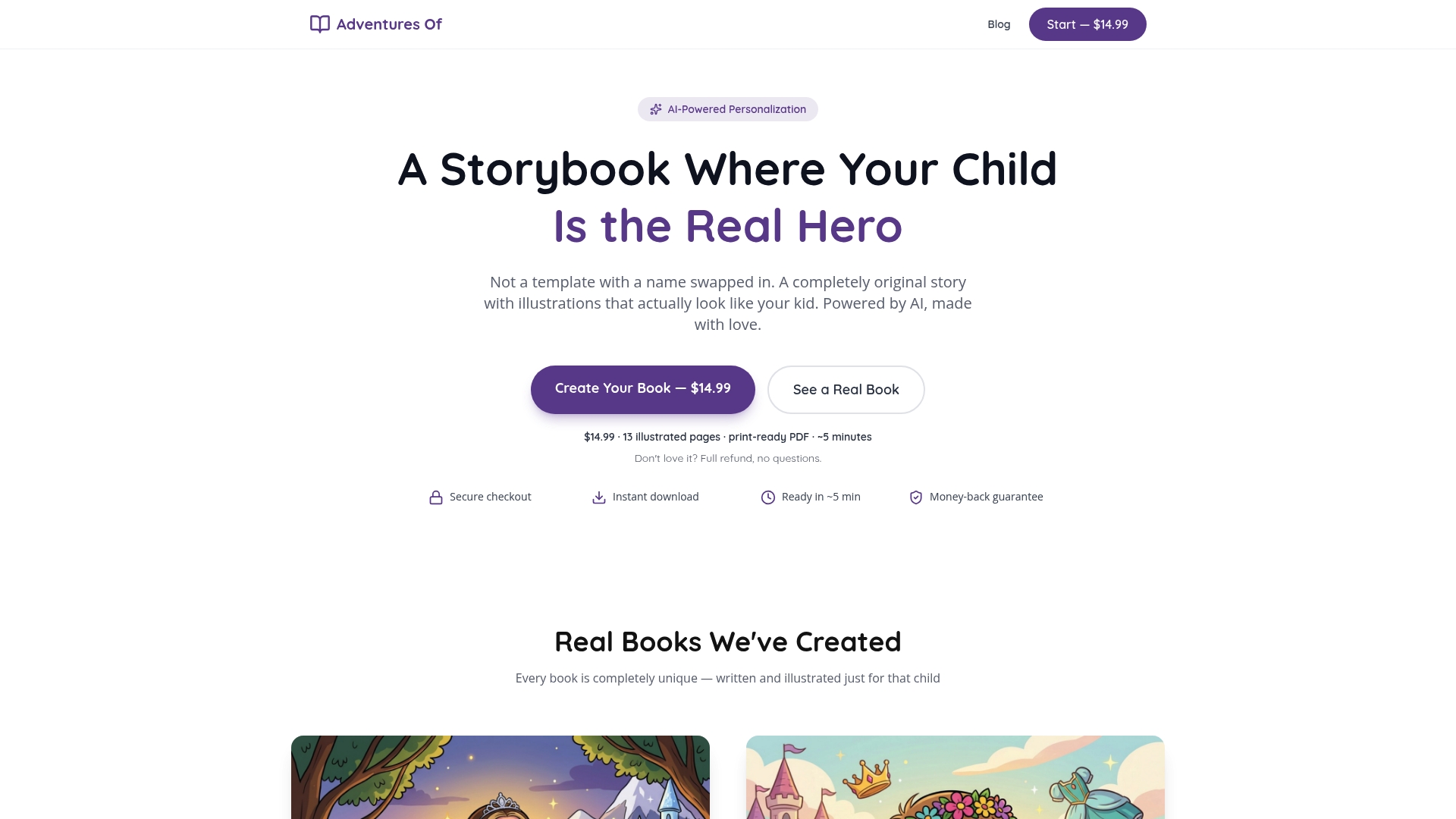
Adventuresofbook generates an original story and original illustrations from photos of your child. There are no templates, no generic characters with a name swapped in. The AI builds a 13-page, 8.5x8.5 illustrated book around your child's actual face and interests, and the whole process takes about five minutes. The book downloads as a print-ready PDF for $14.99, with a 7-day refund if you are not satisfied. For parents who want a gift that feels genuinely personal, create your child's book and see the difference a photo-based original story makes.
FAQ
What are the most common types of AI-generated books?
Practical guides lead AI book production at 19.1%, followed by fiction at 15.3% and self-help at 7.4%, based on analysis of 33,549 AI books on Inkfluence AI. Cookbooks, workbooks, romance, and children's books also appear frequently.
Do AI-generated books need to be disclosed on Amazon KDP?
Yes. Amazon KDP requires authors to disclose AI-generated text, images, and translations. Failure to disclose can result in account penalties or listing removal.
What is the difference between an AI-assisted and an AI-generated book?
An AI-assisted book is human-led with AI support, while an AI-generated book has AI producing most or all of the content. The distinction affects Amazon KDP disclosure requirements and U.S. copyright eligibility.
Are AI-generated children's books personalized or generic?
It depends on the format. Template books swap a child's name into a fixed story. Photo-based services like Adventuresofbook generate an original story and illustrations from the child's actual photos, producing a genuinely unique book.
Can AI-generated books be copyrighted?
The U.S. Copyright Office does not grant copyright protection for fully AI-generated works. Documented human creative input is required for any copyright claim to be valid.