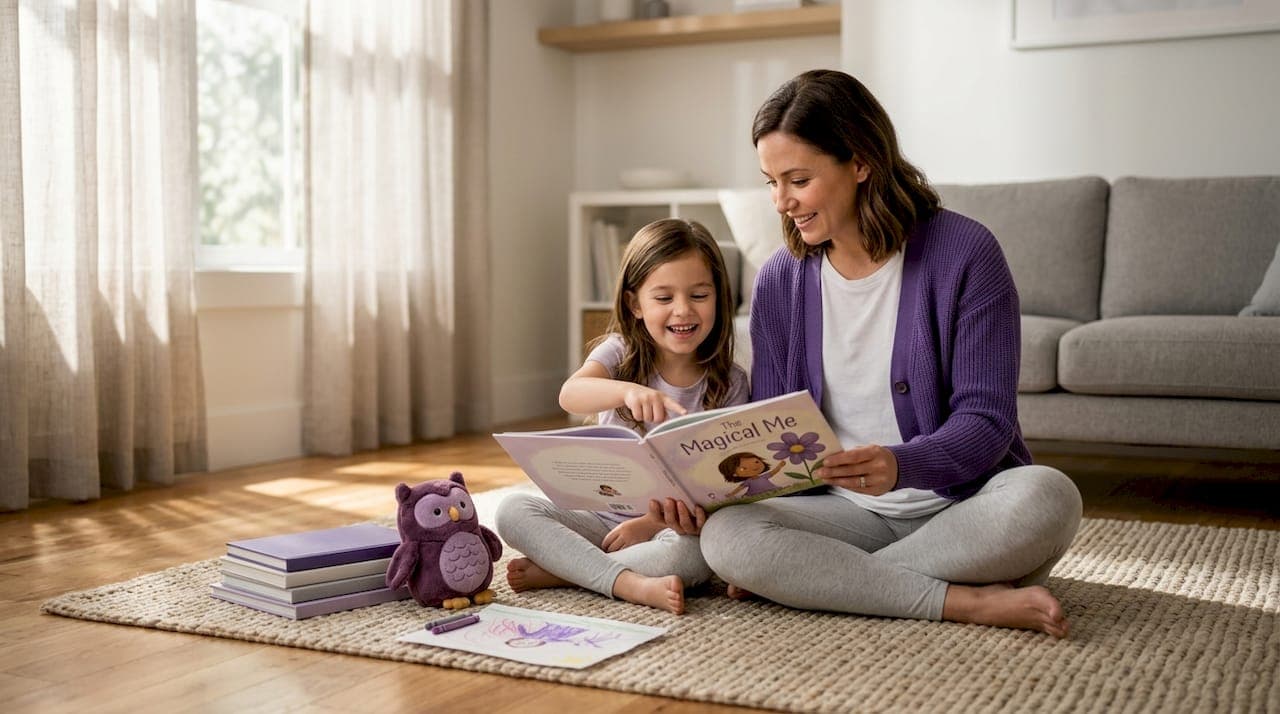
Finding a storybook that genuinely captures your child's imagination is harder than it sounds. Most books on the shelf feature the same handful of stock characters, predictable plots, and zero connection to the real kid sitting in your lap. The good news is that personalized storybooks significantly increase children's engagement, vocabulary growth, story recall, and reading motivation compared to generic books. This article walks you through exactly how to create a storybook that feels like it was made for your child, because it actually was.
Table of Contents
- Why personalization matters: The science of engagement
- Start with what makes your child unique
- Choosing your creation method: DIY vs. storybook services
- Ensuring safe, age-appropriate, and high-quality results
- Comparison table: Finding your best approach
- What most guides miss about creating unique storybooks for kids
- Ready for a truly unforgettable storybook? Start here
- Frequently asked questions
Key Takeaways
| Point | Details |
|---|---|
| Deep personalization wins | Storybooks tailored to your child’s appearance and interests drive engagement and learning. |
| Choose the right workflow | DIY and service options each offer distinct benefits—pick the one that fits your time and style. |
| Print matters | Printed storybooks provide stronger vocabulary and recall benefits for young readers. |
| Safety is key | Always guide AI tools and review final storybooks to ensure child-appropriate content. |
Why personalization matters: The science of engagement
When your child sees a character who looks like them, shares their favorite hobby, and goes on adventures with their best friend, something clicks. They stop being a passive listener and start feeling like the story belongs to them. That emotional connection drives better comprehension, stronger memory, and a genuine love of reading.
Research shows that deep personalization outperforms name-only approaches by a significant margin. Simply swapping "Emma" into a template story is not the same as building a story around Emma's curly red hair, her obsession with dinosaurs, and her fluffy gray cat named Biscuit. Deep personalization, the kind that includes the child's appearance and real interests, boosts prosocial behavior and comprehension through a mechanism researchers call social agency. Basically, kids feel ownership over the story, and that feeling makes everything stick better.
There is also a format consideration worth knowing about. Print books outperform digital formats for vocabulary development in young children, which matters when you're investing time and money into a personalized creation. The tactile experience of a physical book, turning pages, pointing at pictures, keeps younger children more focused and engaged than a screen.
The gap between personalized vs. template books is much larger than most parents expect. Template books reuse the same story structure and illustrations for thousands of children. Truly personalized books generate unique content based on your child specifically. The difference in how kids respond is noticeable almost immediately.
Here are the top benefits for parents to keep in mind:
- Stronger recall: Kids remember stories that feature themselves and familiar people far longer than stories with strangers.
- Better vocabulary: Hearing new words tied to characters and settings they recognize speeds up language learning.
- Higher motivation: Children ask to re-read books that feature them, building reading habits naturally.
- Emotional confidence: Seeing themselves as the hero of a story reinforces positive self-image.
- Prosocial development: Stories where the child-character makes kind or brave choices help model real-world behavior.
"The most powerful thing a story can do is make a child feel seen. When the hero looks like them and cares about the things they care about, the story becomes a mirror, and kids are endlessly fascinated by their own reflection."
Even e-books and learning benefits have their place for older children and supplementary reading, but for core language development in the early years, print wins consistently.
Start with what makes your child unique
Once you know why personalization works, the next step is gathering the ingredients that make your child's storybook distinctly theirs. Think of this as creating a character reference sheet, a simple list of everything that defines your kid right now.
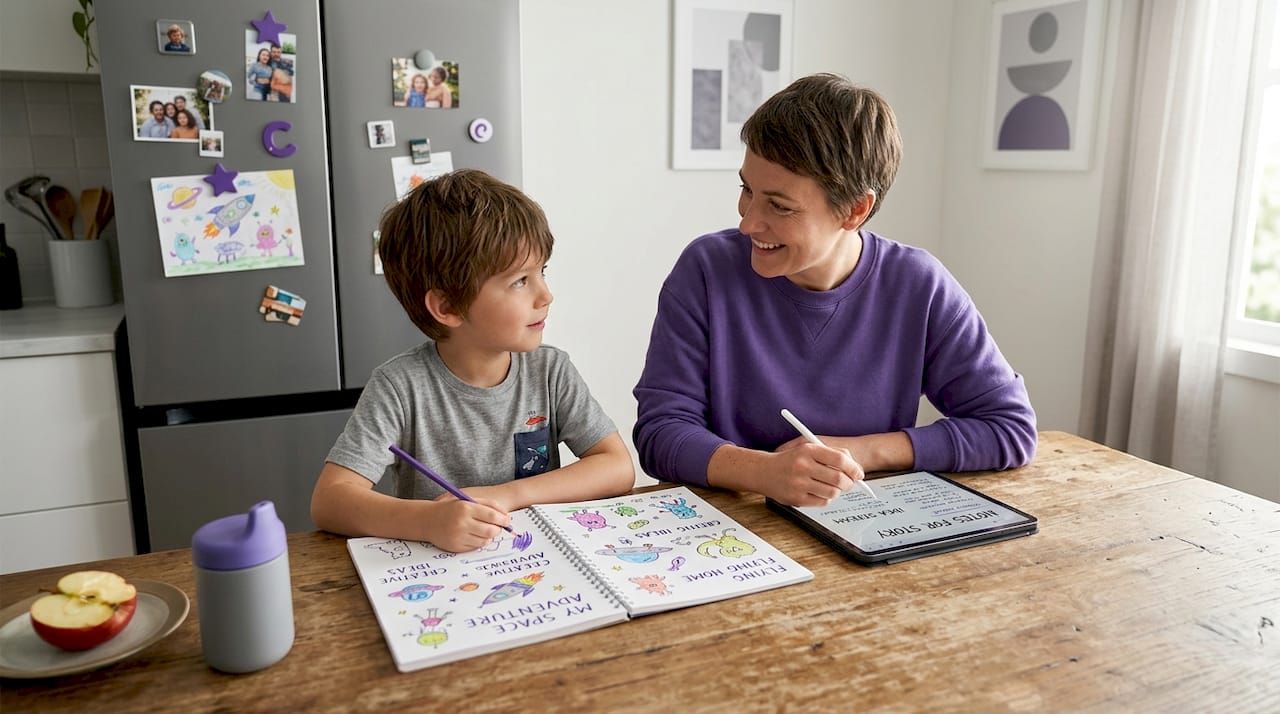
AI-generated personalized storybooks typically require 10 to 15 uploaded photos to produce consistent character illustrations that accurately reflect a child's appearance, interests, and even their pets. That is a useful benchmark whether you're using a service or doing it yourself. The more visual reference you provide, the more recognizable the final character will be.
Here is what to collect before you start:
- Physical traits: Hair color, length, and texture. Eye color. Skin tone. Any notable features your child is proud of, like freckles or glasses.
- Favorite hobbies: Does your child love painting, soccer, building with blocks, baking cookies, or chasing butterflies? These become the plot engine.
- Best friends or siblings: Including a real friend in the story creates an instant emotional connection and gives kids something to share.
- Pets: Pets are story gold. A dog named Peanut or a hamster named Zigzag adds warmth and humor to any adventure.
- Favorite places: A backyard treehouse, the local park, grandma's kitchen. Familiar settings make the world of the story feel real.
- Current interests or obsessions: Dinosaurs, space, mermaids, trucks, cooking shows. Whatever your child is into right now is perfect material.
You do not need to use all of these in every story. A well-crafted personalized book usually focuses on two or three key elements and builds a tight, fun narrative around them. Trying to stuff in everything at once can make the story feel scattered.
Pro Tip: Sit down with your child for ten minutes before you start. Ask them, "If you were the hero of a story, what would your superpower be and who would be your sidekick?" Their answers will surprise you and give you the best raw material imaginable. You'll also discover details you might have overlooked.
For a deeper guide on the full process, easy personalized book creation covers the workflow from start to finish in plain language.
Choosing your creation method: DIY vs. storybook services
With your child's traits in mind, now decide which approach matches your time and creativity. There are essentially two paths: doing it yourself using AI tools, or using a dedicated storybook service that handles most of the process for you.
The DIY route involves prompting a large language model (like ChatGPT or Claude) to write a custom story, generating illustrations using tools like DALL-E or Midjourney, and assembling everything in a design platform like Canva. It gives you maximum creative control and can cost very little if you already have access to these tools. The trade-off is time and a steep learning curve, especially for getting consistent character illustrations across multiple pages.
Storybook services automate the workflow. You upload photos, enter your child's details, and the platform handles story generation, illustration, and formatting. Services balance speed and quality versus the flexibility of DIY but come with a steeper creative curve if you want deep customization. The best services produce print-ready files you can order as a physical book.
Here is a quick at-a-glance comparison:
| Factor | DIY approach | Storybook service |
|---|---|---|
| Effort | High | Low |
| Customization | Very high | Moderate to high |
| Cost | Low to moderate | Moderate |
| Illustration consistency | Challenging | Handled automatically |
| Print options | You arrange separately | Often included |
| Time to complete | Several hours | Minutes to an hour |
Both options have real value. Neither is a bad choice. It really comes down to how much time you have and how specific your vision is.
Pro Tip: Many experienced parents hybridize the approach. Use an AI service to generate a polished draft quickly, then go back in and tweak the text yourself before printing. You get the speed of a service and the personal touch of your own editing. Check out the personalized book workflow guide and the breakdown of how long custom books take to plan your timeline.
Ensuring safe, age-appropriate, and high-quality results
Having picked your method, you need to make sure your storybook is beautifully safe and genuinely engaging for your child. AI tools are powerful but they need clear direction, especially when creating content for kids.
Research confirms that LLM tools require guiding mechanisms and context adaptation to produce safe, effective interactions with children. In plain terms, that means you need to be specific in your prompts and always review what the AI generates before sharing it with your child.
Here is a simple step-by-step process to follow:
- Set the age range clearly: Start every prompt with something like "Write a story for a 4-year-old" or "Generate a gentle, funny adventure for a 7-year-old." Age context shapes vocabulary, sentence length, and plot complexity.
- Define the tone upfront: Specify whether you want funny, heartwarming, adventurous, or educational. Without this, AI tools tend to default to generic.
- Include sensitivity notes: If your child has fears, such as loud noises or the dark, note that you want those elements avoided. If they are from a specific cultural background, you can ask for culturally relevant details.
- Review before sharing: Always read the full story yourself before presenting it to your child. Check for any words, themes, or images that feel off-target.
- Request revisions freely: AI tools respond well to follow-up prompts. "Make it funnier," "shorten the sentences," or "add a scene where Maya and her dog solve the problem together" all work well.
For illustration prompts, describe the art style you want clearly. "Soft watercolor style, warm colors, no scary elements" gives the AI much more to work with than a vague request.
"Safe and engaging are not opposites. With the right prompts and a quick review, AI-generated stories can be both imaginative and completely appropriate for the youngest readers."
On the format side, once your story is complete, print is the recommended final destination. For practical guidance, printing at home guide covers paper choices, binding options, and how to get sharp, professional-looking results from a home printer. For broader context on how the industry is moving, children's publishing insights from recent publishing conferences show that personalized, AI-assisted books are quickly becoming a mainstream expectation. Parents interested in understanding more about the tools involved can also review what AI safety for kids actually looks like in practice.
Comparison table: Finding your best approach
Everything above leads to a practical question: which approach actually fits your family's needs right now?
| Approach | Effort | Cost | Print quality | Best for |
|---|---|---|---|---|
| Full DIY | High | Low | Variable | Tech-savvy parents with time |
| AI storybook service | Low | Moderate | High | Parents who want fast, polished results |
| Hybrid | Medium | Moderate | High | Parents who want control without starting from scratch |
| Template book | Very low | Low | Moderate | Budget-conscious gifting with basic personalization |
For a more detailed breakdown of what separates AI-generated custom books from fill-in-the-blank options, the custom vs. template comparison article is worth reading before you commit to a method. The differences in illustration quality, story originality, and emotional impact are significant.
The hybrid approach is often the sweet spot for most parents. It combines the speed and quality of a purpose-built AI tool with the option to personalize the text further before printing.
What most guides miss about creating unique storybooks for kids
Most how-to articles focus almost entirely on the tools. Which AI platform to use, what prompts to write, how to format a PDF for print. That information is useful, but it skips the part that actually makes a storybook memorable.
The real magic happens when you involve your child in the creation process. Not just as the subject of the story, but as a co-creator. Asking a five-year-old what the villain should look like, or letting a seven-year-old choose how the hero escapes the problem, produces something no AI can generate on its own: genuine surprise and delight on your child's face when they see their idea on the page.
We have also noticed that parents often underestimate how much the creation experience itself matters. Sitting together to look at photos, picking the right details, reading the draft aloud together before it is printed, these small moments build connection and storytelling instincts in kids. The book becomes a shared artifact of that experience, not just a product.
Deep personalization also pays dividends over time. A child who sees themselves as capable, curious, and brave in a story they helped shape carries that narrative with them. That is not a small thing. Our behind-the-scenes insights cover more on how these creative experiences play out across different ages and family setups.
The tools are just the starting point. The relationship between you, your child, and the story you build together is what gives the book its lasting value.
Ready for a truly unforgettable storybook? Start here
If you've made it this far, you have everything you need to create a storybook your child will genuinely love. But if you'd rather skip the setup and get straight to the magic part, we've got you covered.
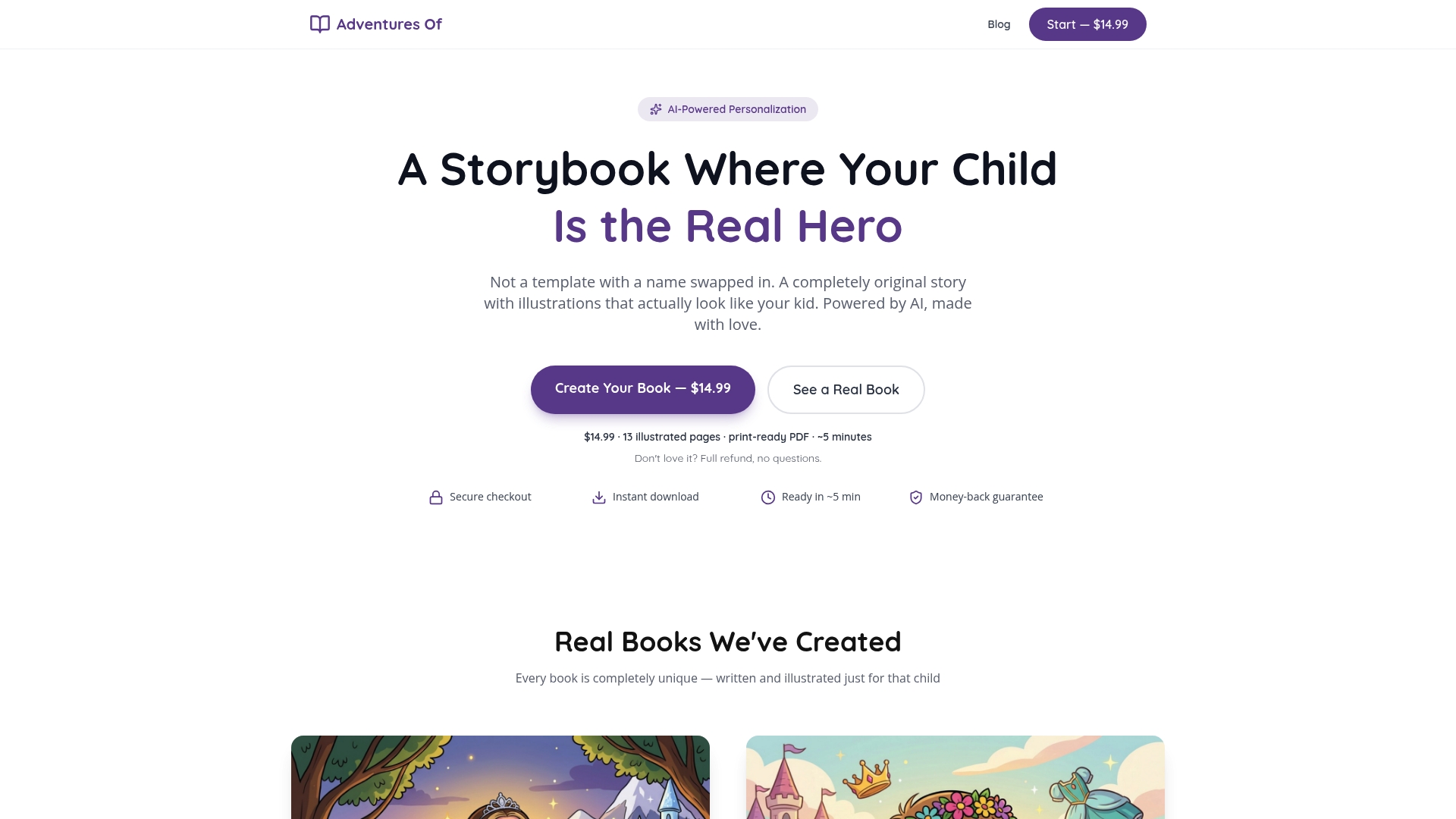
At Adventures of Book, we use AI technology to create fully original stories and illustrations based on your child's uploaded photos and personal details. No templates, no generic characters. Just a one-of-a-kind book featuring your child as the hero, ready to download in about five minutes. Explore our personalized children's books to see how the process works, or check out our custom baby books if you're creating something special for a new arrival. Every book comes with a money-back guarantee, so there is nothing to lose and a lot of joy to gain.
Frequently asked questions
How many photos are needed for an AI-generated storybook?
Most AI storybook services work best with 10 to 15 uploaded photos to produce illustrations that consistently match your child's appearance, interests, and any pets included in the story.
Is print or digital better for custom children's books?
Print is preferred over digital for vocabulary development and engagement in young children, making it the better long-term format for personalized storybooks.
What makes a personalized storybook truly unique?
Going beyond just a child's name to include their appearance, hobbies, and real-life details like pets creates the most engaging result, as deep personalization boosts both comprehension and prosocial behavior more effectively than name-only customization.
Are AI-generated stories safe for kids?
Yes, when guided correctly. LLM tools need guiding mechanisms and context-specific prompts to produce age-appropriate content, so parents should always review the final story before sharing it with their child.
Recommended
- How to Make a Personalized Children's Book (Without Losing a Saturday) | Adventures Of
- Adventures Of | Personalized Children's Storybooks
- Personalized Children's Books — Starring Your Kid | Adventures Of
- Custom Baby Books — First Adventure Starring Your Little One | Adventures Of
- 7 creative ways to use animated memories with your kids — WonderLens | WonderLens