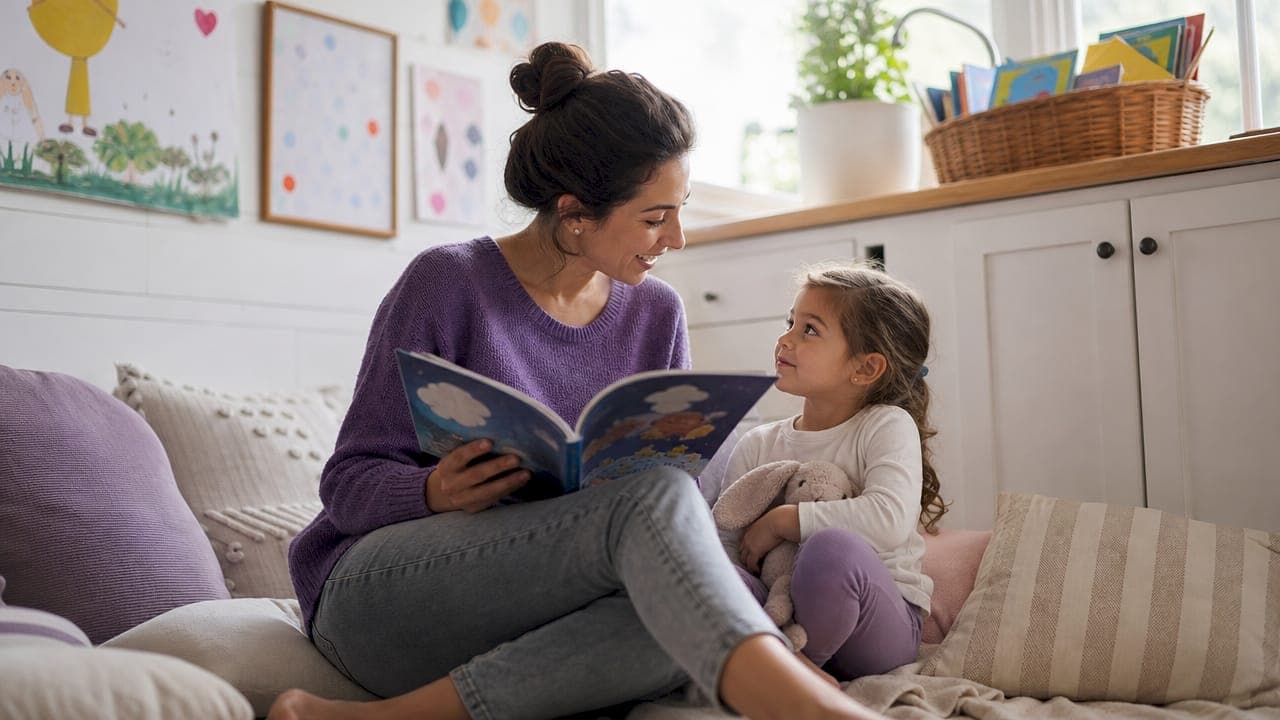
Storytelling is defined as the process by which narrative experiences actively build a child's imagination, language acquisition, and emotional maturity. The role of storytelling in child development goes far beyond bedtime entertainment. Research published in 2026 confirms that children who engage with stories regularly show stronger vocabulary, greater emotional awareness, and measurably higher speaking confidence than peers who do not. Whether you are a parent reading aloud each night or an educator using hand puppets and digital tools in the classroom, the mechanics of how stories shape young minds are worth understanding in full.
How does storytelling shape language development in children?
Storytelling gives children rich linguistic input and pushes them to use language actively, not just absorb it. That distinction matters. Passive exposure to words builds recognition. Active storytelling, where a child narrates, retells, or co-creates, builds fluency.
Research on story-based learning shows that oral fluency and speaking confidence improve significantly in elementary settings when interventions use tools like hand puppets, digital storytelling, and paired storytelling. The effect is not subtle. A separate structured storytelling program found that coherent speech nearly doubled, rising from 30% to 55% among students who received preparation, interactive sessions, and continuous mentoring.
Children also develop narrative grammar through storytelling. They learn that stories have a beginning, a conflict, and a resolution. That structure transfers directly to written composition, reading comprehension, and even math word problems.
- Retelling a story forces a child to sequence events and choose words deliberately.
- Creating an original story requires them to hold a plot in working memory while speaking.
- Responding to story prompts builds the habit of supporting claims with reasons.
Pro Tip: Ask your child to retell a story they just heard, but change one character's decision. That single twist pushes them to reason through cause and effect in their own words.
What is the impact of storytelling on emotional growth and confidence?
Stories let children rehearse real-life challenges through characters before they face those situations themselves. That rehearsal function is one of the most underappreciated benefits of storytelling for kids.
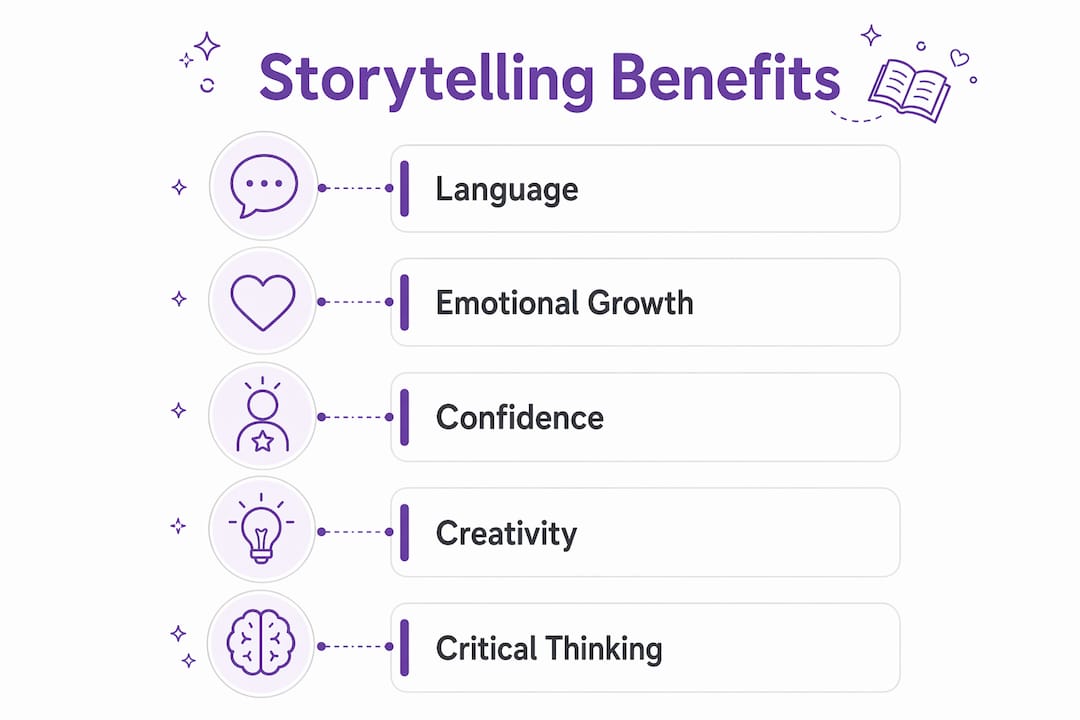
Research from Kentucky Counseling Center confirms that storytelling reduces anxiety about new situations by giving children a safe narrative space to explore fear, conflict, and resolution. A child who watches a story character navigate the first day at a new school has already mentally rehearsed that experience. The emotional charge is lower when the real moment arrives.
For children aged 7–9 specifically, live oral storytelling has been shown to enhance reflective emotional understanding by engaging them with character conflicts and intentions. That engagement moves children from intuitive emotion recognition to explicit emotion understanding. They stop just feeling what a character feels and start analyzing why.
Confidence grows through a related but distinct mechanism. When children tell their own stories without being corrected mid-sentence, they experience agency. They made something. Nobody interrupted it. That feeling compounds over time.
- Let the child choose the story's hero and setting without steering them toward "better" options.
- Resist correcting grammar or logic during narration. Save feedback for after the story ends.
- Ask open questions: "What do you think the character was feeling there?" not "Was the character happy or sad?"
- Celebrate the act of finishing a story, regardless of how polished it sounds.
"Allowing children to author their stories builds personal agency, empowering them to shape their life narratives." — Accomplish Press
Pro Tip: Record your child telling a story on your phone and play it back for them a week later. Hearing their own voice builds pride and gives them a concrete record of growth.
How does storytelling build imagination, creativity, and critical thinking?
Story creation requires children to invent plots, imagine solutions, and hold multiple possibilities in mind at once. Those are not soft skills. They are the cognitive foundations of problem-solving and abstract thought.
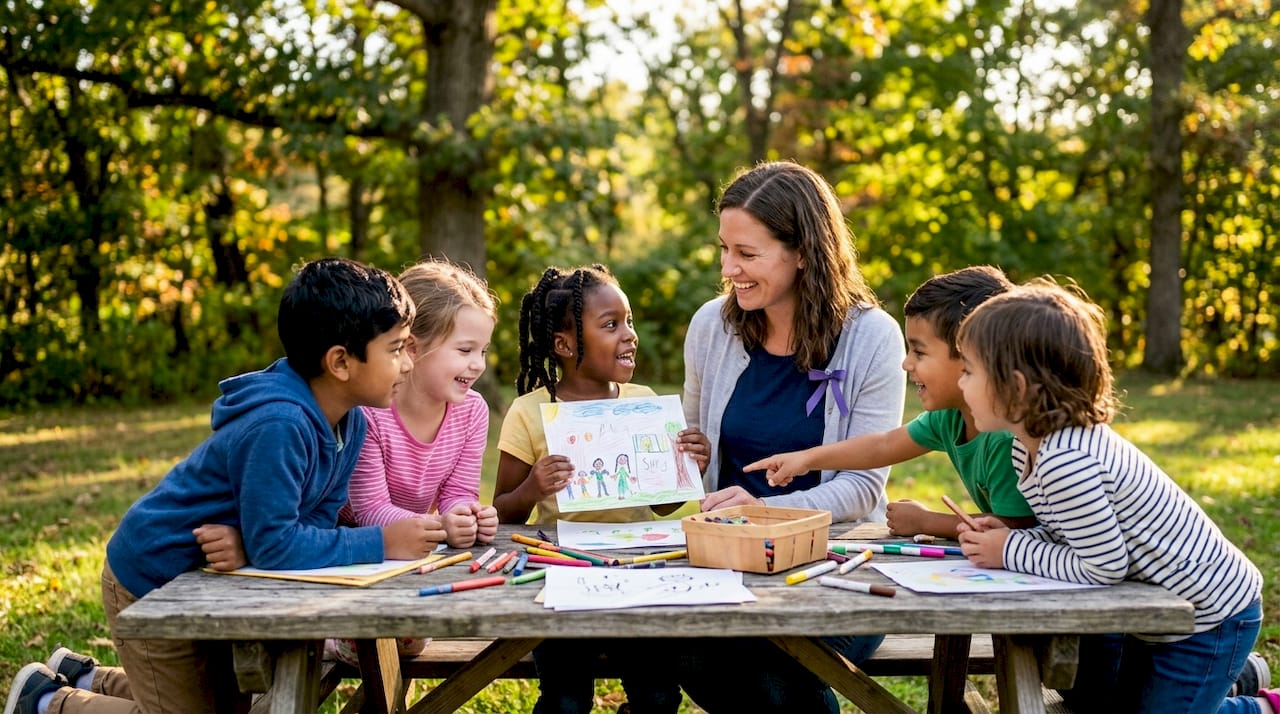
The difference between passive listening and active storytelling shows up at the neurological level. Interactive storytelling triggers neural synchrony and deeper semantic integration compared to passive listening. Co-creation also enhances memory retention and learning outcomes. That means a child who helps build a story remembers it better and understands it more deeply than one who only hears it.
| Skill area | Passive listening | Active storytelling |
|---|---|---|
| Vocabulary retention | Moderate | High |
| Memory of story events | Short-term | Long-term |
| Emotional engagement | Low to moderate | High |
| Problem-solving practice | None | Direct |
| Neural synchrony | Minimal | Significant |
The creativity benefits are also measurable in behavior. Children who regularly create stories are more likely to generate multiple solutions to a problem rather than stopping at the first one. They treat constraints as story obstacles to route around, not dead ends.
- Encourage "what if" questions during any story: "What if the bridge was broken? How would they get across?"
- Let children draw their story before telling it. Visual planning activates spatial reasoning alongside narrative thinking.
- Introduce a story constraint, like "the hero can only use three objects." Constraints sharpen creative thinking faster than open-ended prompts.
Practical ways to use storytelling for child growth at home and in school
The most effective storytelling techniques for child growth share one feature: the child does more than listen. Parents and educators who shift the child from audience to narrator see the strongest results.
Scaffolding storytelling with props, costumes, and questions guides children to build more complex and reflective stories as they mature. A simple prop, like a stuffed animal or a cardboard crown, gives a child a concrete anchor for their narrative. That anchor reduces the cognitive load of invention and frees up mental space for richer language.
A judgment-free storytelling environment is not optional. It is the condition that makes all other techniques work. When children fear correction, they self-censor. They choose simple words over expressive ones. They end stories early to avoid making mistakes. Remove the correction reflex and the stories get longer, stranger, and more emotionally honest.
- Use story starters: "One morning, a kid found a door that wasn't there yesterday..." and hand the narrative to the child immediately.
- Rotate the storyteller role at the dinner table. Each family member adds one sentence to a shared story.
- In classrooms, pair students for "story tennis," where they alternate sentences to build a shared narrative.
- Use personalized storybooks that feature the child as the main character to spark immediate emotional investment.
- Ask "what happens next?" after every story, whether from a book, a movie, or a child's own telling.
Pro Tip: Start a "story jar" at home. Fill it with slips of paper listing characters, settings, and problems. Let your child draw three slips and build a story from whatever they pull. The randomness removes the pressure of having to come up with something "good."
Key Takeaways
Storytelling is the single most accessible tool parents and educators have to build language, emotional resilience, and confidence in children simultaneously.
| Point | Details |
|---|---|
| Active beats passive | Children who co-create stories retain more and develop stronger language skills than those who only listen. |
| Confidence needs safety | A judgment-free storytelling space is the condition that allows children to take creative risks and build voice. |
| Emotional rehearsal works | Stories let children practice navigating fear, conflict, and change before facing those situations in real life. |
| Scaffolding accelerates growth | Props, questions, and story structures guide children toward more complex narratives as they develop. |
| Agency is the goal | Children who author their own stories build problem-solving skills and a stronger sense of personal identity. |
Why I think we underestimate what storytelling actually does
Most conversations about storytelling and child development focus on vocabulary and reading readiness. Those benefits are real. But the deeper effect is on identity.
When a child tells a story, they are not just practicing language. They are practicing being the person who decides what happens next. That is a fundamentally different experience from sitting in a classroom waiting to be called on. Children gain agency through storytelling in a way that few other activities replicate. They move from passive to active. They make choices. They live with the consequences of those choices inside the story, which is a low-stakes way to build the habit of decision-making.
The other thing I have noticed is how much the format of the story matters. A child hearing a generic story about a generic hero does not get the same engagement as a child hearing a story where the hero looks like them, has their name, and faces a problem they recognize. The connection between adult and child during storytelling physically drives brain development and neural synchrony. Personalization amplifies that connection because the child cannot mentally check out. The story is about them.
Parents sometimes worry they are not good storytellers. That concern misses the point. The child does not need a polished performance. They need a space where their voice matters and their ideas get taken seriously. That is something any parent can provide.
— Jason
Adventuresofbook: put your child at the center of the story
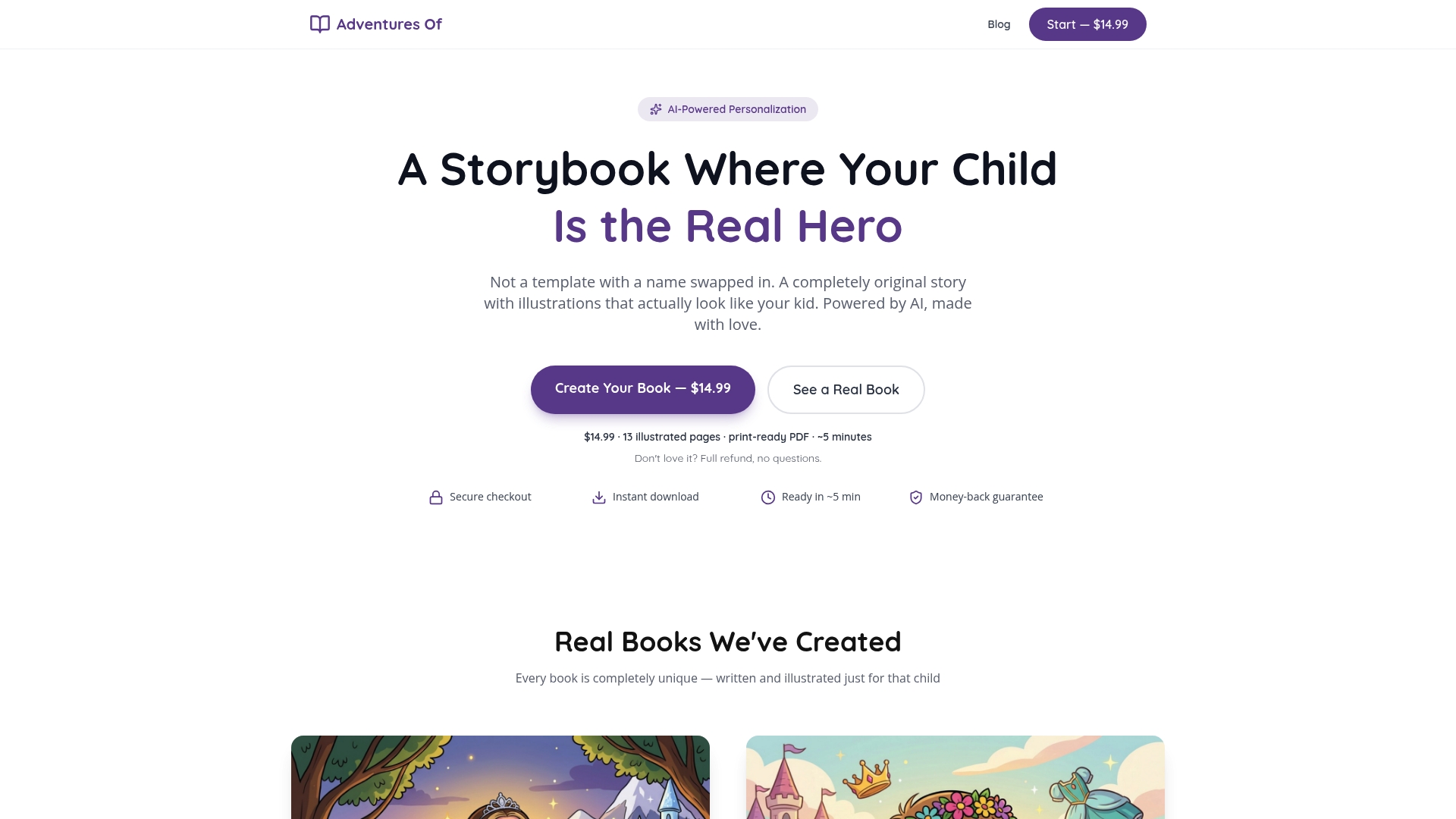
Adventuresofbook creates personalized children's storybooks where your child is the actual hero, built from uploaded photos and their personal details. The AI generates an original story and illustrations that look like your kid, not a template character with a name swapped in. Each book is 13 illustrated pages, delivered as an 8.5x8.5 print-ready PDF in about five minutes, for a one-time cost of $14.99. There are no recurring fees and a 7-day refund policy. If you want a story that makes your child lean in from the first page, create your book here.
FAQ
What is the role of storytelling in child development?
Storytelling actively builds vocabulary, emotional understanding, and speaking confidence in children. Research shows it supports both language acquisition and the development of empathy through narrative engagement.
How does storytelling build confidence in children?
Storytelling builds confidence by giving children agency over a narrative without fear of correction. Studies show that judgment-free storytelling environments encourage creative risk-taking and strengthen a child's sense of voice.
At what age does storytelling most benefit children?
Storytelling benefits children across all early childhood ages, but research on children aged 7–9 shows particularly strong gains in reflective emotional understanding through live oral storytelling.
What storytelling techniques work best for child growth?
Scaffolding with props, using story starters, rotating the narrator role, and asking open-ended questions all produce measurable gains in narrative complexity and language fluency.
Does personalized storytelling have extra benefits over generic stories?
Personalized stories increase emotional investment because the child cannot disengage from a narrative built around their own identity. That sustained attention deepens both comprehension and confidence.