
Step by step creative storytelling is the process of building a compelling narrative through defined stages that ensure emotional impact and clarity for young audiences. Most parents and educators skip the structure and wonder why kids tune out after two minutes. The answer is almost always the same: no framework, no emotional hook, no sensory detail. Frameworks like the Pixar Story Spine, the 5 Cs emotional model, and present-tense narration give you a repeatable process that works whether you are reading aloud at bedtime or writing a custom book. Tools like Grammarly help with clarity during editing, but the structure comes first.
What do you need before starting a story?
The right mindset is the first tool you need. Great storytelling starts with sharing a personal experience, not crafting a perfect epic. That shift matters because it removes the pressure of being a "real writer" and replaces it with something every parent and teacher already has: lived experience with kids.

Before you write a single word, gather three things: a focused story idea, a clear sense of your audience, and a basic planning tool. For children's stories, your audience is specific. Kids aged 3–8 respond to simple cause-and-effect logic, relatable characters, and a clear resolution. A story about a child who loses their favorite toy and finds it under the couch is more engaging to a five-year-old than a quest across three kingdoms.
Here is a quick comparison of tools that support the narrative building process:
| Tool | Best For | Format |
|---|---|---|
| Grammarly | Editing clarity and grammar | Browser extension, app |
| Story Planner (notebook or app) | Mapping beats before drafting | Physical or digital |
| Pixar Story Spine template | Structuring cause-and-effect logic | Printable worksheet |
| Voice recorder | Capturing spoken story drafts | Phone app |
The storytelling workflow for children works best when you plan before you write. Even a five-minute sketch of your story beats saves you from wandering plots and dead ends.
Pro Tip: Write your story idea in one sentence before you start. If you cannot summarize it in one sentence, the idea needs more focus.
How to structure your story using the step by step method
Structure is what separates a story that holds a child's attention from one that loses it at the second paragraph. The 7-beat narrative structure gives beginners a clear map: opening, trigger, attempts, turn, climax, falling action, and ending. Beginners using this structure can finish a complete draft in about 60 minutes. That is a concrete, achievable target for any parent or educator.
The Pixar Story Spine builds on this with a sentence-level discipline. Each beat connects to the next using cause-and-effect logic. Skipping the 'because of that' connector breaks the causal chain and disconnects the story emotionally. Here is how the Spine looks in practice:
- Once upon a time... (Introduce your character and their world)
- Every day... (Show their normal routine)
- Until one day... (The trigger that changes everything)
- Because of that... (First consequence)
- Because of that... (Second consequence, raising stakes)
- Because of that... (Third consequence, approaching the climax)
- Until finally... (The climax and resolution)
- And ever since then... (The new normal, the lesson learned)
Each "because of that" forces you to think about cause and effect. A child character does not just wander from scene to scene. Every action produces a result. That logic is exactly what young readers follow naturally, and it keeps them asking "what happens next?"
Pro Tip: Before you write the full story, fill in the Pixar Story Spine in bullet points. This takes five minutes and prevents you from losing the plot halfway through.
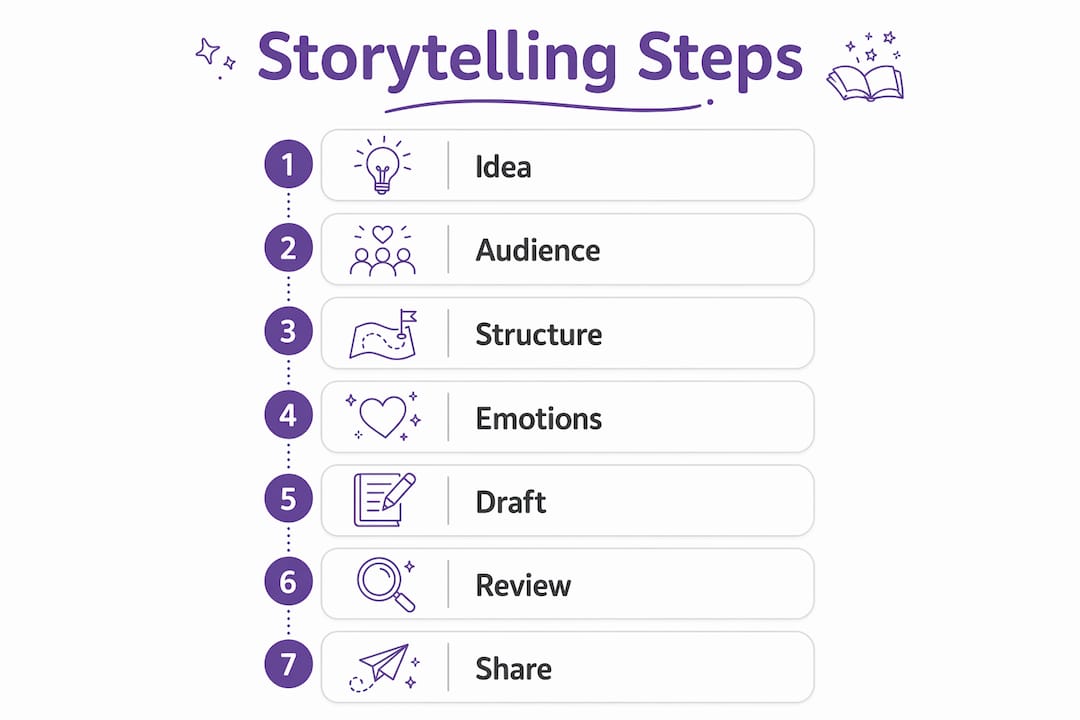
Map your 7 beats on paper or in a notes app before drafting. Label each beat with one sentence. If you cannot fill in all seven, your story idea may need more development before you start writing.
How do you build emotional connection in a children's story?
Emotional connection is what makes a child ask to hear the same story again. The 5 Cs framework gives you a validated outline for building that connection before you expand the full narrative. The five stages are Circumstances, Conflict, Crisis, Climax, and Conclusion. Using this framework reduces drafting time because you know exactly what emotional beat each section needs to hit.
Sensory details are the engine behind emotional immersion. Children do not just read stories. They experience them. Use all five senses deliberately:
- Sight: "The sky turned the color of a bruised peach as the sun disappeared."
- Sound: "The floorboards groaned under her feet, one slow creak at a time."
- Smell: "The kitchen smelled like burnt toast and her grandmother's lavender soap."
- Touch: "The blanket was scratchy on her chin but warm everywhere else."
- Taste: "The lemonade was so sour it made her eyes water."
Sensory details activate mirror neurons, making the audience feel they are living the story rather than observing it. For children, this effect is especially strong because their imaginations are already primed for immersion.
The second technique is shifting from past tense reporting to present tense reliving. "She walked to the door" becomes "She walks to the door, her hand shaking." That single shift changes the emotional temperature of the scene. Pair it with active body language and vocal energy when reading aloud, and the story becomes a performance.
Pro Tip: Read your story aloud to yourself before sharing it with a child. If you feel nothing during a scene, the child will feel nothing too. Add one sensory detail to any flat moment.
Failing to state the story's meaning or lesson leaves the narrative forgettable. Explicitly sharing the 'why' connects with audiences deeply. For children, this does not need to be a moral lecture. One clear sentence at the end, spoken by the character or the narrator, is enough.
What are the most common storytelling mistakes to avoid?
The most common mistake is trying to write and edit at the same time. Professionals draft messily first, then add sensory details during editing. Separating these phases protects your storytelling flow. When you stop to fix a sentence mid-draft, you break the narrative momentum and often lose the emotional thread entirely.
Here are the other pitfalls that trip up parents and educators most often:
- Over-detailing: Including every event from a real experience kills pacing. Creative license lets you prune non-essential plot points to keep focus on one transformation arc. The audience needs to see themselves in the story, not sit through a documentary.
- No single transformation arc: Every effective children's story shows a character changing in one clear way. Brave becomes braver. Scared becomes confident. Lonely finds a friend. If your character ends the story exactly as they began it, the narrative has no emotional payoff.
- Ignoring framing: Framing and emphasis shape how audiences interpret the core message. What you choose to highlight or omit controls the emotional and cognitive experience of the listener. For children, this means keeping the focus tight and the lesson clear.
- Pacing mismatches: Children aged 3–5 need shorter stories with faster resolutions. Children aged 6–9 can follow longer cause-and-effect chains. Match your pacing to your audience's age, not your own preference for detail.
- Skipping connective prompts: Without logical connectors like "because of that" or "and so," stories drift. Use these prompts as guardrails, especially when you are telling a story aloud without a script.
The types of educational books that hold children's attention longest share one trait: they follow a clear emotional arc with a satisfying resolution. That is not an accident. It is structure doing its job.
Key takeaways
Effective step by step creative storytelling for children requires structure, sensory detail, and a single clear transformation arc to hold attention and build emotional connection.
| Point | Details |
|---|---|
| Start with structure | Use the 7-beat narrative or Pixar Story Spine before writing a single sentence. |
| Separate drafting and editing | Write the full draft first, then add sensory details in a second pass. |
| Use the 5 Cs framework | Build emotional connection through Circumstances, Conflict, Crisis, Climax, and Conclusion. |
| Activate the senses | Include at least two sensory details per scene to create immersion for young listeners. |
| Focus on one transformation | Every children's story needs one clear character change to deliver an emotional payoff. |
Why authenticity beats ambition every time
I spent years thinking good storytelling meant elaborate plots and clever twists. It does not. The stories that made kids lean in were always the simple ones: the time I got lost in a grocery store at age six, the dog who ate my homework (it actually happened), the afternoon I tried to bake a birthday cake and set off the smoke alarm.
The common fear is "I'm not a storyteller." Reframing storytelling as sharing a personal incident lowers that barrier immediately. You do not need to invent anything. You need to remember something and tell it with sensory detail and a clear point.
What I have found works best with children is making them part of the story. Ask them what the character should do next. Let them name the dragon or choose the color of the magic door. That participation turns passive listening into active engagement, and it takes pressure off you as the teller.
The other thing I would tell any parent or educator: do not wait until you have a "good enough" story. Tell the imperfect one tonight. Kids are not critics. They are co-creators. The story you tell badly but with genuine feeling will land harder than the polished one you read from a script. Structure gives you confidence. Authenticity gives you connection. You need both, but if you only have one, pick authenticity.
For parents who want to take their child's story further, learning how to make a personalized children's book is a natural next step that puts everything in this guide into a tangible format.
— Jason
Put your child at the center of the story
Everything in this guide works better when the main character is someone the child already loves: themselves. Adventuresofbook creates original personalized storybooks where your child is the actual hero, with AI-generated illustrations built from real photos you upload. There are no templates and no generic characters with a name swapped in.

The process takes about five minutes. You upload a photo, share your child's details, and Adventuresofbook generates a completely original story with 13 illustrated pages in an 8.5x8.5 print-ready PDF. The one-time price is $14.99, and there is a 7-day refund if you are not satisfied. If you want a story your child will ask to hear again and again, personalized children's books are the place to start.
FAQ
What is the pixar story spine and how does it work?
The Pixar Story Spine is a cause-and-effect storytelling framework that connects narrative beats using the prompt "because of that." Skipping this connector breaks the causal chain and weakens the story's emotional continuity.
How long should a children's story be?
Children aged 3–5 engage best with stories that resolve in 5–8 minutes of reading time. Older children aged 6–9 can follow longer narratives, but the 7-beat structure keeps any length focused and paced correctly.
What are the 5 cs in storytelling?
The 5 Cs are Circumstances, Conflict, Crisis, Climax, and Conclusion. This framework builds emotional connection before you expand the full narrative, and using it reduces drafting time by giving you a validated emotional outline.
Should i write in past tense or present tense for kids?
Present tense creates more immediacy and immersion. Shifting from "she walked" to "she walks" makes the scene feel live. Sensory details paired with present tense activate mirror neurons and pull young listeners directly into the story.
How do i know if my story is too complicated for a child?
If you cannot summarize the story in one sentence, it is too complicated. Focus on one character, one problem, and one clear resolution. Pruning non-essential plot points keeps the transformation arc clear and the child emotionally engaged from start to finish.