
Giving your child a storybook where they are the hero is one of those gifts that feels almost magical. But the moment you start typing your child's name into an online form or uploading their photo to a platform you just discovered, a nagging question surfaces: is this actually safe? You're not being paranoid. Personalized storybooks powered by AI and digital tools raise real questions about privacy, content moderation, and age-appropriateness that most guides skip right over. This article walks you through exactly what to watch for, how to prepare, and how to create a personalized storybook your child will love without any of the risks that come with cutting corners.
Table of Contents
- What makes storybook personalization risky?
- Preparing for safe personalization: what parents need
- Step-by-step: safely personalizing your child's storybook
- Troubleshooting and common mistakes to avoid
- What to expect: signs of a safe and engaging personalized storybook
- Why conventional storybook personalization advice isn't enough
- Find safe, memorable storybook personalization options
- Frequently asked questions
Key Takeaways
| Point | Details |
|---|---|
| Moderation is essential | Choose storybook platforms with clear moderation and age gating rules to protect children. |
| Privacy matters | Always review the platform’s privacy policy before sharing personal details or photos. |
| Step-by-step safeguards | Follow the recommended personalization steps for secure, creative, and age-appropriate books. |
| Engagement and safety | A well-personalized storybook should be fun, tailored, and demonstrably safe for your child. |
What makes storybook personalization risky?
Not all personalized storybooks carry the same risks. A printed book with your child's name swapped into a template is very different from an AI-driven platform that generates original stories and illustrations based on uploaded photos. The gap between those two experiences is also a gap in risk levels.
Privacy is the most immediate concern. When you share a child's name, photo, age, or interests with an online platform, you need to know exactly how that data is stored, who can access it, and whether it is ever used to train AI models. Many platforms bury this information in long terms-of-service documents that most parents never read.

Content moderation is the second issue. AI systems that generate stories are only as safe as the guardrails their developers put in place. AI narrative systems require proper moderation, age gating, and governance to match actual risks. Without those controls, an AI could generate content that is tonally off, thematically confusing, or simply not suitable for young readers.
Age-appropriateness is a subtler risk. Some platforms that look child-friendly on the surface are actually built for general audiences. If the content filters are not specifically calibrated for toddlers or early readers, the output may miss the mark in ways that are hard to spot before the book is in your child's hands.
Here is a quick comparison to help you see where the risks concentrate:
| Feature | Traditional personalized book | AI-based personalized storybook |
|---|---|---|
| Content source | Pre-written, edited templates | AI-generated, original output |
| Privacy risk | Low (name only) | Higher (photos, details) |
| Moderation | Editorial review | Automated + optional human review |
| Age targeting | Usually locked to one age group | Varies by platform settings |
| Customization depth | Surface level | Deep, one-of-a-kind |
| Parental control | Limited | Platform dependent |
Understanding how AI illustration works in these storybooks also helps you ask better questions before you commit to a platform. And if you are curious about the image side specifically, our breakdown of AI art safety covers what parents need to know in plain language.
"Governance and moderation need to be proportional to the actual risks involved, not just set to a default baseline that works for general audiences."
Preparing for safe personalization: what parents need
Before you click "create," there are a few things worth lining up. Think of this as your pre-flight checklist. Skipping it is how parents end up on platforms they later regret using.
Here is what to look for before committing to any personalization platform:
- A clear, readable privacy policy. It should explicitly state how your child's data and photos are stored, for how long, and whether they are shared with third parties.
- Moderation standards. Does the platform review AI-generated content before it reaches you? Is there a human in the loop, or is it fully automated?
- Age gating. Are there settings designed specifically for your child's age range, or is the platform built for all ages with no meaningful filtering?
- Parental controls. Can you review and approve the final content before it is delivered?
- Data deletion options. Can you request that your child's photos and details be removed from the platform after the book is created?
Safety controls vary significantly between products, and moderation quality is not something you can assume. Scrutinizing the platform before you start protects you far better than checking the final product after the fact.
Here is a quick feature comparison across the types of platforms you will typically encounter:
| Platform type | Age gating | Content review | Data privacy | Parental control |
|---|---|---|---|---|
| Template book services | Basic | Pre-written only | Low risk | Minimal |
| AI storybook generators | Varies | Automated | Moderate to high | Varies widely |
| Fully custom AI platforms | Strong (best ones) | Human + AI review | High (if vetted) | Full review access |
Our book personalization guide goes deeper on what separates a great personalized book from a generic one. It is also worth reading our take on personalized vs. template books to understand which approach actually delivers more value for your child. For ideas on how storytelling itself can be structured around children's creativity, these storytelling workflow tips offer some helpful framing.
Pro Tip: Before you upload any photo or enter any personal detail, search the platform name plus "privacy policy" and "data security" to see what independent reviewers have said. A platform confident in its safeguards will make those details easy to find.
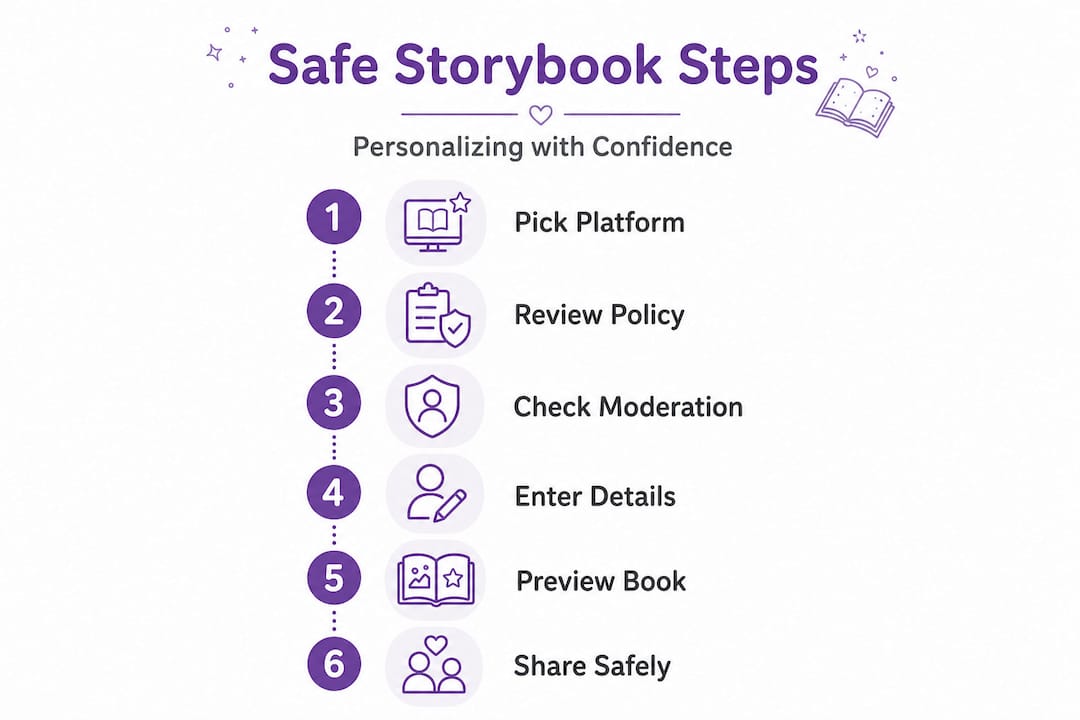
Step-by-step: safely personalizing your child's storybook
Once you have picked a platform you trust, the actual process is straightforward. Here is how to move through it safely.
-
Choose your platform carefully. Use your checklist from the previous section. Prioritize platforms that are transparent about how they handle photos and data. If the privacy policy is hard to find or written in legalese that takes a lawyer to decode, that is a red flag.
-
Select a story theme that suits your child's age. Look for themes that are warm, positive, and developmentally appropriate. A good platform will let you filter by age range or reading level. For younger children, simpler narratives with clear emotional arcs work best.
-
Enter personal details thoughtfully. Your child's first name is generally fine. Be cautious about including full names, birth dates, school names, or location details. The story does not need that level of specificity to feel personal.
-
Review the platform's photo upload policy before uploading anything. This is where most parents skip a critical step. Make sure you understand whether your photo will be stored, for how long, and whether it is used to improve the AI. AI narrative experiences require scrutiny of safety controls precisely because photo data is sensitive in ways that a typed name simply is not.
-
Preview the generated content before finalizing. Any reputable platform gives you a preview. Read the story yourself before sharing it with your child. Check that the language is age-appropriate, the themes are positive, and the illustrations accurately represent your child in a way you are comfortable with.
-
Confirm safety features are active. Before downloading or ordering a print copy, double-check that any parental control settings are turned on and that the content passed moderation review.
Our collection of custom baby books follows exactly this kind of careful process, which is why parents consistently feel confident using it. If you are wondering about timing, our post on custom book timelines covers how long each step realistically takes.
Pro Tip: Use your child's first name but skip the last name. A story about "Sophie the Brave Explorer" is just as magical as one that uses a full name, and it protects your child's identity at the same time.
Troubleshooting and common mistakes to avoid
Even with the best intentions, parents run into issues. Here are the mistakes that come up most often and how to fix them quickly.
Common safety mistakes:
- Skipping the moderation review. Some parents assume that because a platform is marketed to children, the content is automatically safe. Always read the final output yourself before your child sees it.
- Using platforms without a stated privacy policy. If a site cannot clearly explain what it does with your data, the safest move is to walk away.
- Uploading photos without checking the data storage policy. Your child's image is sensitive. A photo used to generate an illustration should not end up in a training dataset or accessible to third parties.
- Ignoring age gating options. If a platform offers age-specific settings and you skip that step, the content calibration defaults to something more general, which may not suit a toddler or early reader.
- Not previewing the final product. This sounds obvious, but many parents are in a rush. Reading the book before gifting it takes five minutes and prevents a lot of awkward moments.
Safety controls and moderation are variable between products and deployments. That variability is exactly why you cannot assume a platform is safe simply because it looks polished or well-reviewed.
Quick fixes:
- If the content feels off, contact customer support immediately. Reputable platforms will offer revisions or refunds.
- If you realize you shared more personal detail than you intended, check whether the platform has a data deletion request option.
- If age settings were skipped, go back into your account settings and adjust them before generating additional content.
For more ideas on finding the right book experience for your child's specific interests, our children's gift guide is a practical starting point. And for context on how interactive books can reinforce learning alongside personalization, these interactive book strategies are worth a look.
Pro Tip: Always double-check age gating settings and review the final generated content from start to finish, not just the first page. Problems, when they occur, often appear deeper in the story where spot-checking misses them.
What to expect: signs of a safe and engaging personalized storybook
You have done the work. Now what should the finished product actually look like? Here are the signs that tell you a personalized storybook hit the mark.
Signs of a safe, high-quality personalized storybook:
- Age-appropriate language throughout. The vocabulary, sentence length, and emotional themes match your child's developmental stage.
- Positive, constructive narrative arc. The story builds your child up, features them solving a problem or going on an adventure, and ends on a warm note.
- Accurate, recognizable illustration. If the platform uses photos to generate illustrations, the resulting image should look like your child in a flattering, creative way, not distorted or generic.
- No unexpected themes or content. Nothing in the story should feel surprising in a way that makes you uncomfortable. Safety-focused platforms review for this specifically.
- Clear branding and moderation transparency. The platform should be upfront about what it checked and how the content was reviewed.
- High print quality. If you are ordering a physical copy, the resolution and paper quality should reflect the premium nature of the gift.
Ongoing safety concerns in AI-driven personalization make rigorous governance and moderation non-negotiable, not optional. The long-term benefits of a well-made personalized storybook are real. Children who see themselves as the hero of a story develop stronger reading engagement, greater confidence, and a more active imagination. But those benefits only land when the book is genuinely safe and thoughtfully crafted. Browse our full range of personalized children's books to see what a well-moderated, creatively rich experience looks like in practice. For a broader perspective on how book choice affects development, these educational book picks offer expert framing.
Why conventional storybook personalization advice isn't enough
Most guides on this topic stop at "check the privacy policy and make sure the platform is reputable." That advice is not wrong, but it is incomplete. The reality is that technology in this space is moving fast, and what was safe and well-moderated six months ago may have changed.
We see two things that conventional advice consistently misses. First, parent involvement during the creation process matters enormously. It is not just about checking a box at the start. Reading the finished story with your child, asking them what they think about it, and staying curious about how it was made turns a passive purchase into an active, connected experience.
Second, platforms evolve. A children's platform might update its AI model, change its data storage practices, or expand its content categories without sending you a notification. Governance and moderation need to match actual risks, and parents who stay informed are far better positioned to catch a problem before it affects their child.
"Safety controls must match actual risks, not just baseline standards set at launch."
The brands worth trusting are the ones that treat safety as an ongoing commitment, not a feature they checked off at launch. Look for platforms that publish regular updates to their moderation practices, make it easy to reach a real person with concerns, and have clear records of how they handle data. Our personalized storybook platform is built around exactly those principles, which is why we are transparent about how every step of the process works.
Find safe, memorable storybook personalization options
Personalized storybooks can be one of the most meaningful gifts you give a child, but only when the platform behind them takes safety as seriously as creativity.
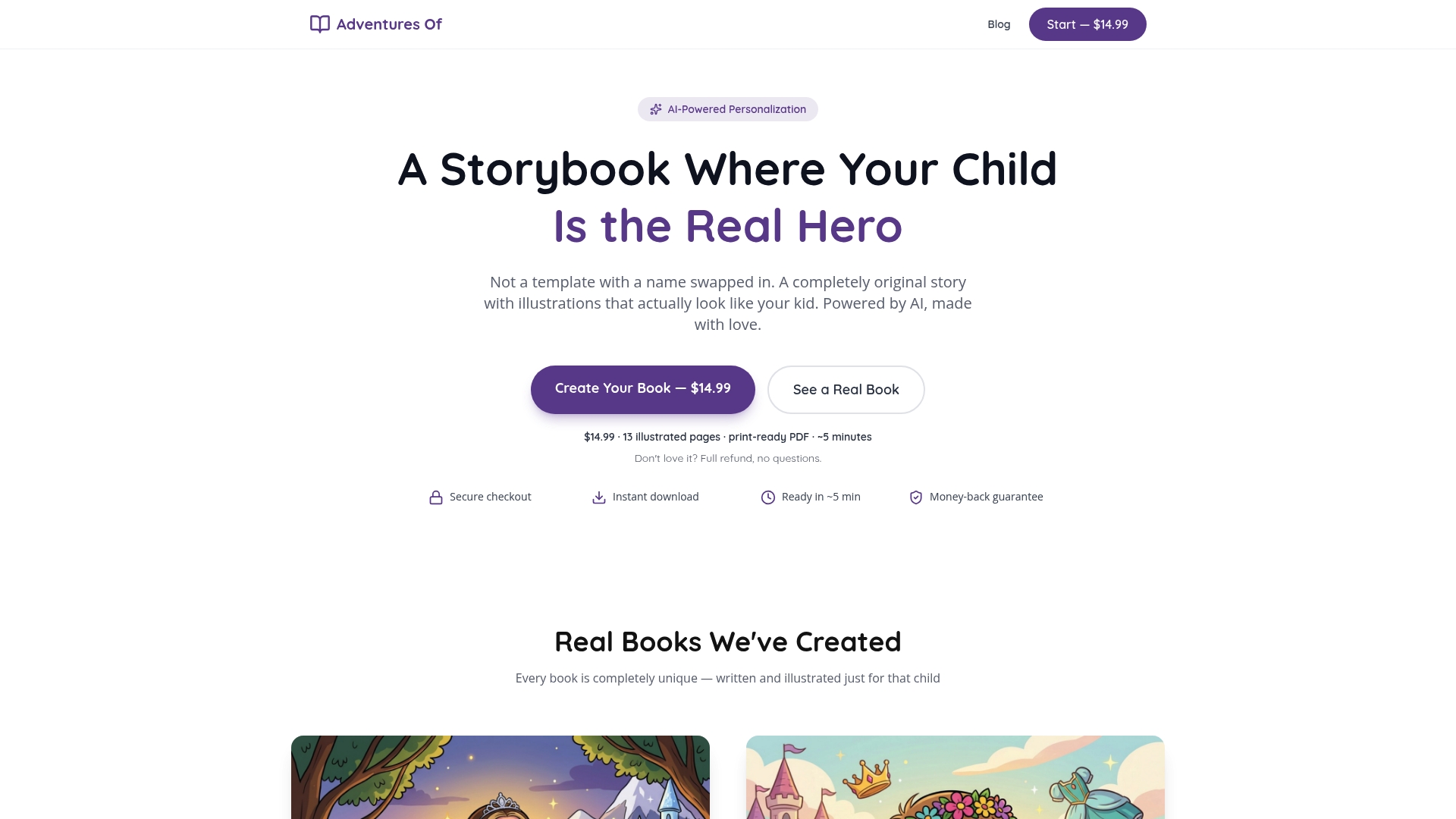
At Adventures Of, we built our safe storybook personalization process around parent peace of mind. Every book is generated with privacy and moderation at the center, not as an afterthought. You can browse our storybook library to explore themes and styles before committing, and our custom baby book options are a great starting point for the youngest readers. The whole process takes about five minutes, and the result is a one-of-a-kind story featuring your child's likeness, interests, and name. No templates. No generic characters. Just a story made specifically for them.
Frequently asked questions
How can I verify the safety of a storybook personalization platform?
Look for clearly stated moderation policies, age gating options, and a readable privacy policy before you share any personal information. Platforms with strong age gating and governance are significantly safer choices for children's content.
Are personalized storybooks safe for toddlers?
Yes, as long as the platform offers age-appropriate content settings and robust moderation. Safety controls must match risks for each specific age group, so always confirm the platform has settings calibrated for very young readers.
What should I avoid when customizing a storybook?
Avoid platforms that do not publish a moderation policy, and never share photos or sensitive personal details without confirming that strong privacy safeguards are in place. Some platforms lack proper governance and moderation, which makes broader scrutiny essential.
Can AI-generated storybooks be safe for children?
Absolutely. AI storybooks are safe when the platform uses strong moderation, clear age-appropriate controls, and transparent data practices. AI narrative experiences require scrutiny of safety controls, including moderation and age gating, so choose platforms that make those details visible and verifiable.