
Why storytelling is a core caregiving tool
Caregivers use storytelling to make sense of one of life's most demanding roles. Across caregiving contexts, from aging parents to children with complex needs, narrative is how caregivers process emotion, construct identity, and find connection with others who understand. This is not a soft skill or a nice extra. Research published in 2025 and 2026 consistently shows that caregiver storytelling acts as a cognitive appraisal tool, shifting focus from burden to personal growth and resilience.
The core functions storytelling serves caregivers:
- Emotional expression: Giving voice to guilt, fear, grief, and relief without judgment
- Meaning-making: Organizing chaotic experiences into a coherent narrative arc
- Identity formation: Building a stable sense of self within a role that often erases it
- Stigma reduction: Normalizing mixed feelings by hearing others share the same ones
- Community building: Creating bonds with people who genuinely understand the weight of caregiving
- Resilience: Reframing burden as growth rather than loss
How storytelling shapes caregiver identity and emotional health
Caregiving disrupts identity. When you spend months or years prioritizing someone else's needs, your own sense of self can quietly dissolve. Research from the University of Arizona found that narrative identity formation correlates with measurable reductions in psychological strain, because constructing a coherent story about your caregiving experience helps resolve that disruption.

Storytelling also gives caregivers a place to put the emotions that have nowhere else to go. Guilt about feeling resentful. Relief when a loved one has a good day. Fear about what comes next. Sharing these feelings through narrative, whether in a support group, online forum, or journal, reduces shame by showing caregivers they are not alone in feeling all of it at once.
Key emotional and identity benefits caregivers gain through storytelling:
- Reduced caregiver burden and stress through narrative sense-making
- Greater self-coherence when identity has been disrupted by the caregiving role
- Permission to hold contradictory emotions without judgment
- Improved long-term mental health linked to positively framed narratives
- A sense of agency, because telling your story means you are the one shaping it
What the Caregiver Speaks intervention actually showed
Caregiver Speaks is a structured, photo-elicited storytelling group designed specifically for family caregivers of people with dementia. Participants bring photographs and share stories connected to them, guided through a process that combines personal narrative with social validation and meaning-making.
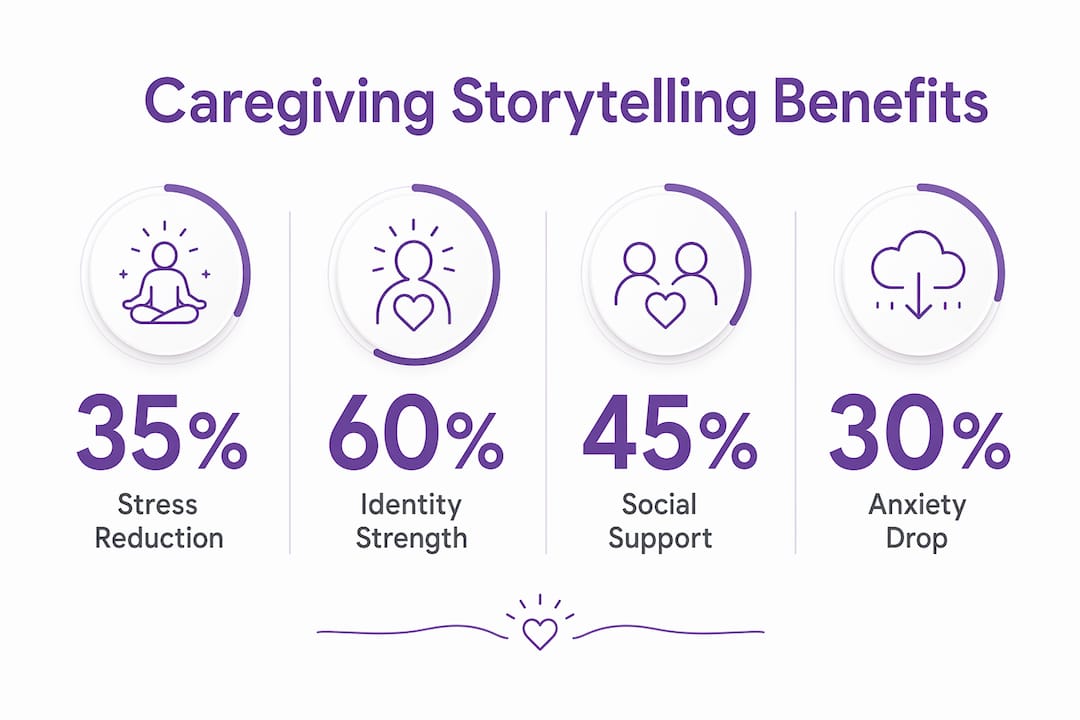
A randomized controlled trial tested the program with hospice family caregivers during bereavement. The results were specific: anxiety decreased by 2.16 points in the intervention group, compared to 0.83 points in the control group over the same period. That gap reflects more than a statistical difference. It shows that structured storytelling, with a community holding the space, produces measurably better outcomes than standard support alone.
| Group | Anxiety score decrease |
|---|---|
| Caregiver Speaks intervention | 2.16 points |
| Control group | 0.83 points |
What made Caregiver Speaks work was not just the telling. It was the combination of social validation (others witnessing and affirming the story), meaning-making (connecting personal experience to something larger), and community (knowing you are not carrying this alone). Those three elements together are what reduce isolation and stigma in ways that one-on-one advice rarely does.
How storytelling shifts perspective and builds connection
Caregiving can feel like a wall you keep running into. Storytelling helps caregivers step back and see the door. Psychologically, this works through cognitive reappraisal: when you narrate an experience rather than just living inside it, you gain enough distance to interpret it differently. Research confirms that narrative reframing bridges awareness and action, helping caregivers recognize personal growth they could not see while in the thick of it.

For family dynamics, storytelling does something specific. When a caregiver frames a difficult situation as a shared family challenge rather than a personal complaint, listeners respond differently. Prosocial storytelling increases willingness to contribute without triggering defensiveness, because the narrative invites people in rather than putting them on trial.
Benefits caregivers report when storytelling is used to build connection:
- Greater social support from family members who finally understand the day-to-day reality
- Reduced isolation through shared experience with other caregivers
- Improved empathy between caregiver and care recipient
- Stronger cooperative problem-solving within families
- A shift from "I am drowning" to "we are navigating this together"
Pro Tip: When sharing your caregiving story with family, frame the situation as something happening to all of you, not something being done to you by them. That single reframe changes how people listen.
Practical narrative techniques caregivers can use right now
The most effective caregiving stories follow a Setup-Strain-Resolution arc. You set the scene with a specific, ordinary moment. You describe the strain that emerged. Then you move toward resolution, even a partial one. This structure lowers defensiveness in listeners because it feels like a story, not an accusation.
Starting in a concrete, mundane moment matters more than most caregivers realize. "Last Tuesday, I was trying to get Dad ready for his appointment" lands differently than "You never help me." The specificity pulls people in rather than pushing them away.
Practical techniques to try:
- The role invitation: End your story with a specific ask. "Could you take him to appointments on Thursdays?" is more effective than a general plea for help.
- Micro-narratives: When full storytelling is not possible, 3–5 sentence narratives interrupt stress patterns and restore perspective quickly.
- Reflective journaling: Writing your caregiving story privately builds emotional regulation over time, even without an audience.
- The 3-minute frame: Keeping your story to roughly three minutes forces clarity and makes it more impactful for listeners.
- Start mundane, not conclusive: Open with a scene, not a verdict. Let the listener arrive at the conclusion themselves.
For caregivers working with children, storytelling and emotional regulation are deeply connected. The same narrative tools that help adult caregivers process stress can be adapted to help kids in their care name and manage their own feelings.
How culture and generation shape caregiving stories
Culture determines what caregivers feel permitted to say out loud. In many communities, discussing caregiving struggle openly carries stigma, particularly when it involves aging parents or mental illness. Generational differences compound this: older caregivers often frame their role as duty and resist narratives that center their own needs, while younger caregivers tend to seek peer validation and shared experience more openly.
These differences affect which storytelling formats work. Oral traditions in many cultures make group storytelling natural and trusted. In others, written or digital formats feel safer because they offer more privacy. Effective caregiver storytelling programs account for this by offering multiple entry points, not a single prescribed format.
Intergenerational storytelling adds another layer. When caregivers share stories across generations, they pass down not just information but frameworks for understanding illness, aging, and family responsibility. Those frameworks shape how the next generation will approach caregiving when their turn comes.
What stops caregivers from sharing their stories
Time is the most obvious barrier. Caregivers are often running on empty, and sitting down to tell a story feels like a luxury. But the barriers go deeper than scheduling. Fear of judgment stops many caregivers from sharing the full truth of their experience, particularly the parts that feel shameful or socially unacceptable.
Emotional overwhelm is another real obstacle. Some caregivers avoid storytelling because starting the story means feeling everything they have been pushing down. Without a safe container, whether a trained facilitator, a trusted group, or a structured program like Caregiver Speaks, that risk feels too high.
Lack of access matters too. Not every caregiver lives near a support group or can afford therapy. Rural caregivers, caregivers without transportation, and those managing around-the-clock care schedules face structural barriers that good intentions alone cannot solve.
Digital and multimedia tools caregivers use for storytelling
Digital tools have expanded what caregiving storytelling looks like. The Story Mosaic system, developed for professional caregivers of older adults, organizes life stories visually through timelines and thematic categories, giving caregivers structured access to the narratives that shape personalized care. Online forums and private social media groups give family caregivers a relatively anonymous space to share stories they might not feel comfortable telling face-to-face.
Audio and video formats are growing. Recorded oral histories, short video diaries, and podcast-style personal narratives let caregivers tell their stories on their own schedule and reach others who might benefit. For caregivers of young children, personalized storybooks offer a way to weave a child's real life into narrative, building connection through story even during difficult caregiving seasons.
How storytelling changes the caregiver-patient relationship
When caregivers share stories with the people in their care, something shifts in the relationship. The care recipient stops being a set of needs and becomes a person with a history, preferences, and a story of their own. Research on the Story Mosaic system found that when professional caregivers engaged older adults in sharing life stories, they were better equipped to provide personalized care and build genuine rapport.
For family caregivers, storytelling with a loved one, whether reading aloud, reminiscing together, or co-creating a narrative, reduces the transactional quality that caregiving can develop over time. It reminds both people that their relationship existed before the illness or dependency, and that it still does.
Key Takeaways
Caregivers who use storytelling consistently show lower stress, stronger identity, and better social support than those who do not.
| Point | Details |
|---|---|
| Storytelling reduces anxiety | Caregiver Speaks participants saw a decrease in anxiety of 2.16 points, compared to a decrease of 0.83 points in the control group. |
| Narrative identity lowers burden | Constructing a caregiver identity through story correlates with measurable reductions in psychological strain. |
| Structure matters | The Setup-Strain-Resolution arc lowers listener defensiveness and improves cooperation. |
| Micro-narratives work fast | Three-to-five sentence stories interrupt stress patterns when full storytelling is not practical. |
| Culture shapes access | Effective programs offer multiple formats because cultural and generational factors determine which storytelling modes feel safe. |
FAQ
What is caregiver burnout and can storytelling help?
Caregiver burnout is a state of physical, emotional, and mental exhaustion caused by the sustained demands of caregiving. Storytelling helps by organizing overwhelming feelings into manageable narratives, which research links to reduced anxiety and psychological strain.
What are the 5 C's of storytelling?
Definitions vary across frameworks. A widely used version includes character, conflict, context, climax, and conclusion, though caregiving-specific models like the Setup-Strain-Resolution arc often prove more practical for real caregiving conversations.
What is caregiver role strain?
Caregiver role strain occurs when the demands of caregiving exceed a person's resources, leading to stress, identity disruption, and reduced wellbeing. Narrative identity research shows that constructing a coherent caregiver story helps resolve this strain over time.
Is caregiver burnout recognized clinically?
Yes. Caregiver burnout is recognized by health professionals as a serious condition with measurable psychological effects. Structured storytelling interventions, including randomized controlled trials like Caregiver Speaks, have demonstrated anxiety reductions of 2.16 points in the intervention group versus 0.83 points in the control group during bereavement.