
AI automates production, personalizes narratives and illustrations from real photos, and handles formatting — but humans must remain the final check on quality, safety, and accountability. With over 4 million books published in the U.S. in 2025, the market is flooded with AI-assisted titles, and the difference between a meaningful personalized children's book and a cheap template swap comes down to exactly those human safeguards.
Here's what that means for you as a parent:
- What AI handles: generating story text, creating character illustrations from uploaded photos, converting files to print-ready PDFs, and tagging metadata
- What humans handle: editorial review for age-appropriateness, content safety checks, privacy oversight, and final sign-off on quality
- Red flags to watch for: no privacy policy, no mention of human review, and "personalized" books that just swap a name into a fixed template
Table of Contents
- How AI reshapes the publishing workflow today
- Why AI matters specifically for personalized children's books
- Quality, ethics, and safety concerns parents should check
- What a responsible human-plus-AI workflow looks like
- How to choose an AI-personalized storybook service
- What to expect: cost, timeline, and what you actually get
- Key Takeaways
- A parent-to-parent perspective on AI-personalized books
- Adventuresofbook: an original story starring your child
- Useful sources for parents
- FAQ
How AI reshapes the publishing workflow today
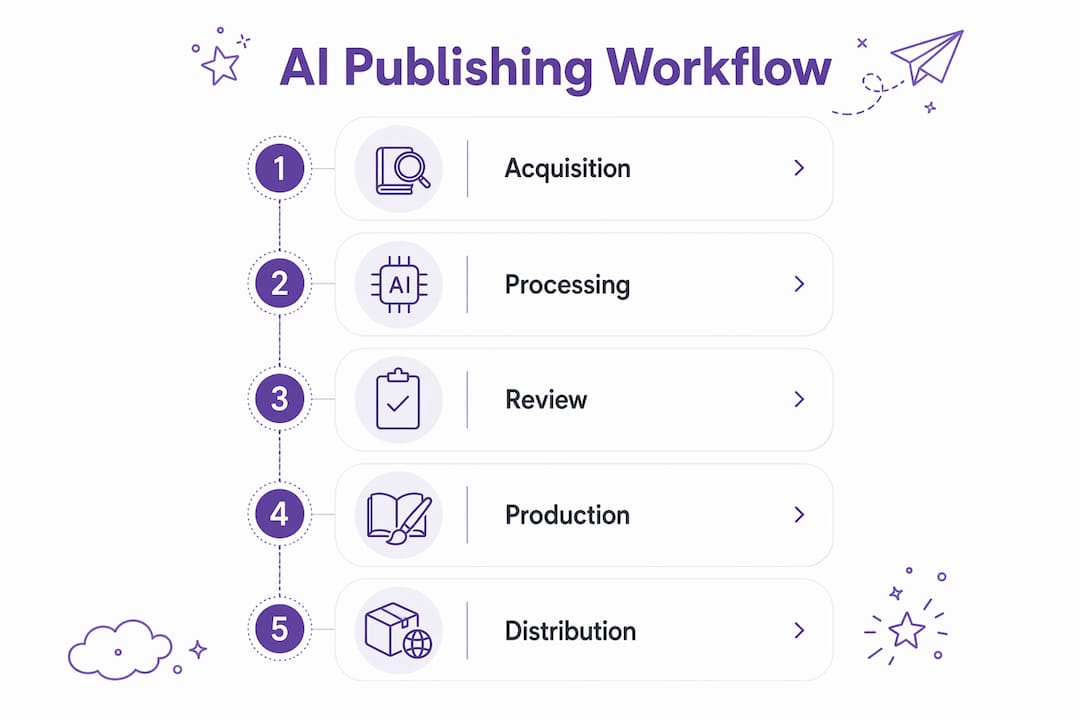
The role of AI technology in publishing now spans every stage, from ideation to distribution. For a personalized children's book, that looks like this in practice:
| Publishing stage | Typical AI task | Human review required? |
|---|---|---|
| Acquisition / intake | Photo processing, preference capture | Yes — privacy and consent check |
| Editorial | Story draft generation, age-appropriate language | Yes — safety and tone review |
| Production | Illustration generation, layout, PDF conversion | Yes — quality and spec check |
| Distribution | Metadata tagging, file delivery | Minimal, but QA on file specs |
| Marketing | Personalized copy, gift messaging | Optional |
AI can automate repetitive production tasks like EPUB conversion, heading tagging, and preliminary alt text — lowering the chance of manual errors while freeing human editors for the decisions that actually matter. The key word is assistive: AI recommends and generates; a human decides what ships to the customer.
Why AI matters specifically for personalized children's books
Generic picture books are fine. But a book where your child is the main character, drawn from their actual photo, with a plot built around their interests and age? That's a different product entirely, and AI is what makes it affordable and fast.
The most valuable AI applications are those that deepen reader connection rather than just increase volume. For children's books, that means:
- Hyper-personalization: plot, tone, and character appearance tailored to one specific child, not a generic stand-in
- Speed: a complete illustrated story generated in roughly five minutes, versus weeks for a commissioned illustrator
- Affordability: custom books that previously required bespoke illustration now cost a fraction of that
- Engagement: children who see themselves as the hero are more likely to ask for the book again
Research on personal narratives and children's development shows that stories centered on a child's own identity reinforce values and emotional connection in ways generic narratives don't. That's the real case for personalization, not novelty.
Pro Tip: Age-appropriate language matters as much as the illustration. Ask any vendor whether their AI adapts vocabulary and sentence complexity by age, or whether every book reads the same regardless of whether the child is three or eight.

A mass-produced book is perfectly fine for casual reading. Personalized books earn their place for gifts, milestone moments, or when you want a child to feel genuinely seen.
Quality, ethics, and safety concerns parents should check
With roughly 4 million U.S. titles published in 2025, a more than 32% increase from 2024, the sheer volume makes quality control a real differentiator. Not every AI-generated children's book has had a human editor check it for age-appropriate content, bias, or cultural sensitivity.
Top concerns to verify before you buy:
- Photo privacy: Where are uploaded photos stored? Are they deleted after generation?
- Data handling: Is processing done on secure servers? Is your child's likeness used for model training?
- Content safety: Does a human review the generated story for inappropriate content before delivery?
- Copyright: Are the illustration models trained on licensed or properly sourced data?
- Bias and representation: Does the service support diverse skin tones, hair types, and cultural contexts?
Publishers and academic bodies are increasingly requiring disclosure of AI use and clear IP protections. The same standard applies to children's book vendors. If a service can't tell you where your photos go, that's a problem.
Pro Tip: Ask the vendor directly: "Do you retain uploaded photos after the book is generated?" A trustworthy service answers this clearly and quickly. Vague or evasive responses are a genuine warning sign.
What a responsible human-plus-AI workflow looks like
A credible AI-personalized book service follows a clear process. According to Springer Nature's analysis of answerability in publishing, AI may assist but cannot be held accountable for published content. A human must always stand behind what ships to a customer.
"Editorial roles should remain answerable; AI may be a recommender but cannot hold authorship or answer for claims." — Springer Nature / Philosophy & Technology
What that responsible workflow looks like in practice:
- Secure photo intake with explicit privacy terms
- AI-assisted story and illustration draft
- Human editorial review for safety, age-appropriateness, and accuracy
- Final human sign-off before delivery
- Clear disclosure that AI was used in production
Adventuresofbook documents its privacy practices, offers a 7-day money-back guarantee, and generates each book from uploaded photos rather than stock character templates. That combination of speed and human-backed accountability is what the industry's best-practice guidance recommends. Look for vendor pages that name a real editorial or privacy contact, not just a generic FAQ.
Pro Tip: Check whether the vendor's privacy policy is dated and specific. A policy that says "we may share data with third parties" without naming them is a red flag for a service handling your child's photos.
How to choose an AI-personalized storybook service
Before you pay, run through this checklist:
- Privacy policy: Does it explain exactly how photos are stored, processed, and deleted?
- Human review: Is there any mention of editorial or safety review before delivery?
- Image handling: Are uploaded photos used only for your book, or for model training?
- Originality: Is the story generated fresh for your child, or is it a template with a name inserted? Check the difference between personalized and template books before deciding.
- Single-child support: Does the service support one child per book, or does it blur multiple children into one story?
- Sample pages: Can you preview the story or illustration style before purchasing?
- Print options: Is a print-ready PDF included, and what are the dimensions?
- Refund policy: Is there a clear, time-bound money-back guarantee?
Questions worth asking customer support directly:
- "Do you keep my child's photos after the book is generated?"
- "Can I preview the story before downloading or printing?"
- "How does your service handle diverse skin tones and hair types?"
Red flags: no privacy information, "personalized" claims that turn out to be name-swap templates, and no stated refund policy. AI-illustrated content safety is a real consideration, and reputable vendors address it openly.
What to expect: cost, timeline, and what you actually get
Plain-English expectations so you can compare fairly:
Typical cost and what's included:
- Adventuresofbook: $14.99 one-time, no subscription
- Includes 13 illustrated pages, 8.5x8.5 print-ready PDF
- Story and illustrations generated from your uploaded photos
- One child per book
Timeline:
- Upload photos and enter your child's details
- AI generates the story and illustrations: approximately 5 minutes
- Download the print-ready PDF immediately
- Order a printed copy if you want one; shipping times vary by printer and destination
- 7-day refund window if you're not satisfied
Deliverables to confirm with any vendor:
- Print-ready PDF with specified dimensions (8.5x8.5 for Adventuresofbook)
- Illustrations based on uploaded photos, not stock characters
- Single child per book (multi-child books are a different product category)
- Clear file format and resolution for home or professional printing
Some services offer printed hardcover or softcover upsells at checkout. That's a reasonable option for a gift, but the core digital PDF is what you're paying for at the base price.
Pro Tip: If you need a printed copy for a specific date, factor in shipping time separately from the generation time. The digital PDF is instant; the physical book is not. Custom book timelines vary by print partner.
Key Takeaways
AI enables faster, more personal children's books, but human oversight, privacy protections, and a clear refund policy are the signals that separate a trustworthy service from a cheap template.
| Point | Details |
|---|---|
| AI handles production, humans handle accountability | AI generates text and illustrations; a human must review for safety, age-appropriateness, and quality before delivery. |
| Market volume raises the stakes | Over 4 million U.S. titles were published in 2025, making quality signals more important than ever. |
| Personalization beats templates | Original stories built from a child's real photos and details drive stronger engagement than name-swap templates. |
| Know what you're paying for | Expect a print-ready PDF, ~5-minute generation, and a 7-day refund window from a reputable service. |
| Adventuresofbook fits this use case | $14.99 one-time, 13 illustrated pages, 8.5x8.5 PDF, original story and illustrations from uploaded photos, one child per book. |
A parent-to-parent perspective on AI-personalized books
The honest take: the technology is genuinely good now, and the concern isn't whether AI can produce a beautiful illustrated story about your kid. It can. The real question is whether the company behind it has put a human in the loop who cares about what your child reads and where your family's photos end up. Your kid deserves to be the actual hero of their book, not a placeholder in a story written for any child with a name dropped in. When you find a service that generates an original story from your child's real likeness, checks it for safety, and backs it with a clear refund policy, that's the one worth your $14.99.
Adventuresofbook: an original story starring your child
If you've read this far and want a book where your child is genuinely the hero, not a template character with their name pasted in, Adventuresofbook is built for exactly that. Upload a photo, share your child's name, age, and interests, and the AI generates an original story with illustrations that actually look like your kid. The whole process takes about five minutes.
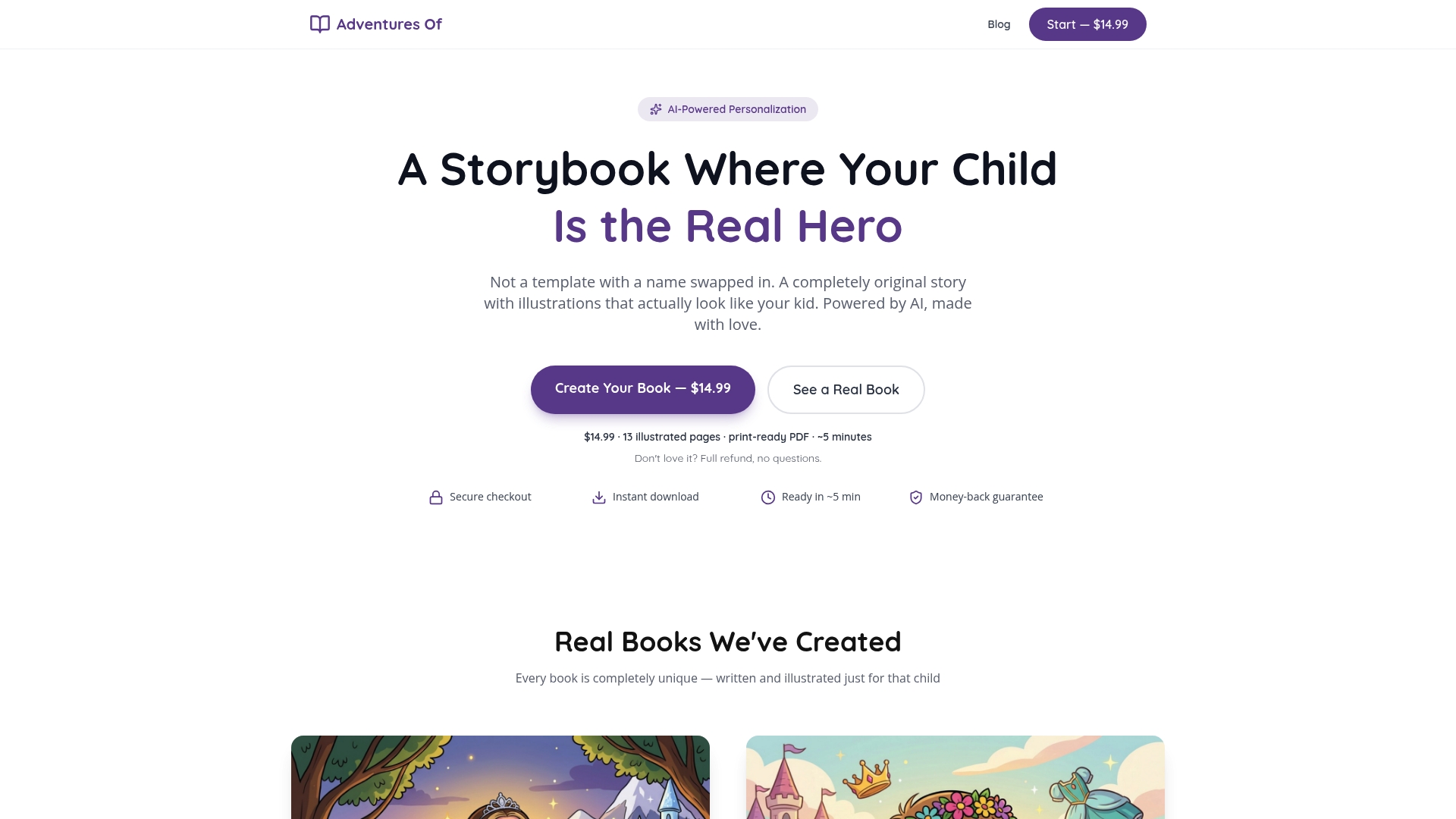
The specs are straightforward: $14.99 one-time, 13 illustrated pages, 8.5x8.5 print-ready PDF, one child per book, and a 7-day money-back guarantee. No subscription, no hidden fees. Privacy is documented, and the refund policy is real. Start your child's personalized book and have a print-ready PDF in your inbox before the end of the hour.
Useful sources for parents
- Publishers Weekly: Book output topped 4 million in 2025 — Industry data on U.S. book market volume and the scale of AI-assisted publishing.
- Springer Nature: AI and answerability in publishing — Policy analysis on why humans must remain accountable for AI-assisted content.
- PublishingState: How AI is redesigning the publishing workflow — Practical breakdown of where AI fits across the publishing lifecycle.
- FT Strategies: Where AI is really adding value in publishing — Industry commentary on hyper-personalization and human editorial judgment.
- Forbes: AI in publishing, a 2025 industry forecast — Predictions for interactive formats, workflow automation, and governance.
- knk Publishing Software: AI white paper — Vendor analysis of immediate AI use cases and human-in-loop recommendations.
- University of Illinois LibGuides: Generative AI and publishing — Library guide covering publisher AI policies and COPE authorship standards.
- NPR 1A: What AI-authored books mean for the publishing industry — Accessible overview of the ethical and market questions AI raises for authors and readers.
- Adventuresofbook library and product examples — Sample pages and product specs for parents evaluating the service.
FAQ
What does AI actually do in a personalized children's book?
AI generates the story text and character illustrations based on your child's uploaded photos and personal details. A human review step checks the output for safety and age-appropriateness before delivery.
How is a personalized book different from a template book?
A template book inserts a child's name into a fixed story written for any child. A truly personalized book, like those from Adventuresofbook, generates an original story and illustrations specific to one child from uploaded photos.
What should I check before buying an AI-personalized children's book?
Verify the privacy policy explains photo storage and deletion, confirm there is a human editorial review step, and check for a clear refund policy. No privacy information or vague data-sharing terms are the clearest red flags.
How long does it take to get an AI-personalized children's book?
The digital PDF typically generates in about five minutes. A printed copy requires additional shipping time, which varies by print partner and destination.
Is AI-generated content safe for children?
AI-generated content can be safe when a human reviews it for age-appropriateness and content safety before delivery. The key is choosing a vendor that documents that review step rather than delivering raw AI output directly to customers.