
Privacy-focused kids books are stories designed specifically to teach children about personal boundaries and digital safety in ways they can understand and act on. This genre, sometimes called privacy literacy literature in educational circles, covers everything from bodily autonomy to digital footprints. The best examples of privacy-focused kids books do not just warn children about danger. They give kids the language and confidence to set their own boundaries. With privacy multidimensional in children's literature, spanning physical space, personal data, and online behavior, the right book can plant seeds that grow into lifelong awareness.
1. Examples of privacy-focused kids books worth reading
The books below represent the strongest examples across age groups and privacy topics. Each one uses a different storytelling approach, but all share one quality: they put the child in control.
Mitzi and the Big Bad Nosy Wolf
This picture book uses a fairy-tale frame to teach digital citizenship. The wolf is not after grandma. He is after Mitzi's personal information. The humor keeps young readers engaged while the story delivers real lessons about what to share online and what to keep private. The back matter includes a glossary and a memory game, which means the learning continues after the last page. That interactive layer is what separates a good privacy book from a great one.
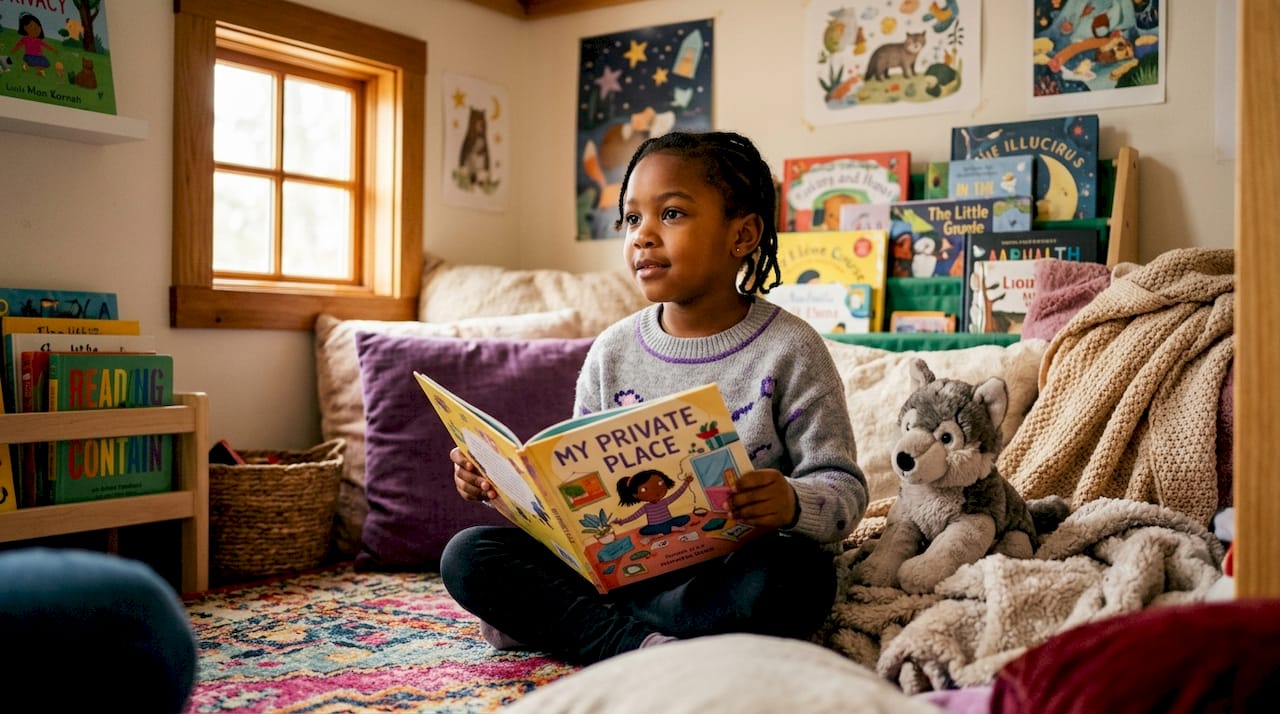
Privacy, Please!
Written by Carnegie Mellon CyLab director Lorrie Cranor, this 25-page illustrated book targets ages 4–6. It focuses on physical boundaries and simple privacy concepts rather than complex digital topics. Cranor wrote the book to fill a real gap in early childhood privacy literature. The relatable scenarios, like knocking before entering a room, give preschoolers a concrete framework they can use immediately.
Adventure in the AI Labyrinth
The Office of the Privacy Commissioner for Personal Data published this storybook specifically for primary school students. It uses a virtual-reality game narrative to cover AI, social media, cyberbullying, and data privacy in one story. Schools receive supporting learning materials alongside the book, making it a full classroom tool. This is the right choice for children ages 8 and up who are already using devices and social platforms.
The Eyemonger
This middle-grade title tackles surveillance and the feeling of being watched. It works well for children ages 8–12 who are ready to think critically about who collects their information and why. The story builds privacy awareness without turning into a lecture. It is one of the few books that addresses the emotional side of privacy, specifically the discomfort of feeling exposed.
My Body Belongs to Me
This short picture book focuses entirely on bodily autonomy for children ages 3–6. It teaches the concept of consent in simple, direct language. While it does not address digital privacy, it builds the emotional foundation that experts say children need before they can understand data privacy. Think of it as the first chapter in a longer privacy education.
Chicken Clicking
This British picture book follows a chicken who shops online unsupervised. The story is funny, but the message is clear: sharing information online has real consequences. It works well for ages 5–8 and sparks natural conversations about what happens to information once it leaves your hands.
Own Your Online
Aimed at ages 8–12, this book covers digital footprints, passwords, and social media in a practical, non-preachy tone. It reads more like a guide than a story, which suits older children who want facts over fables. It pairs well with any of the narrative books above as a follow-up resource.
Pro Tip: When choosing between these titles, check the back matter first. A book with a discussion guide or role-playing activity gives you a ready-made conversation starter for after reading.
2. How privacy concepts in kids books address physical and digital boundaries
Privacy education works best when it builds in sequence. Direct instruction on complex digital privacy often fails with preschoolers because they lack the emotional framework to process it. Physical boundaries come first.
Here is how the sequence works in practice:
- Personal space and bodily autonomy. Books like My Body Belongs to Me teach children that their body is their own. This concept of consent is the root of all privacy thinking.
- Property and personal belongings. Children learn that their diary, their room, and their belongings are private. This is the bridge between physical and informational privacy.
- Information about themselves. Children begin to understand that their name, address, and photo are personal data. Books like Privacy, Please! introduce this idea gently.
- Digital footprints. Older children learn that every click, photo, and message leaves a trace. Own Your Online and Chicken Clicking cover this well.
- AI and social media. At ages 8 and up, children can engage with concepts like data collection, algorithmic behavior, and cyberbullying. Adventure in the AI Labyrinth is built for this stage.
The eSafety Commissioner recommends prompting children to think about who can access their information and how they feel about sharing photos. That kind of reflective question works at every stage of the sequence above. You can ask it after reading any of the books on this list.
3. Features to look for in privacy-focused kids books
Not every book with "privacy" in the title is worth your time. The best privacy-themed books for children share a specific set of features that make the lessons stick.
| Feature | Why it matters |
|---|---|
| Discussion guide | Gives parents ready-made questions to extend the conversation |
| Role-playing activities | Children practice boundary-setting in a safe, low-stakes way |
| Glossary | Defines terms like "digital footprint" in child-friendly language |
| Relatable characters | Children identify with the protagonist and absorb lessons more naturally |
| Empowerment tone | Builds confidence rather than fear around privacy topics |
The tone distinction in that last row is the most important one. Effective privacy books encourage boundary-setting and personal agency, not just caution against strangers or technology. A book that leaves your child scared of the internet has failed. A book that leaves your child confident about what to share and what to keep private has succeeded.
Interactive back matter like discussion guides and role-playing activities transforms a single reading session into a family-wide privacy conversation. Creators of books like Adventure in the AI Labyrinth cite these tools as more impactful than the story text alone.
Pro Tip: After reading, try the door-tag activity from some privacy books: your child decorates a "do not disturb" sign for their room. It is a physical reminder of the concept and a conversation piece for days afterward.
You can also check out the gift guide for bookish kids on the Adventuresofbook blog for more curated picks that pair well with privacy-focused reading.
4. Matching privacy books to your child's developmental stage
The right book at the wrong age does not land. Here is a practical breakdown by stage:
- Ages 3–5 (toddlers and preschoolers). Start with bodily autonomy. My Body Belongs to Me and Privacy, Please! are the right fit. Keep conversations short and tied to daily routines like bath time and bedtime.
- Ages 5–7 (early elementary). Introduce the idea that information is personal. Mitzi and the Big Bad Nosy Wolf and Chicken Clicking work well here. Children this age respond to humor and animal characters.
- Ages 7–9 (mid-elementary). Children are likely using devices. The Eyemonger and Chicken Clicking help them connect the physical privacy concepts they already know to their online behavior.
- Ages 9–12 (preteen). This is the stage for digital footprints, social media, and AI. Adventure in the AI Labyrinth and Own Your Online are built for this group. Discussions can go deeper and include real examples from their own screen time.
Parents should not wait for tech books to start privacy conversations. Physical boundary books at age three build the critical thinking that makes digital privacy lessons land at age nine. The sequence matters more than the speed.
If you are curious about how AI fits into children's storytelling more broadly, the Adventuresofbook post on AI-illustrated content for kids covers that question directly.
Key takeaways
Privacy-focused children's books work best when they build from physical boundaries first and progress to digital concepts as children grow, using empowerment rather than fear as the core message.
| Point | Details |
|---|---|
| Sequence matters | Start with bodily autonomy books at ages 3–5 before introducing digital privacy titles. |
| Back matter is the real tool | Discussion guides and role-playing activities extend learning far beyond the story itself. |
| Tone determines impact | Books that build child agency outperform fear-based safety warnings every time. |
| Age-matching is non-negotiable | A book aimed at age 10 will not connect with a five-year-old, no matter how good the content is. |
| Physical privacy precedes digital | Children need the emotional framework of personal boundaries before they can process data privacy concepts. |
Why I think most parents start this conversation too late
Most parents I talk to assume privacy education starts when their child gets a phone. That is about five years too late. By the time a child is nine and online, the foundational thinking about what is mine, what is private, and who gets to know what should already be in place. Books are the most natural way to build that foundation because they do not feel like a lecture.
What I find genuinely surprising is how few parents know that a Carnegie Mellon cybersecurity researcher wrote a picture book specifically because that gap existed. Lorrie Cranor did not write Privacy, Please! as an academic exercise. She wrote it because she could not find a book that taught her own young children what privacy actually means at a concrete, physical level.
The other thing worth saying: children who grow up with a clear sense of their own boundaries, physical and informational, are harder to manipulate online. That is not a small thing. Privacy literacy is a form of self-defense, and it starts with a picture book about knocking before you enter a room.
The books on this list are not perfect. Some are harder to find than others, and a few are better suited to classroom use than bedtime reading. But every one of them gives children a vocabulary for something they would otherwise have no words for. That vocabulary is worth more than any parental controls app.
— Jason
A personalized story can make privacy lessons personal
Privacy lessons land harder when a child sees themselves in the story. That is the idea behind Adventuresofbook's personalized storybooks, where your child is the actual protagonist, illustrated from real photos you upload.
Each book is an original story, not a template with a name swapped in. The AI generates a unique narrative and illustrations that look like your child, delivered as a print-ready 8.5x8.5 PDF in about five minutes for $14.99. A story where your child makes smart choices about their information hits differently than one starring a generic character. If you want to pair a privacy conversation with a book your child will actually want to read again, create their book here.
FAQ
What age should kids start learning about privacy?
Privacy education starts at ages 3–5 with physical boundary concepts like bodily autonomy and personal space. Digital privacy concepts build on that foundation from around age seven onward.
What makes a privacy book effective for young children?
The most effective books use relatable characters, simple language, and an empowerment tone rather than fear. Interactive back matter like discussion guides and role-playing activities significantly increases the practical impact.
Are there privacy books specifically about digital safety?
Yes. Adventure in the AI Labyrinth, published by the Office of the Privacy Commissioner for Personal Data, covers AI, social media, and cyberbullying for children ages 8 and up. Own Your Online covers digital footprints and passwords for the same age group.
How do I use a privacy book as a conversation starter?
Read the book together, then ask the eSafety Commissioner's recommended question: "Who do you think can see this information, and how does that make you feel?" That single question opens most of the important conversations.
Do privacy books replace parental controls?
No. Privacy books build the judgment and confidence children need to make good decisions on their own. Parental controls manage access. Books build the thinking that matters when controls are not present.