Print-quality children's fiction is defined as children's storytelling that meets professional-grade illustration standards, precise print formatting requirements, and strict safety compliance to produce books that are visually engaging, durable, and safe for young readers. The term "print-quality" is not a formal publishing industry label. Publishers and printers use the phrase "print-ready" to describe files and books that meet production standards. Understanding what defines children's fiction at this level helps parents, educators, and caregivers choose books that genuinely support imagination and reading development, rather than settling for titles that look fine on screen but disappoint in hand.
What is print-quality children's fiction, and why does it matter?
Print-quality children's fiction combines three things: technically correct print files, age-appropriate illustration and story balance, and materials that hold up to how kids actually use books. A book can have a wonderful story and still fail as a physical object if the illustrations are blurry, the colors look muddy, or the binding falls apart after three reads. The standard that separates a truly well-made children's book from a mediocre one is measurable, not subjective.
Professional illustration quality is the number one success factor for children's fiction. Visual shelf presence drives purchase decisions more than any other single element. That finding matters because it shifts the focus away from story alone and toward the full physical package.
Parents and educators evaluating children's books should look at resolution, color accuracy, paper weight, binding, and safety certification. Each of those factors has a specific standard attached to it.
What technical print standards define children's fiction quality?
The technical floor for print-ready kids books starts with image resolution. Interior images require a minimum of 300 DPI resolution, using CMYK color space, saved in high-quality PDF or TIFF formats. Anything below 300 DPI produces visible pixelation when printed, especially in full-color illustration spreads.
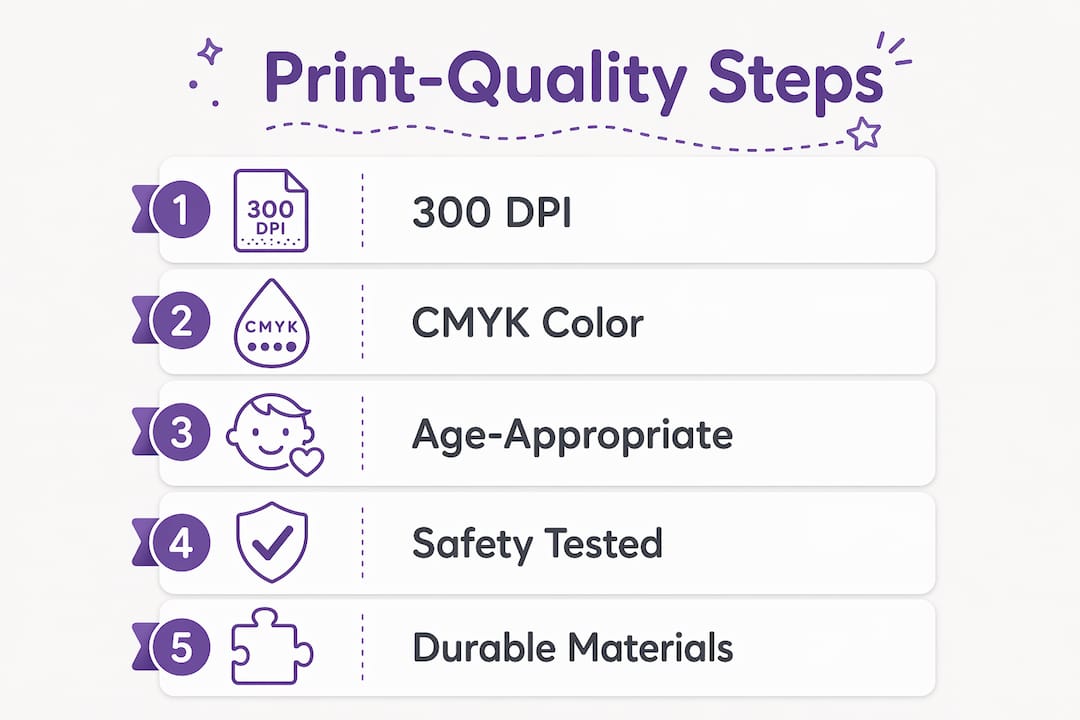
Color space is where many self-published books go wrong. Screens display color in RGB, but printing presses use CMYK. Converting RGB images to CMYK at the last minute causes significant color shifts. Blues can turn purple. Bright yellows go flat. Designing in CMYK from the start, or using a color-managed workflow throughout, prevents this problem entirely.
File format matters just as much. Exporting illustrations as JPEGs risks compression artifacts that are invisible on screen but obvious in print. Lossless formats like PDF or TIFF preserve every detail of the original illustration.
Key technical requirements for print-ready children's books:
- Minimum 300 DPI image resolution for all interior illustrations and cover art
- CMYK color space used throughout the design workflow, not just at export
- PDF or TIFF file formats to avoid compression artifacts
- Bleed and margin settings that match the printer's specifications to prevent white borders or cropped art
- Professional prepress checks including a physical proof before the full print run
Pro Tip: Request a physical proof copy before approving any print run. Color on a monitor and color on paper are never identical, and a proof is the only way to catch problems before they multiply across hundreds of copies.
A formal quality control process that includes physical proofs, color checks, and durability tests is the standard for books that reach retail shelves. Self-published authors and small presses that skip this step often discover problems only after the books are in hand.
How do age and illustration balance shape a quality children's book?
The right ratio of illustration to text depends entirely on the reader's age. Picture books for ages 3–8 require 15–17 full-color illustration spreads, while chapter books for ages 8–12 typically use black-and-white interiors. That shift in illustration intensity reduces printing costs significantly for older-reader titles.
This distinction has real consequences for production planning. A full-color picture book costs far more to print per unit than a chapter book with spot illustrations. The illustration investment in a picture book is not optional. Children in the 3–8 age range process story primarily through images, not text. Cutting illustration quality to save money produces a book that fails its audience.
| Feature | Picture books (ages 3–8) | Chapter books (ages 8–12) |
|---|---|---|
| Illustration style | Full-color spreads | Black-and-white interiors |
| Illustration count | 15–17 spreads | Occasional spot art |
| Print cost per unit | Higher | Significantly lower |
| Text density | Low | High |
| Paper weight | Heavier stock | Standard text weight |
Layout and pacing also differ by age. Picture books use large type, generous white space, and illustrations that carry the narrative. Chapter books rely on text pacing, with illustrations serving as accent points rather than story drivers. A book that gets this balance wrong reads as mismatched, regardless of how good the individual elements are.
What safety standards must print-quality children's fiction meet?
Safety compliance is not optional for children's books sold in the United States. All children's books must comply with CPSIA standards, which require lead levels below 90–100 ppm. Books for children under 12 fall under these regulations, and the requirements apply to inks, coatings, and materials, not just physical components.
The Children's Product Certificate (CPC) is mandatory for the US market. It documents compliance with CPSIA and provides evidence for customs clearance and recall avoidance. A book without a CPC cannot legally be sold through major US retail channels.
Safety requirements for children's books include:
- Lead content limits below 90–100 ppm across all materials, including inks and coatings
- Children's Product Certificate (CPC) documenting third-party testing and CPSIA compliance
- Non-toxic inks throughout, with no harmful solvents or heavy metals
- FSC-certified paper or equivalent sustainable sourcing, which also supports non-toxic material chains
- Choking hazard considerations for books with attached elements targeting ages 0–3
Non-toxic inks and FSC-certified paper support both child health and environmental responsibility. These are not marketing claims. They are production decisions that affect which printers a publisher can work with and which retailers will carry the book.
Safety compliance requires third-party testing and documentation to prevent recalls or customs seizure. This is a point many first-time publishers miss. Internal checks are not sufficient. The CPC must be backed by a certified third-party lab.
How do materials and production choices affect durability?
The physical materials in a children's book determine how long it survives actual use. Coated stock paper like 100lb gloss text enhances color vibrancy for illustration-heavy pages. Matte finishes reduce glare and work well for text-heavy pages or older readers. Neither is wrong. The choice depends on the book's audience and illustration style.
Binding is where durability lives or dies. Case binding, the method used in hardcover books, is the standard for picture books because it withstands repeated handling by young children. Perfect binding, common in paperbacks, works for chapter books but is less suited to board books or heavily illustrated titles that get opened flat repeatedly.
Wrong binding, paper weight, or skipping a physical proof leads to expensive printing failures even when the manuscript is strong. A book with beautiful illustrations printed on paper that is too thin will show bleed-through. A book with perfect binding that gets opened flat will crack at the spine within weeks.
Pro Tip: When printing a book at home or through a local print shop, always request a sample page on your chosen paper stock before committing to the full print run. Color and weight feel very different in person than they look in a spec sheet.
Quality control for children's books includes functional tests, smell tests, and durability tests alongside visual checks. The smell test catches solvent-heavy inks that are technically within legal limits but unpleasant or potentially irritating for young children. These tests are standard practice at professional printers and should be requested by anyone producing books independently.
Key Takeaways
Print-quality children's fiction requires 300 DPI resolution, CMYK color management, age-matched illustration balance, durable materials, and CPSIA safety compliance to produce books that engage young readers and hold up to real use.
| Point | Details |
|---|---|
| Resolution and color space | Use 300 DPI minimum and design in CMYK from the start to avoid color shifts at print. |
| File format matters | Save illustrations as PDF or TIFF, not JPEG, to prevent compression artifacts in print. |
| Age-matched illustration | Picture books need 15–17 full-color spreads; chapter books use black-and-white interiors. |
| Safety compliance | CPSIA compliance and a Children's Product Certificate are legally required for US market sales. |
| Material and binding choices | Use 100lb gloss or matte stock and case binding for picture books to maximize durability. |
What I've learned from looking at a lot of children's books
The thing that surprises most parents when they start paying attention to book quality is how quickly they can feel the difference. Pick up a well-made picture book and a cheap one. The paper weight, the way the cover sits, the color saturation on the illustrations. You notice it in about ten seconds.
What I've found is that illustration quality is the factor most parents underestimate before they start looking, and the one they care most about once they do. A story can be charming and forgettable. An illustration can stop a child mid-page and pull them back in every time. The books that get read 200 times in a household are almost always the ones where the art is doing real work.
The self-published children's book space has a real quality gap. Many titles have genuinely good stories and genuinely poor production. The authors skipped the physical proof, used RGB files, chose the cheapest binding option, and ended up with a book that looks fine as a thumbnail and disappointing in hand. That gap is avoidable, but only if you know what to look for before you commit to a printer.
For parents choosing books rather than producing them, the practical test is simple. Open the book flat. Look at the illustration color against a white wall. Check whether the spine cracks. Flip to the middle and see whether the paper is thick enough that you cannot read the text from the other side. Those four checks tell you most of what you need to know about production quality.
The personalized book category is interesting here. Template-based personalized books, where a name gets swapped into a pre-drawn character, often have decent print quality because they are produced at scale. But the illustration has nothing to do with your child. The story is the same story every child gets. That is a different product than a book where the illustrations actually look like your kid and the story was written for them specifically.
— Jason
Adventuresofbook makes print-ready personalized books that actually look like your child
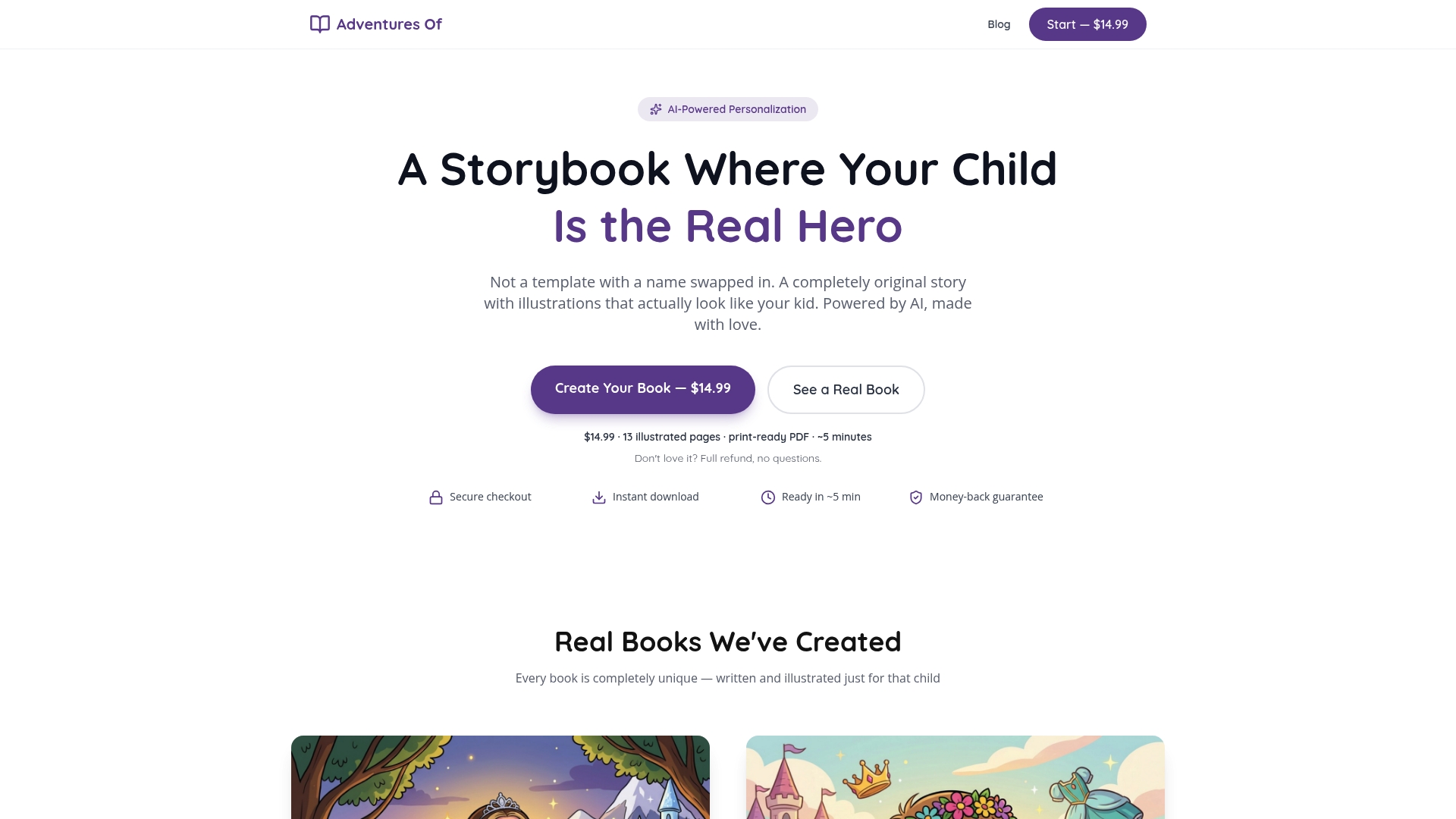
Adventuresofbook creates personalized children's storybooks where the illustrations are generated from your child's actual photos, not a generic template character with a name swapped in. Each book includes 13 illustrated pages in an 8.5x8.5 inch print-ready PDF, built to the technical standards covered in this article: proper resolution, color-accurate files, and a format ready for home printing or a local print shop. The entire process takes about five minutes, costs $14.99, and comes with a 7-day refund policy. If you want a book where your child is genuinely the main character, start creating here.
FAQ
What does "print-quality" mean for a children's book?
Print-quality means the book's files meet minimum technical standards: 300 DPI image resolution, CMYK color space, and lossless file formats like PDF or TIFF. It also covers physical standards like paper weight, binding type, and safety compliance.
What is the minimum image resolution for children's book illustrations?
The minimum is 300 DPI for all interior and cover illustrations. Images below this threshold produce visible pixelation when printed, particularly in full-color picture book spreads.
Do children's books need safety certification to be sold in the US?
Yes. All children's books sold in the US must comply with CPSIA standards, including lead limits below 90–100 ppm, and must have a Children's Product Certificate (CPC) backed by third-party testing.
What paper and binding work best for picture books?
100lb gloss text paper enhances color vibrancy for illustration-heavy pages, and case binding provides the durability picture books need for repeated handling by young children.
How do I evaluate a children's book's print quality before buying?
Open the book flat and check whether the spine cracks. Look at illustration color saturation and check whether text bleeds through the page from the other side. These physical checks reveal production quality faster than any spec sheet.