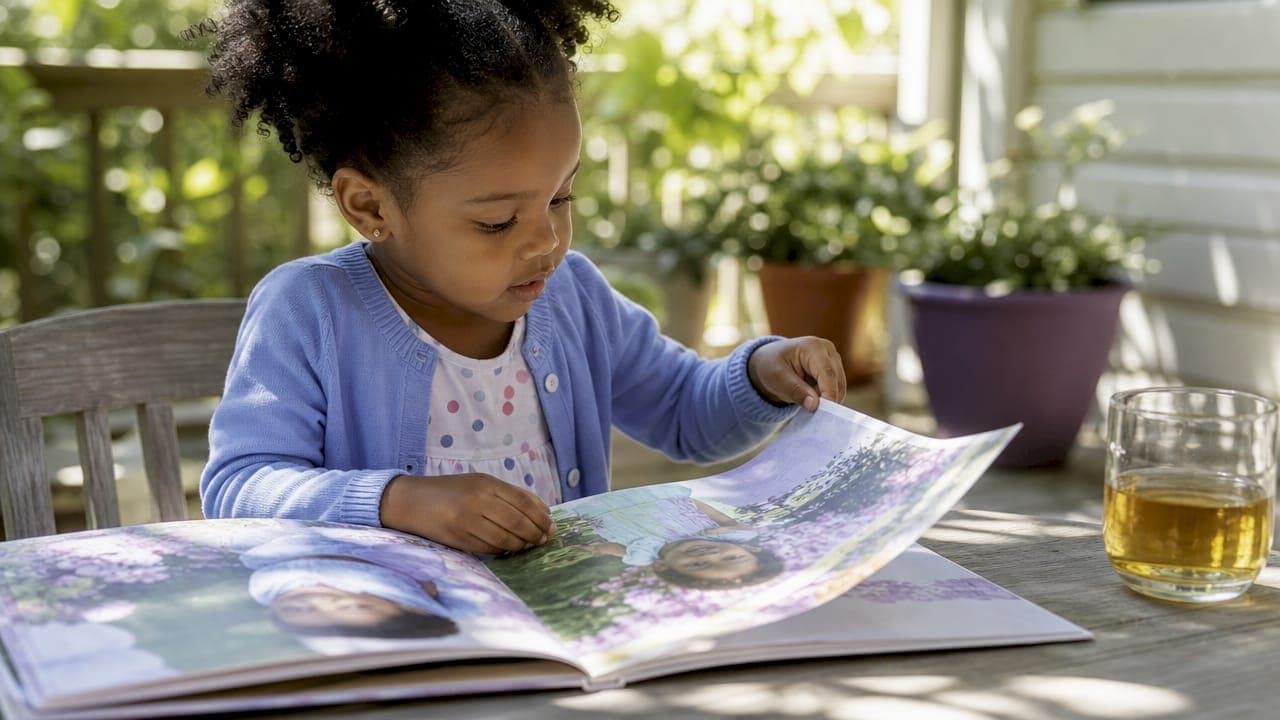
Photo-based personalization is defined as the process of combining your own photos with AI to generate customized images, stories, and illustrations that reflect a specific person's real appearance. This technology sits at the center of a growing category of products, from AI profile generators to personalized children's storybooks. Understanding how photo-based personalization works helps you make smarter choices about which products actually deliver on the promise of putting your child in the story, not just their name. Adventuresofbook uses this exact approach to create original storybooks where the illustrations genuinely look like your kid.
How does photo-based personalization work at the AI level?
Photo-based personalization works by feeding your uploaded images into an AI system that analyzes visual features and uses them as a reference point for generating new content. The industry term for this is image-conditioned generation, though you will also hear it called visual personalization or photo-driven generation. The core mechanism has two parts: understanding what is in your photos, and using that understanding to guide what gets created.
Modern systems use a technique called semantic retrieval. The AI scans your photo library, identifies key subjects (a child's face, hair color, skin tone, expression range), and labels them automatically. Google's Gemini app, for example, uses what it calls Personal Intelligence to analyze and label photos of family members for guided generation. That labeling becomes the context the AI draws on when it builds new images.
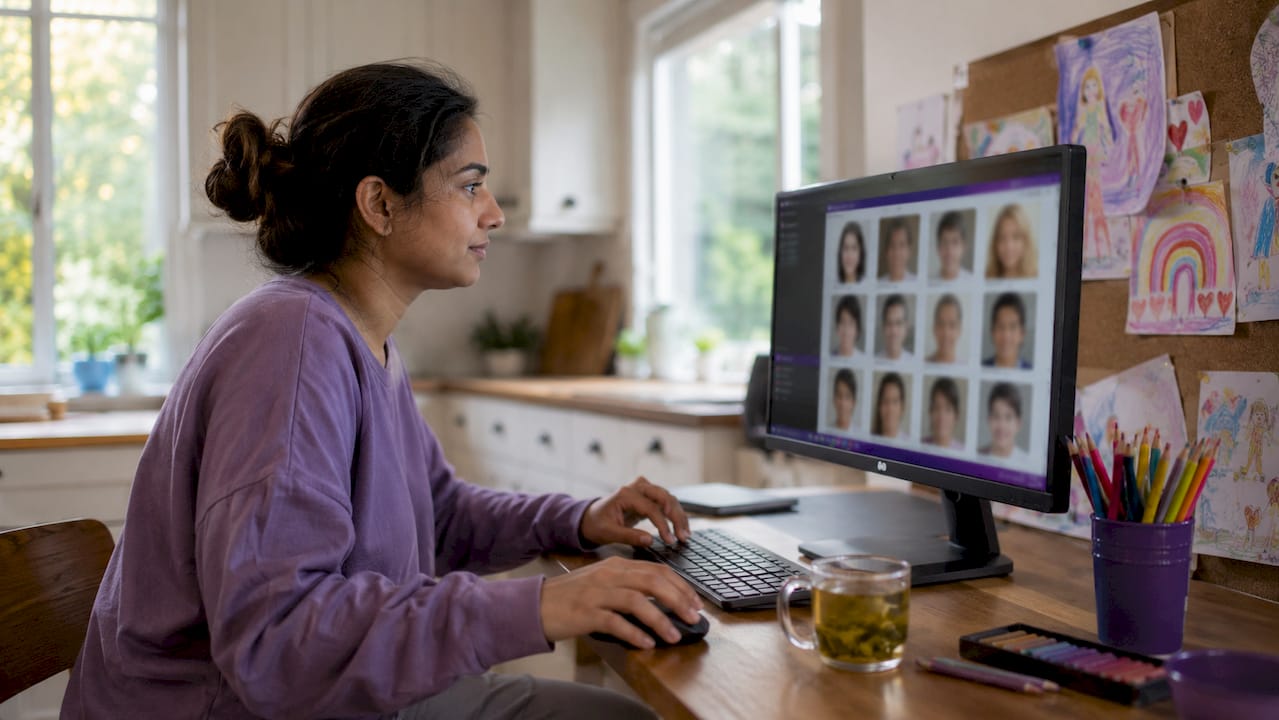
A critical distinction: most consumer systems do not retrain the AI model on your photos in real time. Model weights stay static while your photos act as context, not training data. This protects your privacy and keeps the system stable. Your images guide the output without becoming part of the model itself.
Fine-tuning methods that preserve identity
For products that require tighter identity consistency, developers use fine-tuning techniques. The two most common are DreamBooth and LoRA (Low-Rank Adaptation). DreamBooth and LoRA preserve identity across different scenes far better than simple face-swapping by learning the subject's features realistically, including consistent lighting, shadows, and perspective.
LoRA creates small adapter modules that attach to the base model without retraining it from scratch. DreamBooth does a deeper fine-tune but carries a higher risk of overfitting, meaning the model can become too locked to one look. For speed and flexibility, LoRA is generally preferred in commercial applications.
Pro Tip: Upload photos that show your child from multiple angles and in different lighting conditions. A mix of close-up face shots and wider contextual images gives the AI more visual anchors to work with, which produces more consistent results.
How photo personalization affects choices and product decisions
Visual personalization changes how people make decisions, and the effect is measurable. 87% of initial selection decisions are based solely on primary photographs, with first photos carrying ten times more influence than text descriptions. Applied to personalized products, this means a child seeing their own face in a book illustration responds with immediate recognition and engagement, not the mild interest a generic character produces.
Personalized recommendation systems reduce trial-and-error by filtering low-fit options early. In the context of custom children's books, this means parents spend less time second-guessing whether the final product will actually look like their child. The AI does the matching work upfront.
Personalization shifts consumer decision-making from trial-and-error to precision matching, which increases confidence and loyalty. Parents who receive a book where the illustrations genuinely resemble their child are far more likely to order again or recommend the product. The emotional payoff is direct and concrete.
| Effect | What it means for parents |
|---|---|
| Faster decisions | AI filtering removes poor-fit options before you see them |
| Higher confidence | Seeing your child's likeness reduces purchase doubt |
| Lower return rates | Products match expectations set during the creation process |
| Stronger engagement | Children respond more actively to characters who look like them |
Practical applications in digital storytelling and children's books
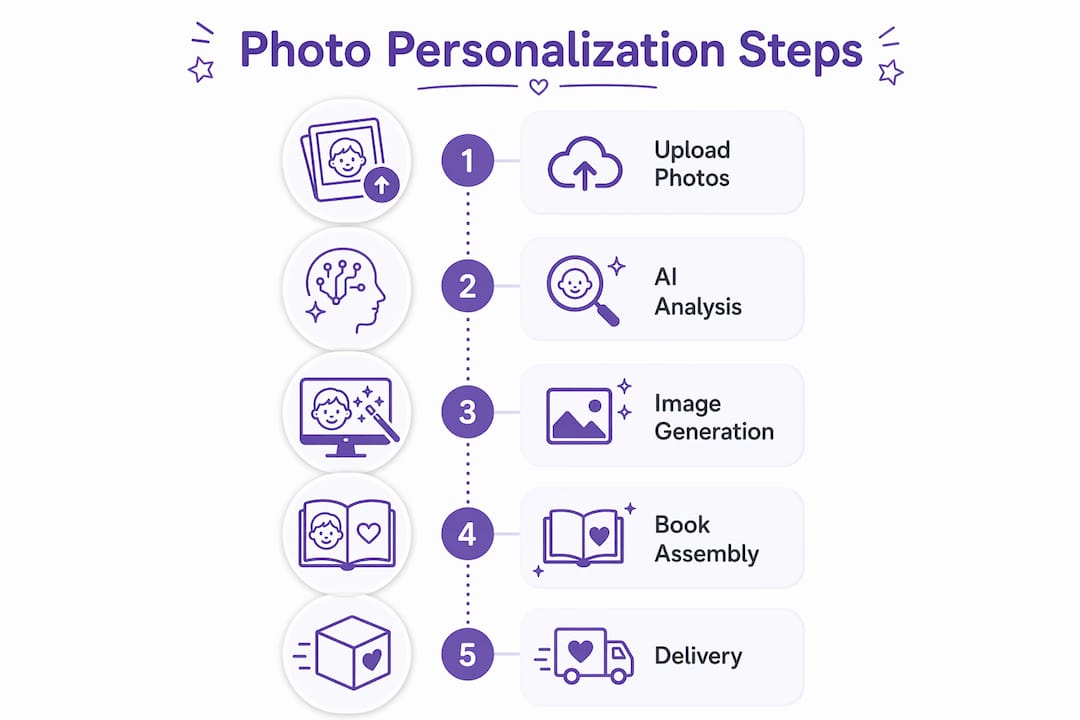
The workflow for a photo-based personalized children's book follows a clear sequence. Adventuresofbook's process is a good example of how the technology translates from AI research into a product parents can actually use.
Here is how the creation process works:
- Upload a photo. You submit a clear photo of your child. The AI analyzes facial features, skin tone, hair, and general appearance.
- Enter personal details. You add the child's name, age, and any relevant interests or story preferences.
- AI generates the story and illustrations. The system writes an original narrative and produces illustrated pages where the character looks like your child. This takes roughly five minutes.
- Review and download. You receive a print-ready 8.5x8.5 PDF with 13 illustrated pages. You can print it at home or through a print service.
The speed is worth noting. Five minutes from photo upload to a personalized children's book is not typical of handmade or template-based products. The AI handles both the writing and the illustration simultaneously, which is what makes that turnaround possible.
Users also retain control over the output. Selecting different reference photos adjusts the AI's visual reference point, which changes how the character looks in the final illustrations. If the first result does not capture your child's likeness well, changing the input photo is the most direct fix.
Privacy matters here too. Adventuresofbook does not use uploaded photos to train its models or share them with third parties. The photo serves as a generation reference, not a data asset.
Pro Tip: For the clearest likeness, use a recent photo taken in natural light with the child's face fully visible. Avoid sunglasses, heavy shadows, or photos where the face is partially obscured.
What separates high-quality results from mediocre ones?
Maintaining identity consistency across customized images is the core challenge in photo-based personalization. Simple face-swapping tools paste a face onto a pre-built image. Fine-tuned models actually learn the subject's features and apply them across new scenes, lighting conditions, and poses.
Balanced visual composition using both holistic and detailed images enables AI to generate more accurate and consistent personalized results. A wide-angle photo gives the AI context about body proportions and general appearance. A close-up gives it detail about facial features. Using only one type produces weaker results.
The comparison between LoRA and DreamBooth is useful for understanding why some products deliver better consistency than others:
| Approach | How it works | Best for | Risk |
|---|---|---|---|
| LoRA | Small adapter modules on base model | Speed, flexibility, commercial use | Slightly less depth than DreamBooth |
| DreamBooth | Deep fine-tune of the full model | Maximum identity fidelity | Overfitting to limited photo sets |
Lighting and perspective in the source photos directly affect output quality. A photo taken in harsh direct light flattens facial features, giving the AI less to work with. Soft, even lighting from the front produces the richest feature data. Perspective matters too. A photo taken from below distorts proportions in ways the AI has to compensate for, sometimes imperfectly.
The difference between a book where the character looks vaguely like your child and one where friends immediately recognize the likeness comes down to these input variables. The AI is only as good as the visual information you give it.
Key Takeaways
Photo-based personalization produces the best results when high-quality photos meet well-chosen AI fine-tuning methods, making the child's likeness the actual foundation of the story.
| Point | Details |
|---|---|
| Core mechanism | AI uses your photos as context to guide image generation, not as training data. |
| Identity preservation | Fine-tuned models like LoRA maintain consistent likeness across scenes better than face-swapping. |
| Photo quality matters | Balanced inputs combining wide-angle and close-up shots produce more accurate results. |
| Behavioral impact | Seeing a real likeness increases child engagement and parent confidence in the product. |
| Privacy safeguard | Reputable systems keep model weights static, so your photos guide output without entering the model. |
Why I think most parents underestimate what "personalized" actually means
Most parents assume personalized means the child's name appears in the text. That is template personalization, and it is a fundamentally different product from what photo-based AI generation produces. I have watched parents open a template-based book and smile politely. I have watched a different parent open a book where the illustrated character has their daughter's exact curly hair and gap-toothed grin, and the reaction is completely different.
The technology behind that second reaction is not magic. It is a well-understood pipeline: photo analysis, semantic feature extraction, identity-conditioned generation. But the emotional result lands differently because the child sees themselves, not a stand-in. That recognition is what drives the engagement researchers keep documenting.
The part most people get wrong is thinking the AI does all the work regardless of input. It does not. The photo you upload is the single biggest variable in the output quality. A blurry, backlit photo from three years ago will produce a weaker likeness than a clear, recent shot taken in good light. The AI is skilled, but it cannot invent detail that is not in the source image.
My honest advice: treat the photo selection as part of the creative process, not a checkbox. Pick a photo where your child looks like themselves, not their best-dressed self for a school portrait. Natural, relaxed, well-lit photos give the AI the most to work with. The result will show it.
— Jason
Adventuresofbook puts your child in the actual story
Adventuresofbook creates original children's storybooks where the illustrations are generated from your child's real photo, not a template character with a name swapped in. Each book is 13 illustrated pages, formatted as an 8.5x8.5 print-ready PDF, and costs $14.99 as a one-time purchase. The entire process takes about five minutes from photo upload to download.

Every story is written and illustrated specifically for one child. There are no shared templates, no generic heroes, and no recycled plots. If you want to see what your child looks like as the star of their own adventure, create your book and have it ready to download in minutes. A 7-day refund policy covers every order.
FAQ
What is photo-based personalization?
Photo-based personalization is the process of using uploaded personal photos as input for AI systems that generate customized images or stories. The AI analyzes visual features from the photos and uses them to guide what it creates.
How does the AI keep my child's likeness consistent across pages?
Fine-tuned models like LoRA learn a subject's specific features and apply them across different scenes and poses. This produces consistent lighting, proportions, and facial features throughout the book rather than a one-time face match.
Are my uploaded photos used to train the AI?
Reputable systems keep model weights static and use your photos only as context for generation. Your photos guide the output without becoming part of the AI model or being shared externally.
How does photo personalization affect how children engage with books?
Children respond more actively to characters who look like them. Research shows that visual recognition drives immediate engagement, which is why photo-based illustrations produce a stronger reaction than name-only personalization.
What makes a good photo for AI personalization?
A clear, recent photo taken in natural light with the child's face fully visible produces the best results. Diverse photo inputs that combine wide-angle and close-up shots give the AI more visual data to work with, improving likeness accuracy.