
Most parents assume technology and bedtime stories are a bad mix. Screens before sleep, short attention spans, passive watching instead of active imagining. But what if the technology itself could make your child the hero of a one-of-a-kind story, with illustrations that actually look like them? That is exactly what AI-powered storybook personalization does. It does not replace the magic of reading together. It adds a whole new layer to it. This article walks you through what personalization really means in 2026, how the technology works, and why it is changing the way families connect over books.
Table of Contents
- What is storybook personalization? The basics for 2026
- How AI creates personalized adventures for kids
- Comparing personalized and template books: What's the difference?
- Safety, age-appropriateness, and ethics in AI-powered storybooks
- The real magic: What storybook personalization can unlock for your family
- Bring your child's imagination to life with personalized storybooks
- Frequently asked questions
Key Takeaways
| Point | Details |
|---|---|
| AI-driven personalization | Advanced AI creates stories uniquely tailored to your child's face, language, and interests. |
| Enhanced engagement | Personalized visuals and narratives increase kids' excitement and connection to storytime. |
| Robust safety | Content moderation and privacy tools protect children and ensure appropriateness. |
| Easy customization | Parents can review, edit, and add personal touches to stories, audio, and print formats. |
| Inspiring creativity | Storybook personalization fosters imagination and family bonding in new ways. |
What is storybook personalization? The basics for 2026
Having introduced the topic, let us get clear on what storybook personalization actually means today. Because the term gets used loosely, and there is a big difference between the old version and the new one.
The original version of a "personalized" children's book was pretty simple. A company took a generic story, swapped in your child's name, maybe their hometown, and printed it out. The illustrations still showed a generic character. The plot was the same for every kid who ordered it. That approach is a template book. It is not bad, but it is limited. You can learn more about the key personalized vs. template books differences if you want a side-by-side breakdown.
Today, personalization means something much richer. Here is what a modern AI-powered personalized storybook can actually include:
- A child's likeness rendered in illustrations, based on real photos you upload
- Custom names, ages, and personality traits woven into the narrative
- Original storylines generated specifically for your child, not recycled plots
- Age-appropriate language matched to your child's reading level
- Multiple delivery options, including digital downloads, audio versions, and print-ready files
The technology behind this is genuinely sophisticated. AI-powered storytelling trends in 2026 show a clear shift toward this kind of deep personalization. According to current research, text and image generation in personalized storybooks works through specialized large language models (LLMs) for narrative and fine-tuned image generation models trained from eight or more photos. These models analyze facial features to create consistent depictions across different scenes, styles, and even languages.
"The shift from name-swap books to AI-generated stories with custom illustrations is not just a technical upgrade. It is a fundamentally different product that treats your child as the creative center of the story."
That distinction matters. When your child sees a character who genuinely resembles them, the emotional connection to the story is completely different.
How AI creates personalized adventures for kids
Now that we have defined what storybook personalization is, let us see how artificial intelligence actually brings these custom stories to life. The process is more straightforward than you might expect.
Here is a step-by-step look at how it works:
- You upload photos. Most services ask for at least eight clear photos of your child from different angles. More photos give the AI more data to work with.
- The AI analyzes facial features. The image generation model studies things like face shape, eye color, hair, and skin tone to build a consistent visual profile.
- You enter story details. You share your child's name, age, interests, and sometimes a theme or adventure type.
- The narrative AI builds the story. A large language model writes an original plot with your child's details embedded naturally throughout.
- Images are generated to match. The AI creates illustrations that show your child's likeness in each scene, consistent across every page.
- Content moderation runs automatically. The story and images pass through filters to make sure everything is age-appropriate and family-friendly.
- You preview, adjust, and order. Most platforms let you review the result before finalizing. Then you download, print, or both.
As AI illustration explained in more detail, the image generation step is where the most impressive tech is happening. Fine-tuned models trained on 8+ photos can maintain a consistent likeness across multiple scenes and art styles, which is what sets these books apart from anything that existed five years ago.

Pro Tip: Upload photos with good natural lighting and a variety of expressions. Smiling, serious, and candid shots all help the AI capture your child's full likeness more accurately.
Here is a quick look at what different platforms typically offer:
| Feature | Basic platforms | Advanced AI platforms |
|---|---|---|
| Photo inputs required | 1 to 3 | 8 or more |
| Illustration style options | 1 to 2 | Multiple styles |
| Languages supported | 1 | Several |
| Story editing | No | Yes |
| Audio version | No | Sometimes |
| Print-ready file | Sometimes | Yes |
The future directions in personalized children's publishing point toward even more interactivity, including augmented reality and multilingual options becoming standard. But even right now, the experience is genuinely impressive. If you want to try it yourself, this guide on how to create personalized books walks you through the process in plain terms.
Comparing personalized and template books: What's the difference?
Now that you know how the process works, let us see how these personalized books stack up against traditional template books. This comparison helps you make a smarter choice depending on what you are looking for.
Template books have been around for decades. They work by inserting a child's name and a few basic details into a fixed story structure. The art is the same for every child. The plot does not change. These books are usually inexpensive and fast to produce, which makes them popular gifts. But they are not truly unique.
AI-generated personalized storybooks work differently at every level:
- The story is original, generated from scratch based on your child's specific inputs
- The illustrations depict your child, not a generic stand-in
- The narrative tone and vocabulary can be adjusted to match your child's age
- Content moderation ensures the story stays appropriate and positive, with editing, audio, and print options available on many platforms
Here is a direct comparison to make this clearer:
| Element | Template book | AI personalized book |
|---|---|---|
| Character appearance | Generic | Resembles your child |
| Story plot | Fixed, reused | Original, generated fresh |
| Name inclusion | Yes | Yes |
| Interest customization | Minimal | Detailed |
| Editing before print | No | Often yes |
| Audio option | Rarely | Sometimes |
| Turnaround time | Days to weeks | Minutes to hours |
| Price range | Low | Moderate to higher |
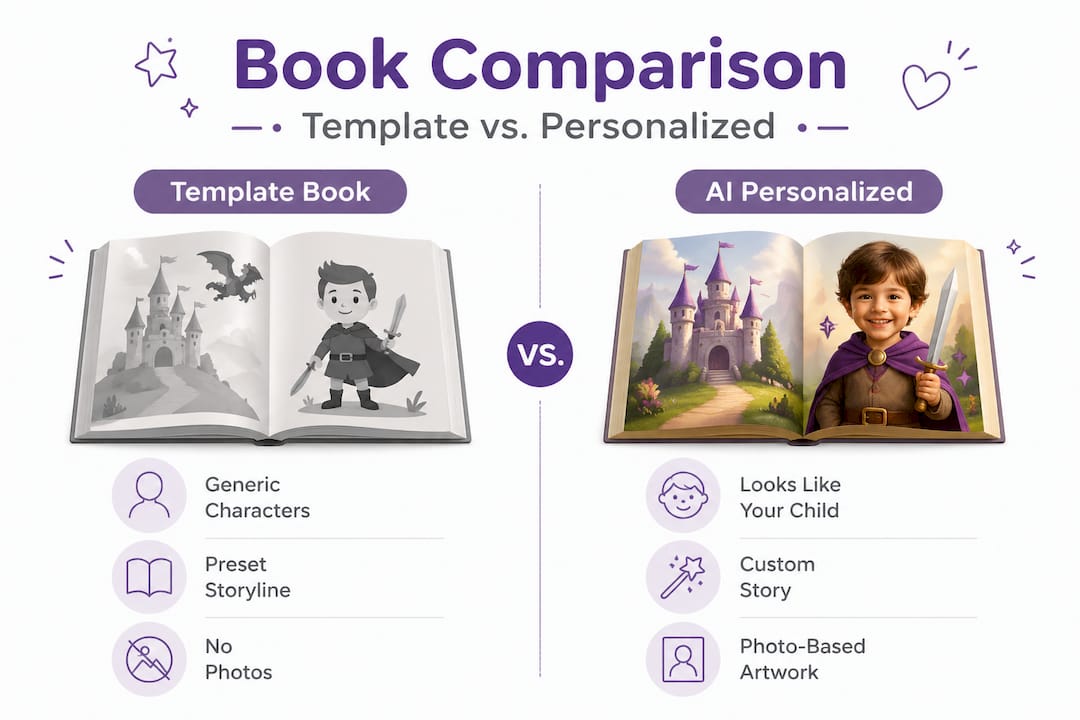
Neither type is automatically better. Template books are great if you need something fast and affordable. But if you want something your child will actually remember, something that feels like it was made just for them, the AI-personalized version wins by a wide margin.
Pro Tip: Think about the child's age and attention span. Younger kids (ages 2 to 5) often respond most strongly to seeing their own face in illustrations, which makes AI-generated books especially effective for that age group.
You can explore the full differences between book types to get a more detailed picture. Understanding what goes into each children's book genre can also help you choose the right kind of story for your child's interests and reading level.
Safety, age-appropriateness, and ethics in AI-powered storybooks
After seeing the advantages of personalization, it is natural to wonder whether using AI in children's books is actually safe and ethical. These are fair questions, and they deserve honest answers.
The good news is that reputable platforms take this seriously. Here is what responsible AI-powered storybook services typically put in place:
- Automated content moderation that screens generated text and images for anything inappropriate, violent, or confusing for young readers
- Age-gating systems that adjust vocabulary, themes, and plot complexity based on the child's age
- Photo privacy policies that govern how uploaded images are stored, used, and deleted after book creation
- Human review options for flagged content before it reaches the final product
- Transparency about AI use, so parents understand what technology is being applied
Research confirms that content moderation is built into the generation pipeline for these books, not bolted on afterward. That means the AI is actively constrained during creation, not just checked at the end.
"When you upload photos of your child, you are trusting a platform with something irreplaceable. The best services treat that trust as a responsibility, not a data opportunity."
On the ethics side, the key questions are around data use and bias. Does the AI depict children of all backgrounds accurately and respectfully? Does the platform share or sell photo data? Responsible providers answer these questions clearly in their privacy policies. Always review those before you upload anything.
For a deeper look at how this plays out in practice, the guide on AI content safety for kids covers the main concerns in plain terms. And if you are thinking about how to use these books as part of early literacy, the expert early reader tips resource is worth a read alongside this one.
The short version: yes, AI-powered storybooks can be very safe for young children when you use a platform that takes content moderation, privacy, and ethical AI practices seriously. Do your research on the provider before you commit.
The real magic: What storybook personalization can unlock for your family
Understanding the technical and ethical aspects is vital, but let us look at the bigger picture. What does this all actually mean for your family?
Here is the thing most articles miss. Personalized storybooks are not just a novelty item that fades after one reading. When a child sees themselves as the hero of a story, something shifts. They start to see reading as something that belongs to them, not just a school activity or a bedtime obligation. That shift is more valuable than any single book.
We have seen this play out in how parents describe the experience. Kids who would normally fidget through a bedtime story sit still and ask for the book again. Kids who say they hate reading suddenly want to know what happens next. The reason is simple. Engagement follows relevance. When the story is literally about you, you pay attention.
There is also something important happening in the family dynamic. Creating a personalized book together, choosing the theme, reviewing the illustrations, reading it aloud as a family, builds a shared experience that sticks. These are the kinds of memories that do not come from a generic gift. Check out our gift ideas for bookish kids if you are thinking about personalized books as a gift for a birthday or holiday.
That said, we want to be honest about the balance. Technology should support reading, not replace the human parts of it. A personalized book is a starting point, not a finish line. Read it together. Talk about the story. Ask your child what they would do differently if they were really the hero. That conversation is where the real literacy development happens.
Some parents worry that if everything is personalized and easy, children will lose patience for books that require more imagination. That is a reasonable concern. The answer is not to avoid personalized books but to use them as one tool among many. Think of them the way a guide to writing chapter books might describe the gateway story. It builds the habit and the love of reading, which then opens the door to longer, more complex books over time.
Personalized AI storybooks are genuinely exciting technology. But the magic is not really in the AI. It is in the moment when your child points to a page and says, "That's me."
Bring your child's imagination to life with personalized storybooks
Ready to see what a book starring your child actually looks like?
At Adventures of Book, we create fully original personalized children's books using AI technology that generates unique stories and illustrations based on your child's photos and interests. There are no templates, no generic characters, and no recycled plots. Just a one-of-a-kind story built around your child in about five minutes. You can also create custom baby books that make a truly memorable keepsake for the earliest chapters of your child's life. Upload a few photos, choose a story theme, preview the result, and download a print-ready file. It really is that straightforward. Come explore what we can create together.
Frequently asked questions
How many photos do I need to create a personalized storybook?
Most services require at least 8 photos to build an accurate and consistent visual depiction of your child. Research confirms that image generation models rely on 8 or more photos to analyze facial features and maintain consistency across multiple scenes and styles.
Are personalized storybooks safe for young kids?
Yes, when created by a responsible platform. Content moderation is built into the generation process to keep stories age-appropriate and aligned with family values, not added as an afterthought.
Can I edit the story or images before printing?
Many providers give you a preview and allow adjustments to the text, illustrations, or audio before you finalize. The ability to edit and review is one of the features that sets advanced platforms apart from basic ones.
What happens to my child's photos after making a book?
Reputable platforms either securely delete uploaded photos after the book is generated or store them under strict privacy policies. Always read the provider's privacy policy before uploading any images of your child.
Are personalized books only for young children or can older kids enjoy them too?
Personalized storybooks work across a wide age range. Story complexity, vocabulary, and themes can all be adjusted, making them engaging for toddlers and older kids alike.