
Most parents assume AI children's books are just name-swap templates with a digital coat of paint. That assumption sells the technology short. Understanding how AI creates children's books reveals something genuinely different: systems that generate original narratives, produce character illustrations from a child's actual photo, and maintain visual consistency across every page. This guide breaks down the real technology behind personalized AI children's books, walks through what the creation process looks like, and helps you figure out what to look for when choosing one for your child.
Table of Contents
- Key takeaways
- How AI creates children's books: the core technology
- Keeping your child's face consistent across every page
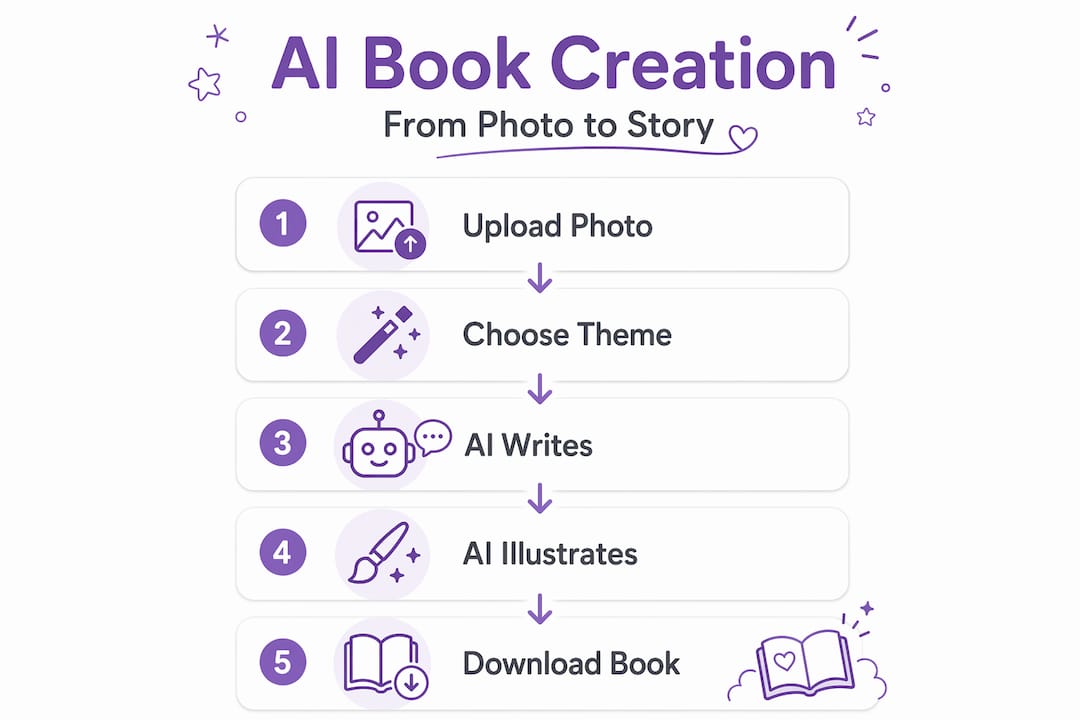
- The step-by-step process from photo to finished book
- Publishing and legal considerations worth knowing
- AI personalized books vs. traditional template books
- My honest take on where AI books are right now
- See your child star in their own original story
- FAQ
Key takeaways
| Point | Details |
|---|---|
| AI uses multiple models | Story creation, illustration, narration, and editing each rely on separate AI models working together. |
| Character consistency is the hard part | The anchor image pattern solves the toughest technical challenge: keeping your child's likeness accurate across every page. |
| Original stories, not templates | True AI personalization generates a new narrative per child, not a static story with a name inserted. |
| Publishing rules apply | Amazon KDP and other platforms require disclosure when AI generates text or images in a book. |
| Quality varies widely | Not all AI book tools are equal. Photo-based illustration and original story generation signal higher quality than template swaps. |
How AI creates children's books: the core technology
The phrase "AI children's book" covers a lot of ground. At the basic end, some tools swap a child's name into a pre-written story. At the sophisticated end, systems use several AI models working together to generate a unique story, illustrate a child-specific character on every page, add narration, and export a print-ready file. The difference matters.
The story itself comes from a large language model (LLM). You provide inputs like the child's name, age, interests, and any themes you want included. The LLM generates a structured narrative with scene beats, character descriptions, and age-appropriate language. Good systems enforce a JSON story schema so each page receives exactly the right amount of text and scene direction to pair with an illustration.
Illustration is handled by a separate image generation model. It takes the story scene description and the child's uploaded photos as reference inputs, then renders a full illustration with the child as the main character. Text-to-speech narration is another layer entirely, converting the story text into voiced audio with real-time word highlighting so children can follow along. NousyBooks uses six Gemini models orchestrated to handle story creation, illustration, editing, audiobook narration, and voice assistant interaction across one pipeline.
- Story generation: An LLM builds the narrative from child-specific inputs, usually formatted as a structured scene-by-scene outline
- Illustration: An image model renders each scene with the child's likeness derived from uploaded reference photos
- Narration: A text-to-speech engine reads the story aloud, often with highlighted words for emerging readers
- Print formatting: A separate layout engine handles bleed, trim, and color correction to produce a print-ready file
Pro Tip: When evaluating AI book tools, ask specifically whether the story is generated from scratch or pulled from a template library. The distinction is not always obvious from marketing copy, but it changes the product entirely.
AI-generated books can also support multiple languages and narration with real-time word highlighting for native pronunciation, which makes them accessible to bilingual families or classrooms with diverse learners.
Keeping your child's face consistent across every page
Character consistency is the problem that separates a good AI children's book from a frustrating one. If page one shows a girl with brown curly hair and green eyes, and page four shows the same character with straight blonde hair, the book loses its magic. Children notice. Parents notice even faster.
This happens because image generation models do not have memory between outputs. Each page illustration is technically a fresh generation. Without intervention, features drift across pages.
| Problem | What it looks like | How the anchor image pattern fixes it |
|---|---|---|
| Hair drift | Character's hair color or texture changes mid-story | Page 1 illustration fed as reference anchor for all subsequent pages |
| Skin tone shifts | Character appears lighter or darker on different pages | Explicit skin tone description embedded in every generation prompt |
| Clothing inconsistency | Outfit changes without narrative reason | Scene consistency instructions included per page generation call |
| Facial feature variation | Eye shape, face structure changes across pages | Reference photo + anchor illustration used as dual input |
The anchor image pattern works by generating page one first, using the child's uploaded reference photos. Pages two through four are then generated in parallel, each receiving page one's illustration as an additional input alongside explicit consistency instructions. This converts a vague personalization goal into a measurable, repeatable constraint. The result is reduced character drift without requiring fine-tuning or specialized model training.
Pro Tip: Before purchasing any AI children's book, ask to see sample pages or a preview. Check whether the child character looks the same on page two as on page eight. Inconsistency there is a direct sign the tool skips this step.
Understanding how AI illustration actually works in practice helps you ask better questions when comparing services.
The step-by-step process from photo to finished book
The actual workflow for creating a personalized AI children's book is simpler from a parent's perspective than the technology underneath it. Here is what the process typically looks like from start to finish.
- Upload reference photos. You provide clear photos of your child, usually front-facing with good lighting. These become the visual foundation for every illustration in the book.
- Enter child details. Name, age, interests, and any story themes you want included. Some platforms offer a voice assistant interface so younger children can help choose their own adventure.
- Story generation. The LLM builds a full narrative from your inputs. This is not a template fill-in. The story is written specifically for your child's details, with scene descriptions tied to each page.
- Illustration generation. Each scene is illustrated with your child as the main character, using the anchor image pattern to maintain consistency across pages.
- Narration and language options. Some platforms add audio narration with word highlighting. Language selection at this stage makes the book accessible to bilingual families.
- Export and delivery. The final file goes through a print-ready layout engine that handles bleed, trim, and color settings. You receive a digital download, a print-ready PDF, or both depending on the platform.
The full cycle on efficient platforms takes around five minutes. If you want a practical walkthrough, this step-by-step creation guide covers the process in more detail.
Publishing and legal considerations worth knowing
This section matters most if you are an educator planning to share AI books in a classroom setting, or a parent thinking about publishing a book you helped create. But even if you just want to buy a book for your child, it helps to understand how the industry is being regulated.
The rules around disclosure are clear and tightening. Key points to understand:
- Amazon KDP requires disclosure whenever AI generates text or images in a book, regardless of how much a human edits it afterward. The disclosure is triggered by a checkbox in the KDP publishing workflow.
- The classification depends on how substantially human revision alters the AI output. AI-generated, AI-assisted, and human-authored content are treated differently.
- The Authors Guild recommends that authors retain explicit control over AI-related rights, specifying in contracts whether AI may be used for translations, audiobooks, or artwork.
- Parental control over content is a real consideration. Reputable platforms let you review and approve the story before the book is finalized.
"Contracts should specify licensing of AI-related rights and require author consent for AI-generated translations, audiobooks, and artwork." — Authors Guild AI Model Contract Clause Guidance
If you are an educator exploring AI in children's literature for classroom use, it is worth reading the AI content safety guidance specifically for children's contexts before introducing AI-generated books to students. Maintaining authorial control over AI-generated elements is the clearest ethical standard the industry has established so far.
AI personalized books vs. traditional template books
Not every "personalized" children's book uses AI in the same way. A lot of what gets marketed as personalized is still a template book with a name and hair color swapped in. Knowing the difference saves you money and sets the right expectations.
| Feature | Template-based books | AI-generated books |
|---|---|---|
| Story content | Fixed narrative, name inserted | Original story generated per child |
| Character illustration | Generic avatar adjusted for name/color | Illustrated from child's actual photos |
| Uniqueness | Same book, different name | Genuinely one-of-a-kind per child |
| Production speed | Instant (pre-built) | Minutes (generation required) |
| Drawbacks | Feels generic after first read | Quality varies by platform |
Template books are not bad. They are reliable, affordable, and consistently illustrated. But AI personalized books create original stories and illustrations rather than swapping out placeholders, which is a meaningfully different product. The child is not a character inserted into someone else's story. The story is built around them from the start.
The main drawback to watch for with AI books is inconsistency in illustration quality. Because AI tools vary in how they handle the anchor image pattern, the gap between a good AI book and a mediocre one is visible on the page.
My honest take on where AI books are right now
I've spent a lot of time looking at how AI creates children's stories across different platforms, and here is what I've come to think: the technology is genuinely impressive, but the implementation is uneven.
The personalization that works best is not just "your child's name in the title." It's a book where a six-year-old with a dinosaur obsession and a curly-haired character who looks like her actually sees herself in the story. I've seen children interact with books like that very differently than with standard picture books. They point at the character. They ask to hear it again. That response is real, and it's not something a template delivers.
What I'd watch for: platforms that claim AI personalization but generate the same illustration style regardless of the uploaded photo. That's a sign the photo is used for color palette selection, not actual character generation. It looks like personalization but doesn't feel like it to the child.
I also think the multi-model orchestration approach, where separate AI systems handle story, illustration, narration, and layout as distinct tasks, is the right architecture. It produces more consistent quality than trying to do everything with one model. The platforms that get this right are producing books that genuinely hold up as children's literature, not just novelty items.
The field is moving fast. What I expect to see more of: real-time story adaptation based on child reading patterns, better character aging as kids grow, and tighter parent controls over themes and content. The bones are already there.
— Jason
See your child star in their own original story
If you want to see this technology in action rather than just read about it, Adventuresofbook does exactly what this article describes. Upload a photo of your child, enter their name and a few details about their interests, and the system generates a completely original story with 13 illustrated pages where your child is the main character. The illustrations are built from your photo, not from a generic avatar template.
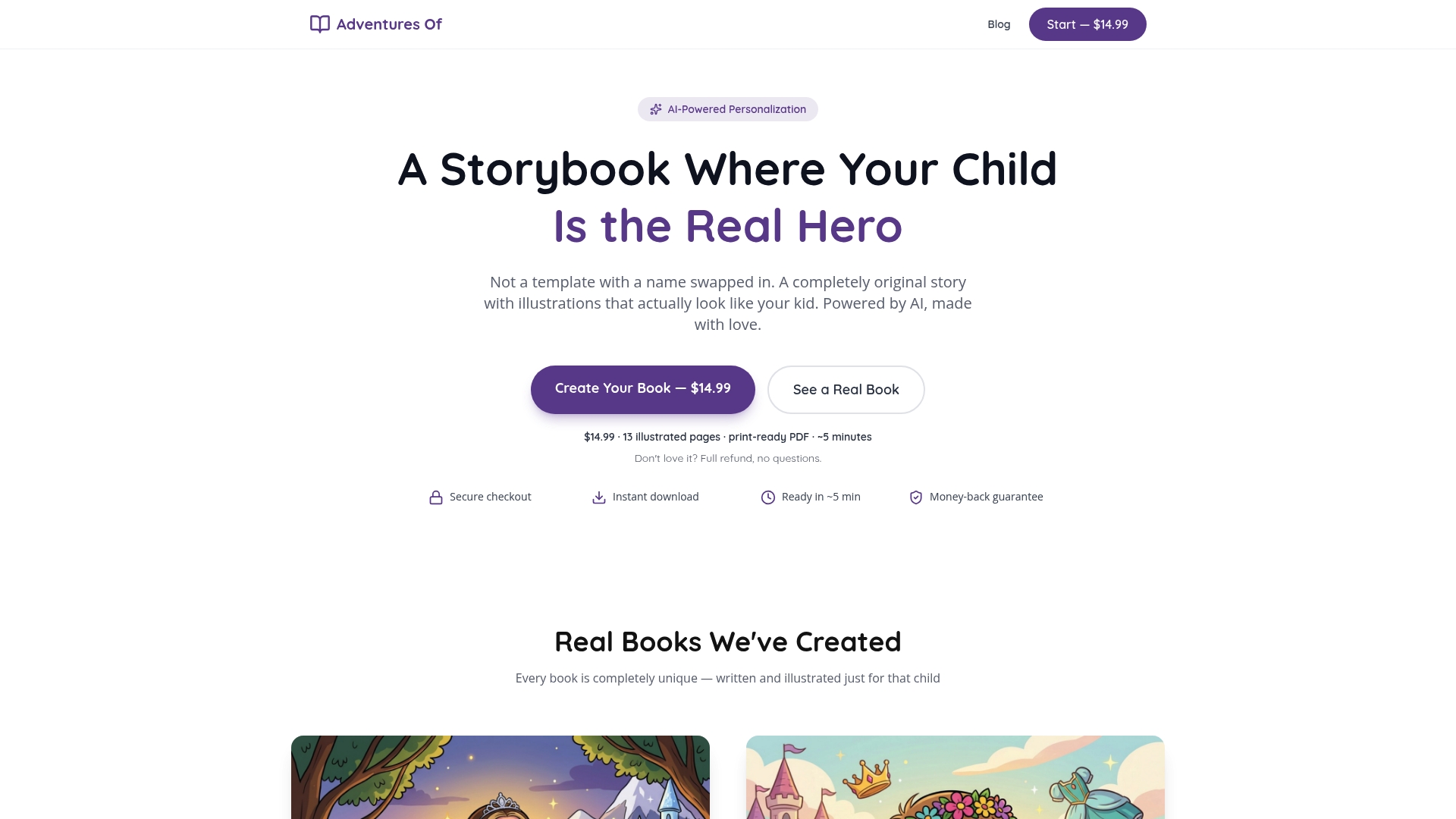
The whole process takes about five minutes. You receive an 8.5x8.5 print-ready PDF for $14.99, with a 7-day refund policy if you are not satisfied. There are no templates and no shared character designs. Every book is generated specifically for one child. If you want to see what a personalized book starring your kid actually looks like, that is the place to start. You can also browse the book library to get a feel for illustration styles and story types before committing.
FAQ
How does AI keep a character looking the same across pages?
The anchor image pattern solves this by using the first generated page as a reference input for all subsequent pages. This keeps hair, skin tone, clothing, and facial features consistent without requiring model retraining.
Is AI-generated content in children's books safe for kids?
Reputable platforms include content review and parental approval steps before a book is finalized. Parents should check whether the platform allows story review before purchase and whether the content policies are clearly stated.
Does Amazon require disclosure for AI children's books?
Yes. Amazon KDP requires disclosure whenever AI is the primary generator of text or images in a published book, regardless of how much the human author edits the output afterward.
What makes an AI children's book genuinely personalized vs. a template?
A truly personalized AI book generates an original story and character illustrations from the child's photo and details. A template book inserts a name into a pre-written narrative. The story content and visual character are the two things to check.
How long does it take to create an AI children's book?
On platforms that use efficient multi-model pipelines, the full process from photo upload to downloadable book takes around five minutes. Print-ready formatting is handled automatically as part of the generation process.