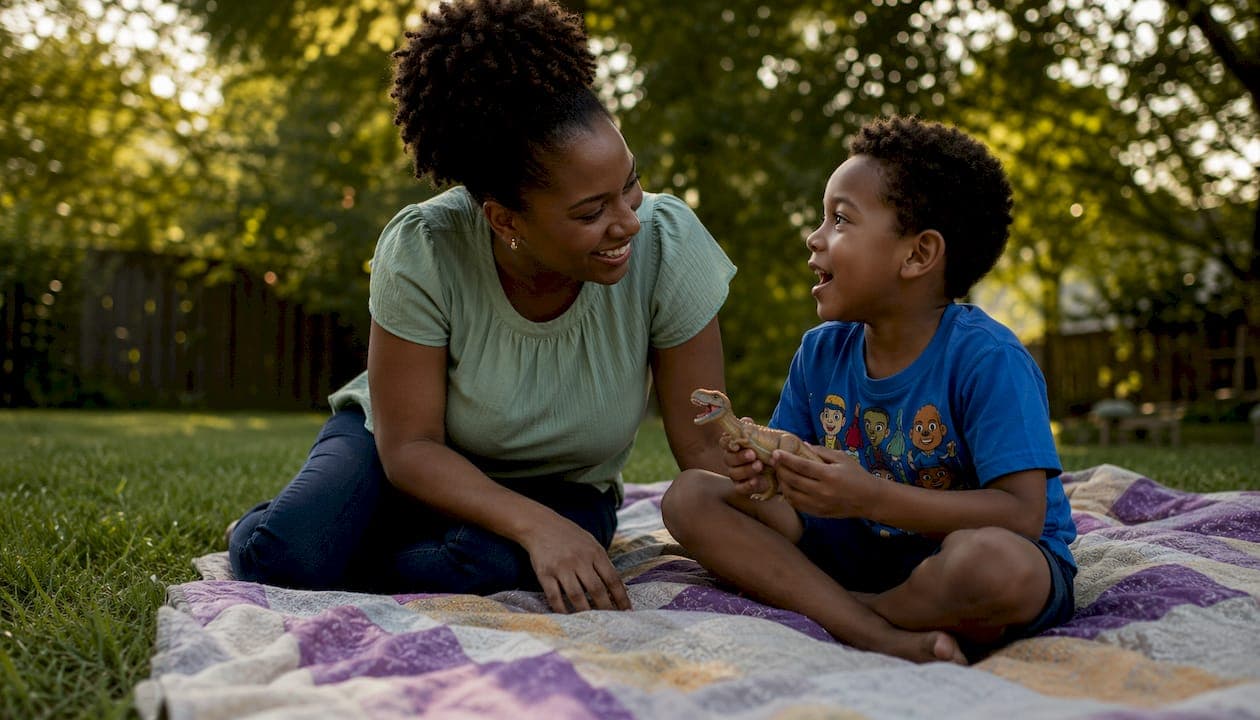
Two scripts you can read aloud right now will get your child inventing a plot in under two minutes. For a quick session, say: "Pick a hero, give them one special power and one thing they're scared of, then tell me what goes wrong." For a longer weekend project, add: "Now tell me one rule about the world your hero lives in, and one thing they absolutely cannot do." That's child-driven plot creation in its simplest form.
Capture these five inputs before you do anything else:
- Hero name and age
- One power (what makes them special)
- One fear (what could stop them)
- One world rule (how this place works differently)
- One constraint (what the hero cannot do or use)
Quick summary: Script 1 (1–2 min): hero + power + fear + problem. Script 2 (~45 min): add world rule + constraint, then build a full plot using the BBT scaffold below.
Table of Contents
- What is child-driven plot creation, and why does it matter?
- The five symbols every child needs to start a story
- How the Because / But / Therefore method fixes "and then" stories
- Two timed activity plans: 45 minutes and 5 minutes
- How to act while your child leads the story
- What to do when the story stalls
- Two worked examples: raw idea to finished blurb
- Turning the child's plot into a finished personalized book
- Key Takeaways
- The child is the hero, not the template
- How Adventuresofbook turns your child's plot into a real book
- Sources and further reading
- FAQ
What is child-driven plot creation, and why does it matter?
Child-led storytelling puts the child in the author's chair and the adult in the role of facilitator. The adult asks questions, records answers, and resists the urge to fix or redirect. The child makes every plot decision.
The developmental payoff is real. Structured storytelling tasks that focus on conflict and resolution build problem-solving and narrative skills in young children. Story-based play also lets children rehearse social-emotional strategies in low-stakes contexts, practicing empathy and consequence-thinking through characters rather than real situations. And as author Natalie Babbitt observed about children's fiction, child heroes are usually acted upon, which means a concrete sequence of exterior events is not optional. Plot is the engine.
Pro Tip: When a child says "I don't know what happens next," don't fill the silence. Count to five in your head. The answer almost always comes.
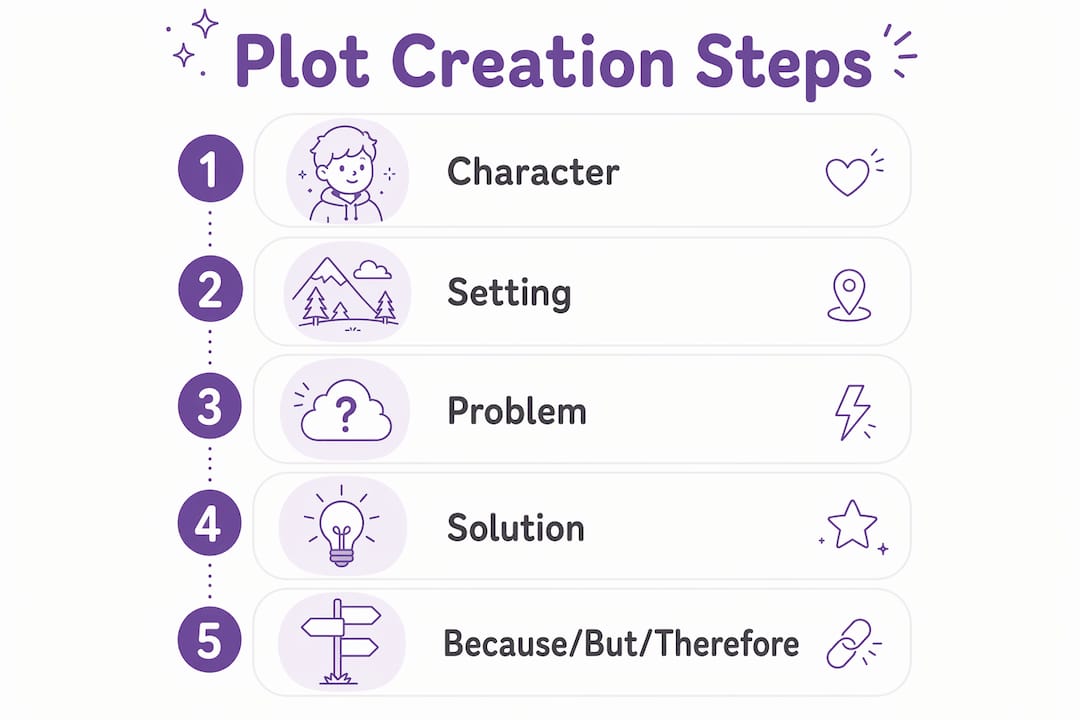
The five symbols every child needs to start a story
Tales Toolkit uses discrete symbols (Character, Setting, Problem, Solution) to give children independence when creating stories, and its approach is backed by educator training. Add one more symbol, Constraint, and you have a complete starter kit.
Here's what each symbol means in practice:
- Character: "A girl named Zara who can talk to clouds." Give the child a small card or object to hold while they describe their hero.
- Setting: "A city where it rains upward." One unusual detail is enough.
- Problem: "Zara's cloud friends are disappearing one by one." The problem must threaten something the hero cares about.
- Solution: "She has to climb the sky ladder before the last cloud vanishes." The child proposes this, not you.
- Constraint: "She can only climb at night, and she's afraid of the dark." This is what creates real tension.
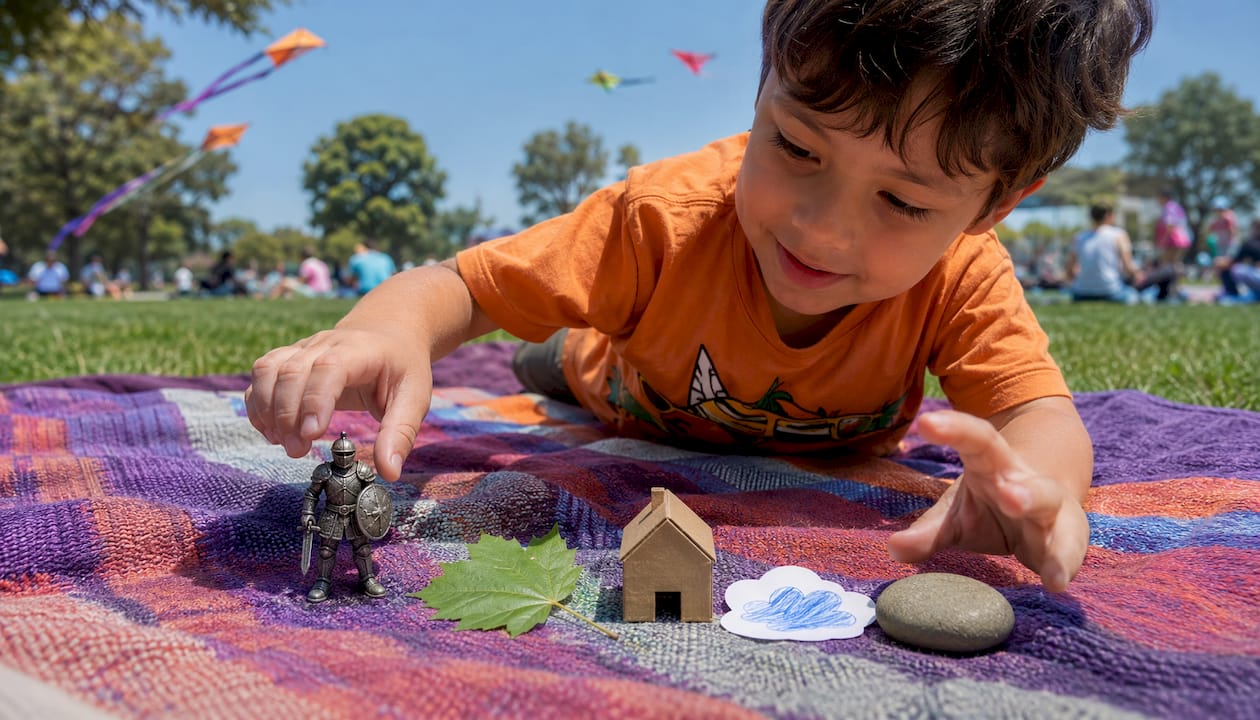
Hand these to the child as five index cards, five small objects, or five spoken questions. The physical act of holding a "problem card" helps younger children separate the story elements in their minds.
Pro Tip: Everyday objects work better than printed templates. A toy figure for Character, a crayon drawing for Setting, a knotted string for Constraint. Children form stronger creative links with things they can touch and move around.
How the Because / But / Therefore method fixes "and then" stories
The single biggest problem in children's plots is the "and then" chain: "She went to the forest and then she found a door and then she opened it and then a monster came." Every event is equal weight, with no cause connecting them.
The Because / But / Therefore scaffold (BBT) forces causality in one move. The formula: [Character] wants [goal] because [reason]. But [obstacle]. Therefore [action/consequence].
Before (and then list):
Zara went to the sky. And then she found the cloud. And then it was sick. And then she gave it rain. And then it got better.
After (BBT):
Zara climbs the sky ladder because her best cloud friend is fading away. But she can only climb at night, and she's terrified of the dark. Therefore she has to face her fear before the last cloud disappears forever.
Use these three prompts to walk a child through each slot:
- "Why does your hero have to do this? What would happen if they didn't?"
- "What stops them? What's the one thing working against them?"
- "So what do they decide to do about it?"
The BBT structure doesn't need to be explained to a child as a formula. Just ask those three questions in order and write down what they say.
Two timed activity plans: 45 minutes and 5 minutes
The ~45-minute weekend session
This timeline is drawn from a weekend AI storytelling project that typically takes about 45 minutes and collects a hero, world rule, and constraint as its core inputs.
- 0–5 min: Warm up with the two-script prompts from the opening. Write down every word the child says.
- 5–15 min: Build the five symbols together (Character, Setting, Problem, Solution, Constraint).
- 15–25 min: Run the three BBT questions. Record the child's exact phrasing, not a cleaned-up version.
- 25–35 min: Read the BBT back to the child and ask: "What's wrong with this story?" Not "do you like it?" That question puts the child in the editor's chair.
- 35–45 min: Finalize the inputs table below, then move to generation.
Sample inputs table:
| Field | Example |
|---|---|
| Hero name | Zara, age 7 |
| One power | Talks to clouds |
| One fear | The dark |
| World rule | Rain falls upward |
| Constraint | Can only climb at night |
| BBT blurb | Zara climbs the sky ladder because her cloud friend is fading. But she can only go at night, and she's terrified of the dark. Therefore she must face her fear before the last cloud disappears. |
Privacy note: When uploading photos to any AI tool, check that the platform does not retain images after generation. Adventuresofbook's AI illustration approach and safety practices are explained on their blog for parents who want the details before uploading.
The 5-minute quick method
Ask the three BBT questions back to back, write down the answers verbatim, and read the result aloud. That's a usable plot blurb in under five minutes. It won't be polished, but it will be the child's story, not yours.
How to act while your child leads the story
Researchers Amanda White, Shelley Stagg Peterson, and Emma Quigan found that adults who co-construct stories with children work best as mediators and interested listeners, using prompts, gestures, and silence to give children space to lead.
In practice, that means:
- Say: "Tell me more about that." / "What does your hero do next?" / "Why does that happen?"
- Avoid: "Wouldn't it be cool if..." / "What if the monster was actually friendly?" (That's your plot, not theirs.)
- Wait: After a question, pause. Silence is not a problem to fix.
- Record: Write or type the child's exact words. Paraphrasing loses the voice.
Do: Ask open questions that keep the child in the driver's seat. Don't: Offer two choices and let the child pick. That's still adult-directed.
Pro Tip: If you're using a reading comprehension game or literacy app alongside this activity, keep them separate. Story creation and reading practice are different modes. Mixing them mid-session tends to pull children out of the creative flow.
What to do when the story stalls
Common problems and their one-sentence fixes:
- "And then" list with no tension: Apply the three BBT questions immediately. One round is usually enough.
- Adult overdirection: Stop talking. Ask "What do you think happens?" and wait.
- Moralizing ending: If the child adds "and the lesson was..." unprompted, that's fine. If you suggested it, cut it.
- Too many characters: Ask "Which one is the most important?" and drop the rest for now.
- Story goes in circles: Ask "What's the one thing that has to happen before the story can end?"
Quick in-session checklist:
- Is the child making the plot decisions, or are you?
- Does the story have a BBT structure (cause, obstacle, consequence)?
- Have you written down the child's exact words?
If the session is going nowhere after 10 minutes, stop and save the notes. Some ideas need a night to settle. Come back the next day and start with "Remember that story about...?"
Two worked examples: raw idea to finished blurb
Example 1: Age 4–5
Parent prompt log:
- "Who's your hero?" → "A bunny named Pip."
- "What can Pip do that's special?" → "He can jump really really high."
- "What is Pip scared of?" → "Loud noises."
- BBT questions → "Pip jumps to the moon because his carrot fell up there. But there's a big thunderstorm on the moon and it's SO LOUD. Therefore Pip has to be brave and get his carrot anyway."
Final blurb:
Pip the bunny can jump higher than anyone, but when his favorite carrot lands on the moon, he has to face the one thing he fears most: the loudest thunderstorm in the sky. He takes one deep breath and jumps anyway.
Example 2: Age 6–7
Parent prompt log:
- "Who's your hero?" → "A kid called Marcus who has robot arms."
- "What's the world rule?" → "Robots aren't allowed in the city."
- BBT questions → "Marcus needs to fix the broken bridge because everyone is stuck. But robots are banned so his arms are illegal. Therefore he has to disguise his arms with a giant coat and fix it in secret."
Final blurb:
Marcus has robot arms that can fix anything, but in a city where robots are banned, using them means breaking the rules. When the only bridge collapses and everyone is stranded, he pulls on his biggest coat and gets to work before anyone notices.
Both blurbs are ready to drop directly into an AI generation tool or into Adventuresofbook's create flow.
Turning the child's plot into a finished personalized book
Once you have the BBT blurb and the five inputs, converting them into a finished book takes a few steps:
- Capture inputs using the table from the 45-minute session above.
- Upload a clear photo of the child (front-facing, good lighting works best).
- Select an illustration style that fits the story's tone.
- Generate the story and illustrations. Adventuresofbook produces an original story and illustrations based on the child's real likeness in about five minutes.
- Download or order print. The file is an 8.5x8.5 print-ready PDF, 13 illustrated pages.
Key product facts:
- Price: $14.99 one-time, no subscription
- Format: 8.5x8.5 print-ready PDF, 13 illustrated pages
- Generation time: approximately 5 minutes
- Refund policy: 7-day money-back guarantee
- Privacy: uploaded photos are used for generation only; Adventuresofbook's privacy practices are detailed on their personalized children's books page
Pro Tip: Paste the child's exact BBT blurb into the story input field. The more specific the language, the more the finished story reflects what the child actually invented.
Key Takeaways
Child-led plot creation works because the child authors every decision, the adult records without redirecting, and a simple causal scaffold (BBT) turns raw events into a real story.
| Point | Details |
|---|---|
| Use the five-symbol toolkit | Capture Character, Setting, Problem, Solution, and Constraint before writing a single sentence. |
| Force causality with BBT | Replace "and then" chains with Because / But / Therefore to give the plot real structure. |
| Record the child's exact words | Paraphrasing loses the child's voice; verbatim notes are what make a personalized book feel genuine. |
| Adult role: listen and wait | Ask open questions, stay silent after them, and never offer two choices for the child to pick between. |
| Adventuresofbook for the finished book | The child's BBT blurb and five inputs feed directly into Adventuresofbook's create flow for a $14.99, 13-page personalized book. |
The child is the hero, not the template
Here's what I keep coming back to: most parents worry they're not creative enough to help their child write a story. That's the wrong concern. The child has the story. Your job is to ask the right questions and get out of the way.
The BBT scaffold and the five symbols aren't there to constrain a child's imagination. They're there to give it a shape it can hold. An imperfect draft with a real obstacle and a real consequence is worth ten polished stories that an adult quietly steered to a tidy moral.
One child, one book. That's the point. A story built around your specific kid's fear of loud noises or their obsession with robot arms is not interchangeable with anyone else's. That specificity is what makes it worth keeping.
How Adventuresofbook turns your child's plot into a real book
You've done the work: you have a hero, a BBT blurb, and five specific inputs. Adventuresofbook is the fastest way to turn that into something your child can hold.
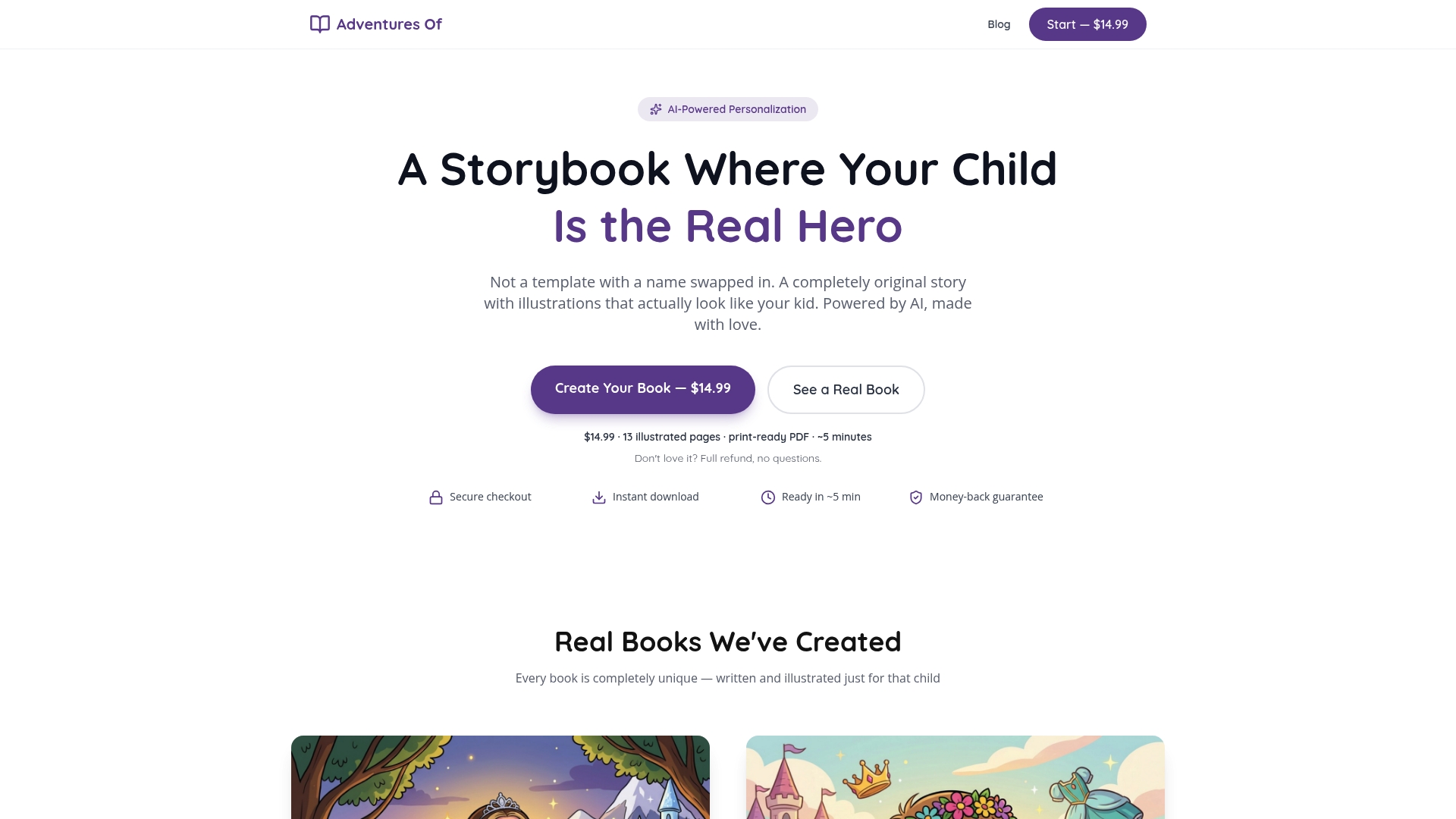
For $14.99 (one-time, no subscription), Adventuresofbook generates an original story and illustrations based on your child's real photo. Not a template with a name swapped in. The illustrations actually look like your kid. The story uses the details you collected. The whole thing takes about five minutes and produces a print-ready 8.5x8.5 PDF with 13 illustrated pages. If it's not right, the 7-day refund policy covers you. One child per book, which is exactly the point: this is their story, not a shared one.
Take the BBT blurb you wrote during the activity, paste it into the story field, upload a clear photo, and you're done. You can start the create flow here. If you want to see the full process first, the step-by-step guide walks you through every screen.
Sources and further reading
Key sources used in this article, with a note on what each one is useful for:
- Tales Toolkit (Hundred.org): Educator-backed symbolic storytelling system; useful for parents who want to go deeper on the five-symbol method or find classroom resources.
- Natalie Babbitt, "Something Has to Happen" (Project MUSE): Classic author essay on why exterior action is non-negotiable in children's fiction; worth reading if you want the literary case for plot-first thinking.
- Young children co-constructing stories with teachers (NZCER): Research by White, Peterson, and Quigan on adult facilitation roles; the source for the mediator/interested listener framework.
- Using the Storytelling Method to Promote Social-Emotional Competence (SAGE): Covers Story Magician's Play Time and how narrative play builds social-emotional skills.
- Weekend AI story machine project (ExplainX): Practical source for the 45-minute session structure and input fields.
- Because / But / Therefore scaffold (RaisingKids.info): The BBT method explained for parents; good follow-up if you want more worked examples.
| Resource | Best for |
|---|---|
| Tales Toolkit | Symbolic toolkit training and classroom use |
| Babbitt / Project MUSE | Literary case for exterior plot in children's books |
| NZCER (White et al.) | Adult facilitation language and timing |
| SAGE (Koivula et al.) | Social-emotional benefits of story-based play |
| Adventuresofbook personalized books | Turning the child's plot into a finished, illustrated book |
FAQ
What is child-driven plot creation?
Child-driven plot creation is a storytelling approach where the child makes every plot decision and the adult acts as a facilitator, recording answers and asking open questions without directing the story.
How do I use the Because / But / Therefore method with a young child?
Ask three questions in order: "Why does your hero have to do this?", "What stops them?", and "So what do they decide?" Write down the child's exact words. You don't need to explain the formula itself.
What inputs does Adventuresofbook need from the child's plot?
Adventuresofbook works from a child's name, age, uploaded photo, and story details. Pasting the BBT blurb into the story field gives the AI the specific conflict and character details it needs to generate an original story rather than a generic one.
How long does a child-led storytelling session take?
A full session with the five-symbol toolkit and BBT scaffold typically takes about 45 minutes. The quick method, three BBT questions answered back to back, produces a usable plot blurb in under five minutes.
At what age can children start creating their own plots?
Children as young as 4 can contribute to a plot using the five-symbol prompts, especially when a parent records their words. The BBT scaffold works well from around age 5 onward, once children can follow a simple cause-and-effect question.