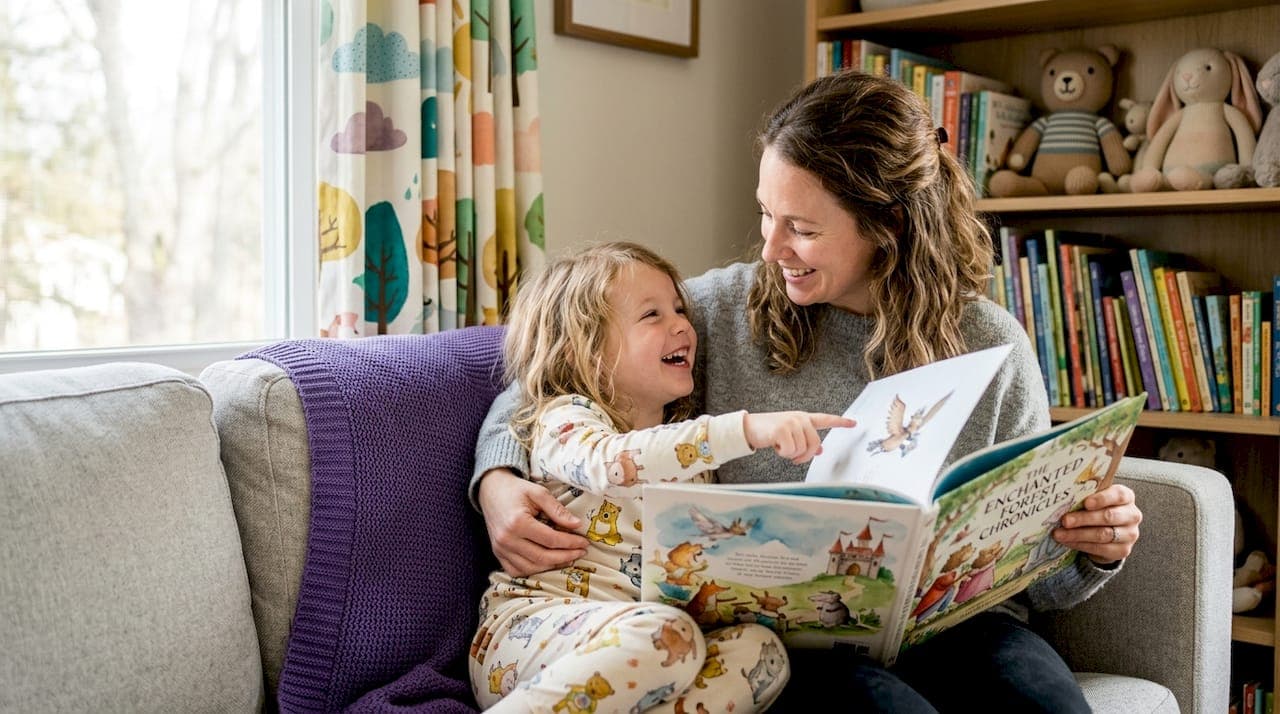
If you've come across the term "explaining AI illustrated children's books" and felt more confused after reading about it than before, you're not alone. Parents and educators are seeing a surge of AI-generated books on the market, and most coverage swings between breathless enthusiasm and sharp criticism without giving you the practical picture. What actually goes into these books? Are they worth your child's time? And how do you tell a quality product from what experts are calling "AI slop"? This article walks you through all of it, plainly.
Table of Contents
- Key Takeaways
- How AI actually creates children's books
- Quality and ethics in AI children's books
- How to choose and use AI illustrated books wisely
- AI books vs. traditional books vs. hybrid approaches
- My honest take on where AI fits in children's books
- A smarter way to get a personalized book for your kid
- FAQ
Key Takeaways
| Point | Details |
|---|---|
| AI books are not all templates | Quality AI books generate original stories and illustrations from a child's real photos, not generic characters with a name swapped in. |
| Quality problems are real | Spelling errors, shallow plots, and character inconsistency are documented issues in lower-quality AI-generated children's books. |
| Ethics and privacy matter | Parents should check how platforms handle uploaded photos and whether AI content is clearly disclosed before purchasing. |
| Hybrid approaches work best | Combining AI speed with human editorial oversight produces better storytelling and visual consistency than fully automated workflows. |
| Personalization drives engagement | Books featuring a child's actual likeness and interests have a measurable positive impact on early literacy and reading motivation. |
How AI actually creates children's books
When people picture an AI-generated children's book, they often imagine a machine spitting out generic clip art with a child's name pasted over a placeholder character. That is not how the better versions work. Understanding how AI illustration works helps separate the real thing from the oversimplification.
Modern AI tools handle two separate jobs: writing the story and generating the illustrations. On the writing side, large language models produce narrative text based on inputs like a child's name, age, interests, and story themes. On the illustration side, image generation models create visuals based on text prompts and, in more advanced setups, reference images such as uploaded family photos.
The illustration styles these systems can produce are genuinely varied. Common outputs include:
- Soft watercolor looks similar to classic picture books
- Bold, flat digital illustration with clean outlines
- Hand-drawn pencil or crayon textures designed to feel warm and tactile
- Painterly styles that mimic oil or gouache illustration
The most meaningful use case is photo-based personalization. When a platform accepts real photos of a child and builds illustrations that actually reflect that child's appearance, the result is categorically different from a template. RobotsMali produced 107 culturally grounded children's books in under 12 months and distributed them to over 300 pupils, demonstrating that AI can create books rooted in specific cultural contexts rather than defaulting to generic Western imagery.
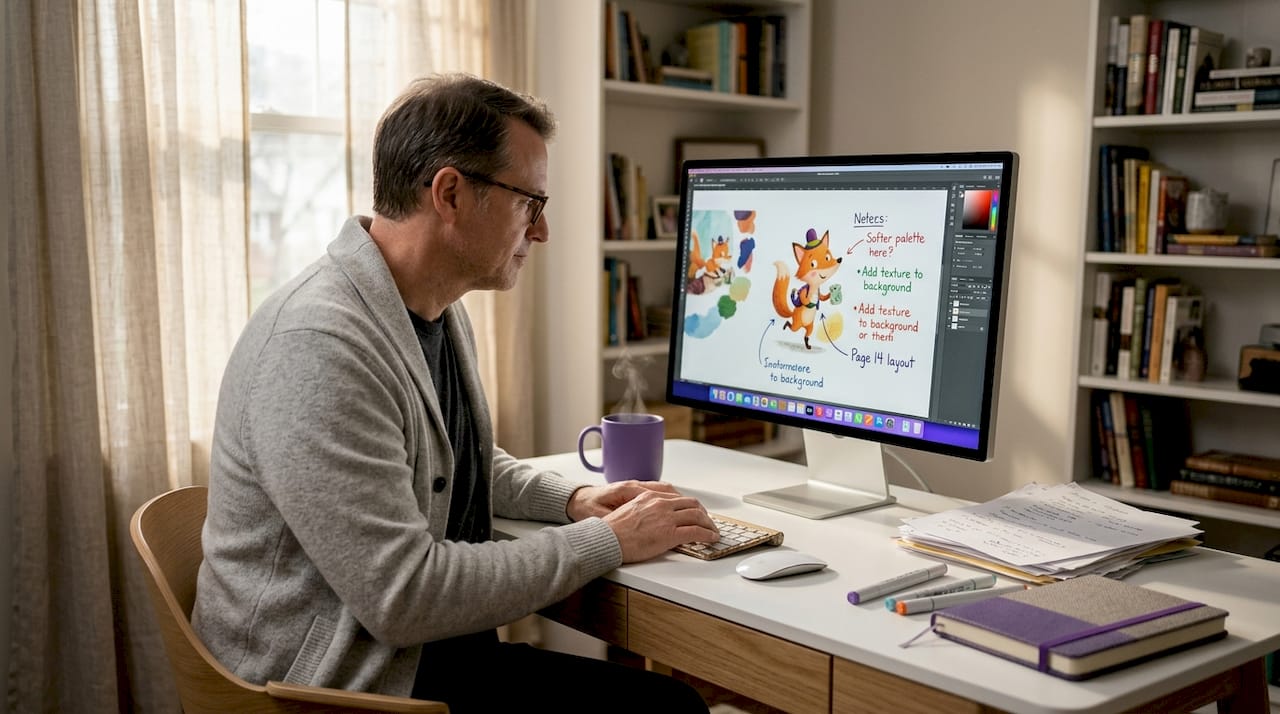
The key distinction worth knowing: AI-assisted content involves a human creator using AI as a production tool, with significant editorial control and creative direction. Fully AI-generated content means the machine handled story, illustration, and layout with minimal human involvement. That difference matters a lot when evaluating quality, and we'll come back to it.
Quality and ethics in AI children's books
This is the part most promotional articles skip over. The impact of AI in kids' publishing is real, but so are the problems.
What is ethical AI in children's books? It starts with honesty about what the technology can and cannot do. The most documented quality issues include:
- Spelling and grammar errors that slip through because AI systems are not proofreaders by design.
- Incoherent plot progression, where a character's problem in chapter one is forgotten by chapter three.
- Character drift, where a child's face, hair color, or clothing changes from page to page without any narrative reason.
- Cultural bias, where AI defaults to familiar Western imagery even when prompted otherwise.
- Shallow emotional content, where stories lack the developmental nuance that trained authors and editors bring to children's literature.
Experts specifically identify "AI slop" as a category of low-quality automated content that poses real risks for children aged 0 to 8, whose early reading experiences shape their relationship with books and learning.
Privacy is a separate concern. Many parents upload photos of their children without knowing how those images are stored or whether they're used to train future AI models. Limited transparency around personal family photos is one of the most cited concerns in the space. Before uploading any child's image to a platform, read the privacy policy. Look for explicit statements that photos are not stored beyond your order and are not used for training data.
Copyright adds another layer of complexity. The U.S. Copyright Office has made clear that mere AI prompt provision does not qualify for copyright. Human modification and creative control are required for legal protection, which affects both creators selling AI books and parents wondering what they actually own.
A published ethics framework for AI content aimed at young children identifies five pillars every creator and platform should follow:
Safety, developmental appropriateness, fairness, transparency, and accountability form the foundation of ethical AI content for children ages 0 to 8. These pillars address the unique vulnerabilities of the youngest readers.
The Authors Guild recommends transparency about AI involvement as a baseline standard for ethical publishing. If a book does not disclose that AI was used in its creation, that is a red flag worth taking seriously.
How to choose and use AI illustrated books wisely
Knowing what to watch for makes the difference between a great purchase and a frustrating one. Here is what to look for when evaluating any AI-generated children's book, whether you are buying or creating.
Check for real personalization. A book where only the name changes is a template book. A book where the illustrations reflect the actual child in the story is something different. Ask directly: does the platform generate original illustrations from my child's photos, or does it swap a name into pre-drawn artwork? The difference between personalized and template books is more significant than most people realize.
Look for AI disclosure. Any honest platform will tell you upfront that AI is involved in the process. Self-publishing platforms require proper AI-content disclosure to avoid rejection. If a storefront hides that information, treat the product with skepticism.
Evaluate human involvement. Fully automated books carry more quality risk. Look for evidence of human editorial review, developmental suitability checks, and quality control on both story and illustration.
Read the privacy policy before uploading photos. Specifically look for: where photos are stored, how long they are retained, and whether they are used for AI model training. If the policy is vague or absent, that matters.
Assess the story on its own merits. Does it have a clear beginning, middle, and end? Does it suit your child's age group? Is the vocabulary appropriate? A technically impressive illustration paired with a hollow story is still a weak book.
- Books for ages 2 to 4 need simple sentence structure and high visual contrast
- Ages 5 to 7 benefit from mild narrative tension and relatable emotions
- Ages 8 and up can handle more complex plots and moral dimensions
Pro Tip: When testing an AI book platform for the first time, request a sample page or preview before purchasing. A platform confident in its quality will show you exactly what you're getting.
Benefits of AI-generated kids books are most clearly felt when personalization is specific and the story is developmentally suited. A child who sees their own face, name, interests, and neighborhood reflected in a story is a child who wants to read that book again.
AI books vs. traditional books vs. hybrid approaches
Understanding where each approach fits helps you make smarter choices as a parent or educator.
| Dimension | AI-generated | Traditional | Hybrid (AI + human) |
|---|---|---|---|
| Cost | Low to moderate | Higher for custom work | Moderate |
| Production time | Minutes to hours | Weeks to months | Days to weeks |
| Visual consistency | Variable, often inconsistent | High with one illustrator | High when human reviews each page |
| Story depth | Varies widely by platform | Generally stronger | Depends on human input level |
| Personalization | High potential, platform-dependent | Limited unless commissioned | Strong with proper workflow |
| Copyright clarity | Uncertain without human input | Clear | Clear when human contribution is substantial |
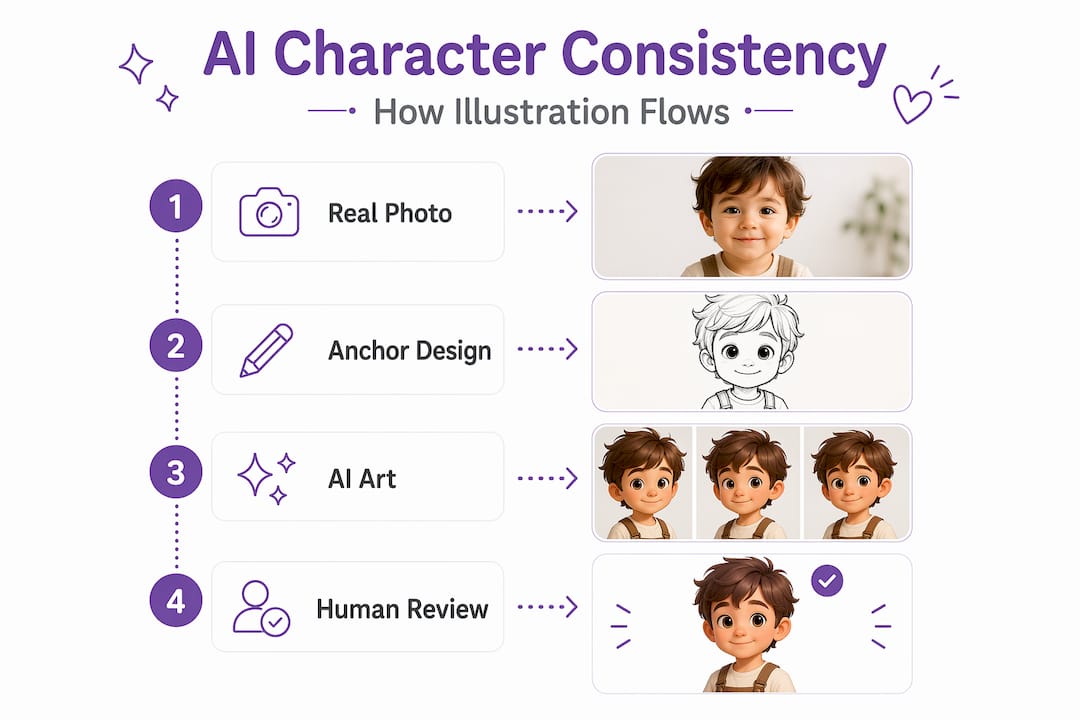
The visual consistency problem is the most technically interesting challenge in the space. AI image models do not have memory between generations. Ask the model to draw the same child ten times and you will get ten slightly different children. Character drift with changing hairstyles, faces, and props across pages is one of the most common complaints about fully AI-generated illustrated books.
The solution used in better workflows is building anchor characters: detailed visual specifications that lock in key physical features before generation begins. Consistency control techniques like anchor characters and style guides are what separate professional AI illustration work from the automated-and-exported approach.
Traditional illustration by a single human artist naturally solves this problem. One artist draws the same character 30 times and produces a visually coherent book. That's why traditional illustration still has a real advantage in books where character consistency is central to the story.
Hybrid workflows, where AI handles rapid iterations and humans provide emotional accuracy, tend to deliver the strongest overall result. The AI accelerates production. The human catches the things AI misses.
Pro Tip: If you're commissioning or creating a children's book using AI illustration tools, build a detailed style guide for your main character before generating a single page. Document skin tone, eye color, hair style, clothing, and any recurring props. This dramatically reduces drift across pages.
For parents buying a book rather than making one, the practical question is simpler. Does the final product look visually consistent? Does the story hold together? Does it look like a human reviewed it before it was sold? Those three questions catch most of the quality problems.
My honest take on where AI fits in children's books
I've spent enough time watching this space to have a clear opinion. AI cannot replace the creative heart of a children's book. The books that made a difference in my own childhood had a specific kind of human intention behind them. An author who understood what it felt like to be seven years old and afraid of the dark. An illustrator whose color choices were not random but deliberate and emotionally precise. AI enables faster publishing but cannot replicate that kind of intention on its own.
What I've actually found is that the technology is useful precisely when it handles the mechanical parts and leaves the meaningful parts to humans. Photo-based personalization is a great example. Generating an illustration that genuinely looks like a specific child is genuinely hard to do at low cost. AI solves that problem well. But whether the story that surrounds that illustration is worth reading is still a human judgment call.
The thing I'd push back on is the idea that AI books are automatically inferior. The traditional gatekeeping roles of librarians and editors are largely absent from AI self-publishing platforms, which is a real problem. But that problem is not inherent to AI. It is a product of platforms prioritizing speed and volume over quality control.
What parents and educators should actually demand is transparency, editorial oversight, and honesty about what the technology does and does not do. When those things are present, AI can genuinely expand access to personalized, culturally specific, and engaging children's books. When they are absent, you get AI slop that wastes a child's reading time.
The bar should be the same as for any children's book: does this serve the child in front of you?
— Jason
A smarter way to get a personalized book for your kid
If you want to see a responsible use of AI in children's book creation, Adventuresofbook is worth knowing about.
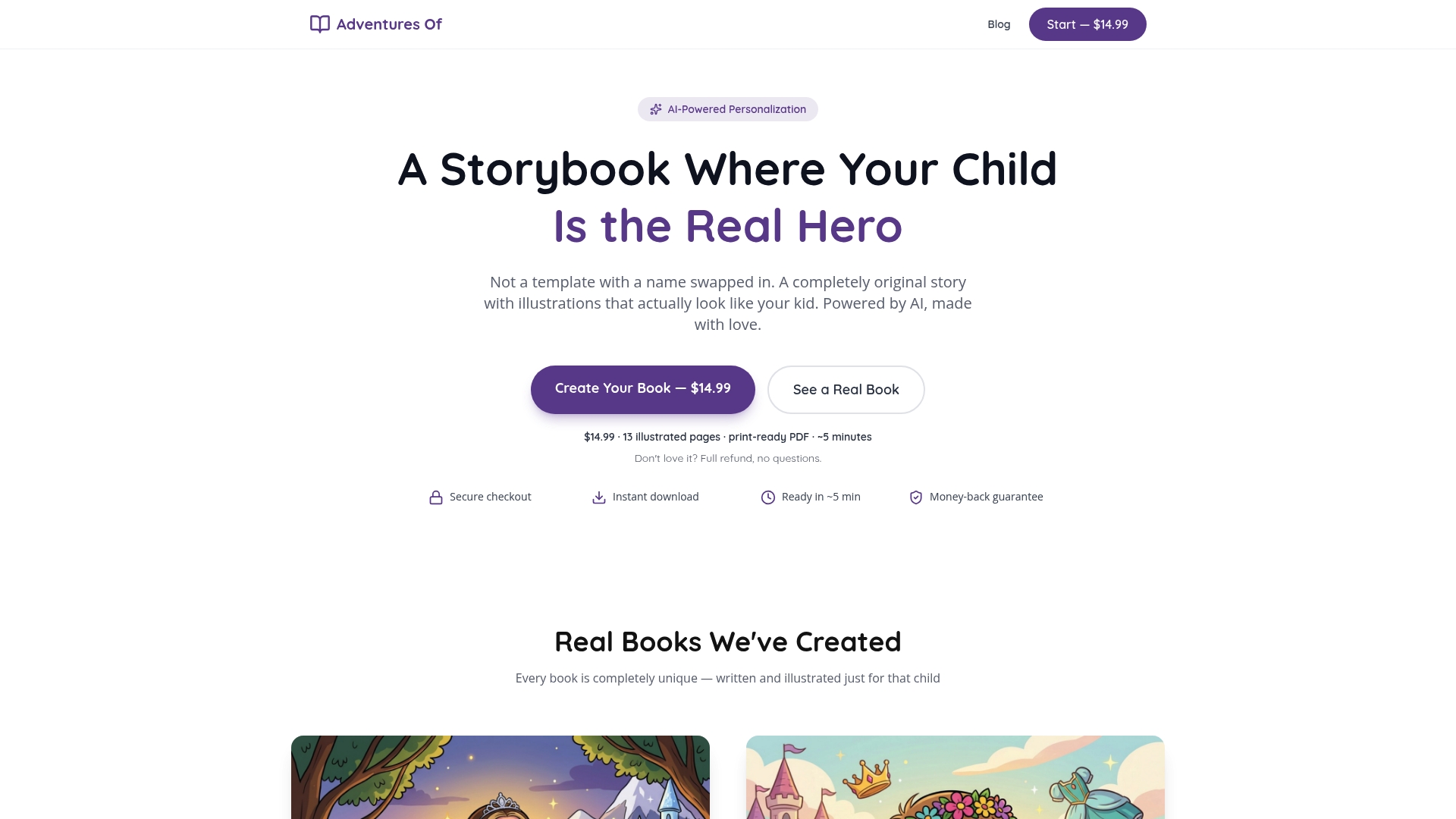
Each book from Adventuresofbook starts with photos you upload of your child. The AI generates an original story and 13 illustrated pages built around that child's actual appearance and interests. Not a template with a name dropped in. An original. The whole process takes about five minutes, and the result is a print-ready 8.5x8.5 PDF you can download immediately for $14.99. There's a 7-day refund policy if the result doesn't meet your expectations. If you want to see how making a personalized children's book actually works from a parent's perspective, that walkthrough is a solid place to start.
FAQ
What is an AI-generated illustration in a children's book?
An AI-generated illustration is a visual created by an image generation model based on text prompts or reference photos rather than drawn by a human artist. In children's books, these visuals can range from simple generic scenes to detailed personalized images built from a child's uploaded photographs.
Why do some AI children's books look low quality?
Many AI-generated books are produced without human editorial review, leading to issues like character drift, spelling errors, and shallow storylines. Quality drops sharply when platforms prioritize production speed over developmental appropriateness and visual consistency.
Is it safe to upload my child's photos to an AI book platform?
It depends on the platform's privacy policy. Before uploading, confirm that photos are not stored permanently, not shared with third parties, and not used to train AI models. Platforms with clear, specific data policies are the safer choice.
Do AI-illustrated children's books have copyright protection?
Not automatically. The U.S. Copyright Office requires substantial human creative input beyond AI prompts for copyright to apply. Books with significant human editing, story direction, and creative control have a stronger claim to protection than fully automated outputs.
What is the difference between AI-assisted and fully AI-generated children's books?
AI-assisted books involve a human creator using AI as a production tool while maintaining editorial and creative control over the final result. Fully AI-generated books are produced with minimal human input. The distinction matters for quality, ethical transparency, and copyright.