
The most effective custom storybook starts with one clear goal, three to five precise personal details, and an AI tool that generates an original story and illustrations from a single photo of your child. Pick a theme from the list below, gather your inputs, and you can have a print-ready PDF in a few minutes.
Quick checklist before you start:
- Preferred name (what your child actually goes by)
- Age or developmental stage
- One goal (confidence, a new routine, a milestone)
- One core interest (dinosaurs, space, baking, soccer)
- One front-facing photo with good lighting
Trust signals to confirm before you pay: a generation time of about five minutes, 13 illustrated pages, square PDF format, refund available within a week, and one child per book.
Table of Contents
- Your Custom Book Inspiration List: 30+ Themes Grouped by Goal
- What personal details actually make the book feel real
- What the AI creation process actually looks like
- Storytelling moves that make the book emotionally meaningful
- File formats, page counts, and print options explained
- How to update or expand the book as your child grows
- Choosing print materials and binding for durability
- Why Adventuresofbook fits what this list is built around
- Key Takeaways
- What I actually learned from building one of these books
- Useful sources and next steps
- FAQ
Your Custom Book Inspiration List: 30+ Themes Grouped by Goal
Personalized book topics that match a child's age and goal consistently outperform broad or generic titles for engagement. Here are more than 30 ideas, organized by what you want the book to do.
Confidence-building
- "I Can Do Hard Things" — child faces a challenge (a big test, a new skill) and finds their own solution. Ages 3–7.
- The Bravest Kid on the Block — child overcomes a fear (the dark, a new school) step by step. Ages 4–8.
- My Superpower — story built around one real strength your child has, named and celebrated. Ages 3–6.
- The Kid Who Never Gave Up — persistence narrative tied to a hobby your child already loves. Ages 5–9.
- First Day, Best Day — starting kindergarten or a new grade, told from the child's point of view. Ages 4–7.
Routines and independence
- The Morning Champion — getting dressed, brushing teeth, and making it out the door on time. Ages 2–5.
- Bedtime Explorer — winding down becomes an adventure that ends in sleep. Ages 2–5.
- I Made My Own Lunch — a custom baby book concept that grows with the child; starts with simple choices. Ages 3–6.
- The Cleanup Crew of One — tidying a room framed as a mission with a reward. Ages 3–7.
- Potty Training Hero — a milestone narrative that normalizes the process without pressure. Ages 2–4.
Milestone celebrations
- The Birthday Adventure — child's actual age becomes the number of challenges they conquer. Ages 3–8.
- Big Kid Now — losing a first tooth, riding a bike, or reading a first book solo. Ages 4–8.
- Welcome, Baby — older sibling becomes the guide for a new family member. Ages 3–7.
- Graduation Day — preschool or kindergarten completion, with the child as the star. Ages 4–6.
- My First Trip — a real family destination becomes the setting for an original story. Ages 4–9.
Hobby and interest-driven adventures
- Dinosaur Detective — child solves a prehistoric mystery using facts they already know. Ages 4–8.
- Space Commander — child pilots a mission to a planet they choose. Ages 4–9.
- The Young Chef — cooking adventure with real recipe logic woven into the plot. Ages 4–8.
- Soccer Star — a big match, a tough opponent, and a lesson about teamwork. Ages 5–9.
- Artist in the Wild — child uses drawing or painting to solve a problem in the story. Ages 4–8.
- The Animal Whisperer — child communicates with animals tied to a real pet or favorite species. Ages 3–7.
- Builder Extraordinaire — LEGO, blocks, or engineering framed as world-saving construction. Ages 4–9.
Learning and skill-building
- The Reading Robot — child teaches a robot to read, reinforcing phonics through the story. Ages 4–7.
- Numbers Are Everywhere — math concepts embedded in a real-world adventure. Ages 3–6.
- My First Map — geography and direction-following as a treasure hunt. Ages 5–9.
- The Science Kid — child runs experiments to solve a neighborhood mystery. Ages 5–9.
- Words in Every Language — child discovers a new language through a travel adventure. Ages 4–8.
Emotional support and transitions
- Two Homes, One Me — navigating a family change with warmth and stability. Ages 3–8.
- When I Feel Big Feelings — naming and managing emotions through a relatable scenario. Ages 3–7.
- My New Friend — moving to a new town or school and making the first connection. Ages 4–8.
- Goodbye Isn't Forever — grief or separation handled gently through metaphor. Ages 4–9.
- The Worry Jar — anxiety management framed as a solvable puzzle the child controls. Ages 4–8.
What personal details actually make the book feel real

A good personalized book uses 1–3 meaningful details rather than a long list of facts. More inputs do not mean a better story; they often fragment it.
The five inputs that matter most are: preferred name, current developmental goal or challenge, one core interest, age, and a single high-quality photo. That is it. Resist the urge to add a sibling's name, a pet, a best friend, and a favorite color all at once. The AI needs room to build a coherent narrative, and so does your child when they read it.
On privacy: before you upload a photo, check the vendor's privacy policy. Confirm that images are used only to generate the book and are not stored for other purposes. One child per book limit is a firm limit on most AI platforms, including Adventuresofbook, so plan accordingly if you have multiple kids.
Pro Tip: Choose a front-facing photo with even lighting and a plain or neutral background. A single clear image produces more consistent character likeness across all a dozen or so illustrated pages than several lower-quality snapshots.
What the AI creation process actually looks like
Most AI-powered storybook services follow the same basic flow, and the whole thing moves faster than you probably expect.
- Pick a theme from your inspiration list and confirm it matches your child's age and goal.
- Enter personal details — name, age, interest, and the developmental goal you want the story to address.
- Upload one photo — front-facing, good lighting, neutral background.
- Review a preview — most platforms show sample pages before you commit to a purchase.
- Download or order — receive an instant PDF or place a print order for a physical copy.
AI-based services typically complete generation in around 5–10 minutes, with an instantly downloadable PDF. Adventuresofbook completes generation in about five minutes. For print editions, shipping times vary by vendor and location, so check the product page before you need a gift by a specific date.
When evaluating any vendor, look for four things: a clear privacy policy, a stated refund window, sample pages you can browse before buying, and an explicit note about whether stories are original or template-based. The difference between an original story and a template with a name swapped in is significant, and it shows up in how much your child connects with the book.
Storytelling moves that make the book emotionally meaningful
The theme you pick sets the stage. What makes the book land is how the child is positioned inside the story.
Start with a clear narrative goal: what should your child feel or understand by the last page? Confidence, calm, excitement about a new skill? Name that before you fill out any form. Then make sure the child is the decision-maker in the story, not just a named bystander. A book where "Emma watched the dragon fly away" is a template. A book where Emma figures out how to communicate with the dragon because she loves animals is a story.
Age-appropriate language matters more than parents usually realize. Toddlers (ages 2–4) need short sentences, repetition, and concrete actions. Early readers (ages 5–9) can handle a three-act structure, a real obstacle, and a resolution they earn. When you fill out the form, note your child's reading level, not just their age.
Pro Tip: Ask the AI to include one or two pause points in the story, places where a question is posed to the reader ("What do you think she should do next?"). These interactive moments extend engagement and turn a read-aloud into a conversation.
File formats, page counts, and print options explained
| Spec | What to expect |
|---|---|
| Page count | 13 illustrated pages (Adventuresofbook) |
| File format | Print-ready PDF, 8.5x8.5 inches |
| Resolution | 300 DPI minimum for clean print output |
| Binding options | Softcover (standard) or hardcover (gift-ready) |
| Paper weight | 80 lb text for interior; heavier cover stock for durability |
For younger readers, hardcover binding holds up to repeated handling far better than softcover. Square sizes work well for children's books, and the 8.5x8.5 format is a practical standard that most home printers and professional print services can handle without cropping.
Print checklist before you order:
- Confirm images are bleed-safe (extend to the edge of the page without white borders)
- Check resolution is at least 300 DPI
- Order a single proof copy before buying multiples as gifts
- For gifting, look for a "ship direct to recipient" option to save a step
How to update or expand the book as your child grows
A custom storybook is not a one-time artifact. The most practical approach is to treat each book as a snapshot of a specific age and goal, then create a new one when the child moves into a new developmental stage.
A confidence book for a four-year-old starting preschool is a different story than one for a seven-year-old learning to read chapter books. The theme can stay similar; the language level, the challenge in the story, and the interest driving the plot should all shift. Some parents build a small shelf of these over time, one per milestone, which also makes for a meaningful keepsake collection.
Choosing print materials and binding for durability
For children under five, the priority is durability over aesthetics. Board-book style is ideal for toddlers, but most AI storybook services produce standard softcover or hardcover formats. If hardcover is available, choose it. The cover stock is thicker, the spine holds up to repeated opening, and it photographs better as a gift.
For paper weight, 80 lb text stock is the minimum worth ordering. Lighter paper shows bleed-through on illustrated pages and tears at corners quickly. If a vendor offers a laminated cover option, it is worth the small upcharge for books that will be read daily.
When ordering multiple copies, such as one for home and one for a grandparent, confirm the vendor allows multiple print orders from the same PDF. Most do. Adventuresofbook delivers a print-ready PDF you can use to order copies through any professional print service as well.
Why Adventuresofbook fits what this list is built around
Every theme on this list works best when the child is genuinely recognizable in the illustrations, not a generic cartoon with a name tag. That is where Adventuresofbook is different from template-based services.
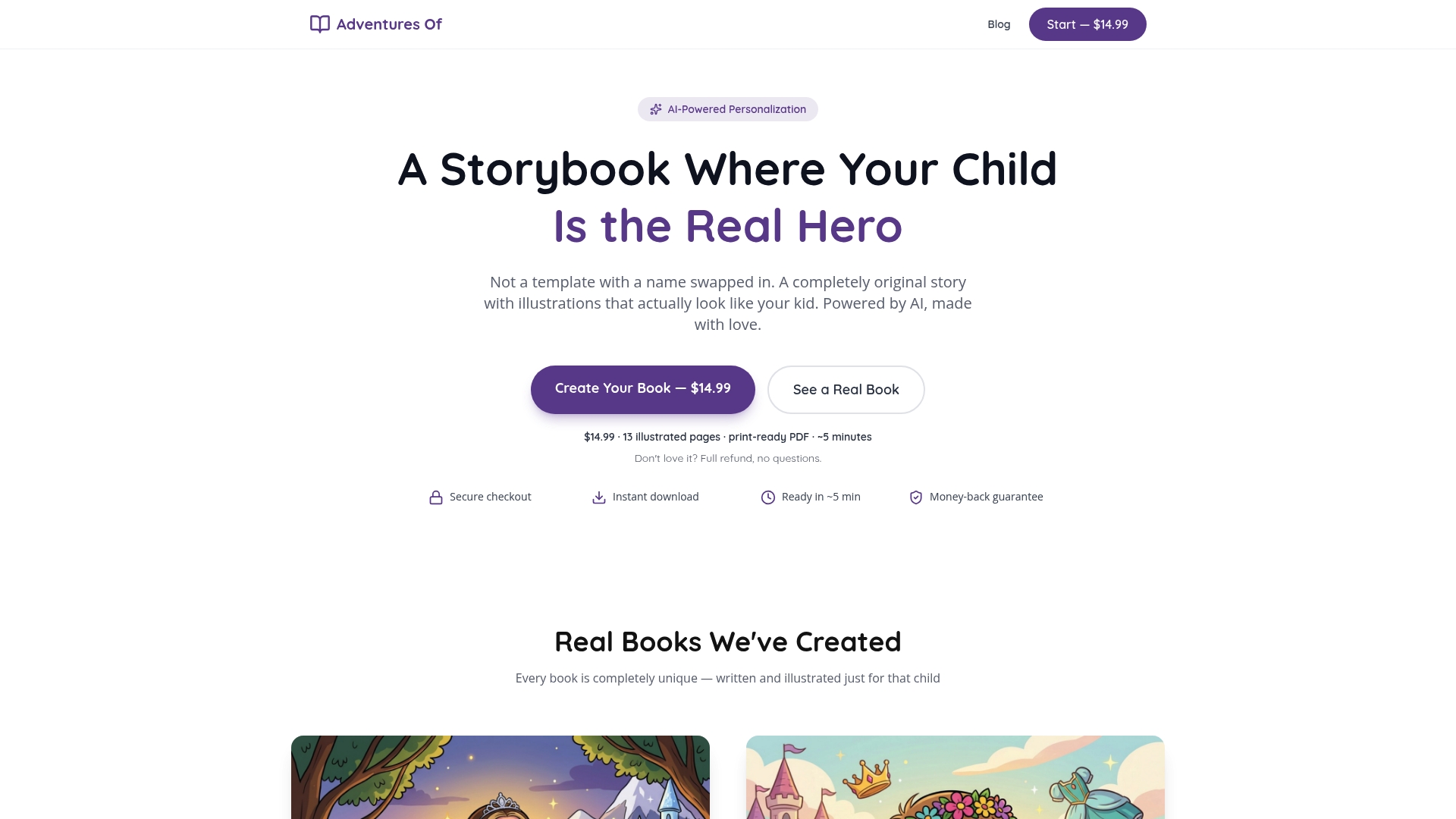
Adventuresofbook generates an original story and original illustrations from a single uploaded photo of your child. No template. No stock character with a name swapped in. The story is written from scratch around the inputs you provide, and the illustrated character looks like your kid across all 13 pages. The whole process takes about five minutes, the PDF is ready to download immediately, and the price is $14.99 one-time. If you are not happy with the result, there is a refund available within a week. One child per book is the current limit, so if you have two kids, you will need two separate orders.
For parents who want a personalized children's book that goes beyond a name printed on a template, this is the direct route. Start at adventuresofbook.com/create.
Key Takeaways
A focused theme, five precise inputs, and an AI tool that generates original stories from a real photo produce the most engaging custom storybook a child will actually want to read again.
| Point | Details |
|---|---|
| One theme beats many | Single-goal books (confidence, routine, milestone) give the story clear purpose and improve engagement. |
| A limited number of inputs such as name, age, one goal, one interest, and one photo produce coherent AI narratives; adding more can fragment the story. | |
| Generation is fast | AI-powered creation typically completes quickly, with an instant PDF download. |
| Print specs matter | Choose hardcover, 80 lb text stock minimum, and 300 DPI resolution for books that hold up to daily reading. |
| Adventuresofbook | Generates original stories and illustrations from your child's photo with a refund available within a week and a page count of 13, square PDF format. |
What I actually learned from building one of these books
The theme I almost chose for my daughter was "loves animals, wants to be brave, also starting a new school, and has a little brother she adores." That is four themes. The book I actually made focused on one thing: she was nervous about kindergarten, and she loves dogs. The story put her in charge of finding a lost puppy on the first day of school. By the end, she had made a friend, solved a problem, and the puppy was safe.
She asked to read it four nights in a row. Not because it was beautifully illustrated (though it was), but because she was the one who figured things out. That is the difference between a book with your child's name in it and a book where your child is genuinely the hero. Pick one goal. Keep the inputs tight. The story does the rest.
Useful sources and next steps
- How to Make a Personalized Children's Book — Adventuresofbook's step-by-step guide for choosing themes and filling out the creation form.
- Personalized Books vs. Template Books — Explains the practical difference between original AI storytelling and template-based personalization.
- Adventuresofbook Library — Product facts, sample pages, and trust signals including privacy policy and refund terms.
- Pooks.ai: How to Choose the Right Personalized Book Topic — Useful framework for matching a book topic to a child's age and reading habits.
- Mixbook: Unique Photo Book Ideas — Broad theme inspiration that translates well into storybook concepts, especially for milestone and interest-driven books.
FAQ
How many personal details should I include in a custom storybook?
Three to five inputs produce the most coherent story: preferred name, age, one goal or challenge, one interest, and a single photo. More details tend to fragment the narrative rather than enrich it.
Can I make one book for two children?
Most AI storybook platforms, including Adventuresofbook, support one child per book. If you have two kids, you will need to create two separate books, each with that child's own photo and details.
How long does it take to get a custom AI storybook?
AI-based generation typically takes around 5–10 minutes, and the PDF is available for immediate download. Adventuresofbook completes the process in about five minutes. Printed editions ship separately, so check delivery times if you need the book by a specific date.
What makes an AI-generated storybook different from a template book?
A template book swaps a child's name into a pre-written story with a generic character. An AI-generated book like those from Adventuresofbook writes an original story and creates illustrations based on your child's actual photo, so the character in the book looks and acts like your specific child.
What is the best theme for a child starting school?
A confidence or transition theme works well, such as a story where the child solves a problem on their first day using a skill or interest they already have. Pairing a real interest (animals, building, art) with the school-start scenario gives the story both emotional relevance and a concrete plot.