
Children's book creation is a structured process combining targeted writing, quality illustration, precise formatting, and strategic publishing steps. The industry standard for picture books is a 32-page format with 500–1,000 words across 12–14 text spreads. That structure is not arbitrary. It reflects how young readers process stories, how printers calculate spine width, and how retailers categorize books on shelves. This children's book creation guide 2026 walks you through every stage, from choosing your age group to uploading your final print file, with the specific details that first-time authors usually learn the hard way.
What does a children's book creation guide 2026 actually cover?
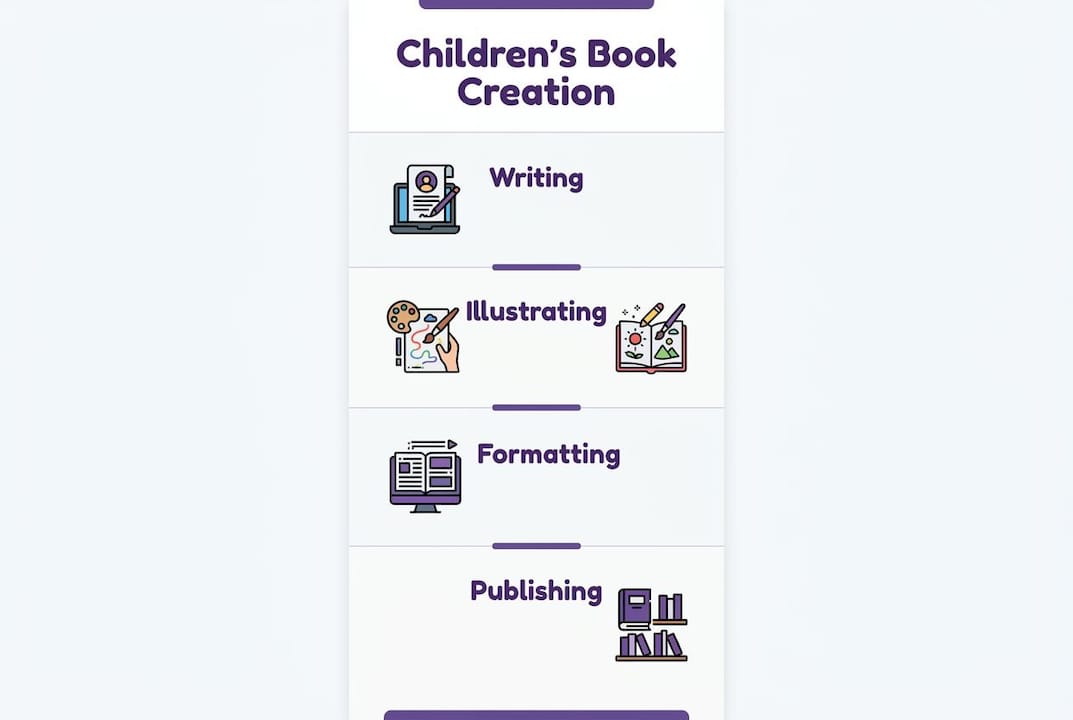
The children's literature creation process spans four distinct phases: writing, illustrating, formatting, and publishing. Each phase has its own standards, costs, and common mistakes. Getting clear on all four before you start saves you from expensive rework later. Self-publishing a children's book typically costs $2,000–$10,000 and takes at least two months. That range reflects how much illustration and formatting choices drive the total budget.
How do I define my target audience and choose the right book category?
Your age group determines everything: word count, sentence length, illustration density, and trim size. Getting this wrong means your book feels off to readers and gets miscategorized by retailers.
The main children's book categories break down like this:
- Board books (ages 0–3): 10–14 pages, simple concepts, no more than one sentence per page, thick cardboard construction
- Picture books (ages 3–8): the classic 32-page format, 500–1,000 words, illustration on every spread
- Early readers (ages 5–8): 32–64 pages, simple sentences, some illustration but text-driven
- Chapter books (ages 6–10): 4,000–10,000 words, minimal illustration, short chapters
- Middle grade (ages 8–12): 30,000–50,000 words, complex plots, rare illustration
- Young adult (ages 12+): 50,000–80,000 words, adult-level themes and structure
Developmental stage shapes language choices directly. A 4-year-old needs concrete nouns and present-tense action. A 10-year-old can handle flashbacks and multiple characters. Matching vocabulary to reading level is not just good practice. It is what separates books that get read again from books that sit on shelves.
Retailers and libraries also use these categories to shelve and promote books. Misclassifying your book as a picture book when it runs 2,000 words creates friction at every step of distribution.
What are the best practices for writing and revising your manuscript?
Writing a children's book manuscript is not easier than writing for adults. It is harder. Every word earns its place, and pacing mistakes are immediately obvious when you read aloud.
Follow these steps in order:
- Draft your story arc first. Identify the problem, the attempt, the failure, and the resolution before writing a single sentence. Children's books need a clear three-beat structure even at 500 words.
- Write for the ear, not the eye. Rhyme and rhythm work when they are consistent. If you start with rhyme, every page must rhyme. Inconsistent meter is the most common first-draft mistake.
- Read aloud 3–5 times. The read-aloud test is the most critical quality control step. You will catch awkward phrasing, pacing gaps, and page-turn problems that silent reading misses entirely.
- Conduct a picture walk. Read the manuscript with a child in your intended age group and watch where they lose interest. Their attention is the most honest feedback you will get.
- Hire a children's book editor. A general editor will not catch age-appropriateness issues. Look for editors with specific picture book or middle-grade credits.
- Revise page turns deliberately. Each page turn should create a small moment of anticipation. If the reader has no reason to turn the page, the pacing is flat.
Pro Tip: Write your page-turn moments first, then fill in the text around them. This forces you to think in spreads rather than paragraphs, which is how picture books actually work.
Overlong text is the most common pitfall for first-time authors. A 32-page picture book with 1,800 words will crowd out the illustrations and frustrate young readers. Cut ruthlessly.
How to secure illustrations that fit your children's book
Professional illustration drives approximately 80% of a children's book's commercial success. That figure explains why illustration is where most of your budget should go, and why cutting corners here costs you more in lost sales than it saves in production.
Your main options for illustration:
- Hire a professional illustrator. Rates for picture book illustration range widely. Expect $3,000–$8,000 for a full 32-page picture book from an experienced artist. Check portfolios for style consistency across a full project, not just sample pieces.
- Royalty-share agreements. Some illustrators accept a lower upfront fee in exchange for a percentage of royalties. This works when both parties trust the project's commercial potential.
- Self-illustration. Viable if you have a genuine illustration background. Readers and reviewers will compare your work to professional standards without knowing you did both.
- AI-generated illustration. Useful for drafts and concept visualization. Rights and consistency across 32 pages remain active concerns. Read the AI illustration considerations before committing to this route for a commercial project.
Before your illustrator draws a single page, finalize your trim size, paper type, and bleed requirements. Changing trim size after artwork is complete means redrawing every spread. That is an expensive mistake that happens more often than it should.
Pro Tip: Your contract with an illustrator must specify who owns the original image files, how many revisions are included, and whether the illustrator retains any merchandising rights. Verbal agreements do not hold up.
A compelling book cover must communicate the book's age target, tone, and emotional promise at thumbnail size. Most parents browse Amazon on a phone. If your cover does not read clearly at 150 pixels wide, it will not convert.
What technical formatting steps prepare your book for print and ebook publishing?
Technical formatting is where many self-published children's books fail at the platform level. Amazon KDP and IngramSpark both reject files that do not meet their specifications.
| Format requirement | Specification |
|---|---|
| Resolution | 300 DPI minimum for all interior and cover files |
| Color mode | CMYK for print; RGB only for screen-only ebooks |
| Minimum page count | 24 pages for Amazon KDP paperback |
| Bleed | 0.125 inches on all sides for full-bleed spreads |
| Ebook format | Fixed-layout EPUB or Kindle KF8 for picture books; reflowable EPUB for chapter books |
A mismatch between your interior page count and cover spine width is one of the most common formatting errors on KDP and IngramSpark. The spine width is calculated from page count and paper type. If those numbers do not match your uploaded files, the platform rejects your cover. Calculate spine width last, after your interior is fully locked.
Low-resolution artwork and incorrect color mode are the leading causes of print-on-demand rejections. Ask your illustrator to deliver files in 300 DPI CMYK from the start. Correcting color mode after delivery often shifts colors visibly, requiring another round of proofing.
For ebooks, picture books require fixed-layout EPUB because the text and image positions must stay locked. Reflowable EPUB, which works fine for chapter books, breaks picture book layouts entirely on most devices.
How to publish and market your children's book effectively in 2026
Publishing is not the finish line. It is the starting point for discoverability. Follow these steps to give your book the best possible reach:
- Purchase your own ISBN from Bowker. Using your own ISBNs preserves credibility with bookstores and libraries. KDP's free ISBN lists Amazon as the publisher, which limits how libraries and independent bookstores perceive your title.
- Choose your distribution channels. KDP covers Amazon. IngramSpark reaches bookstores, libraries, and international retailers. Most authors use both.
- Set metadata with precision. Effective Amazon metadata includes clear age ranges, themes, and use cases rather than keyword stuffing. Choose BISAC categories that match your actual content.
- Price within the market range. Paperback picture books price between $8.99 and $13.99 to balance production cost and buyer expectations. Pricing above $15 for a self-published picture book reduces conversion significantly.
- Order a physical proof copy. Colors shift between screen and print. A proof copy catches color problems, spine alignment issues, and paper quality surprises before your book goes live to buyers.
- Build early reviews. Send advance copies to teachers, librarians, and parent bloggers in your genre. Reviews on Amazon and Goodreads drive discoverability in the first 90 days more than any paid promotion.
- Plan school and library visits. Children's book authors who do school visits consistently report stronger local sales and word-of-mouth than those who rely solely on online marketing.
Key Takeaways
A successful children's book requires matching your age group to industry format standards, investing in professional illustration, and meeting platform technical specs before you submit a single file.
| Point | Details |
|---|---|
| Match category to age group | Your age group determines word count, format, and illustration density before you write a word. |
| Read aloud 3–5 times | The read-aloud test catches pacing and phrasing issues that silent revision misses. |
| Lock technical specs first | Finalize trim size and bleed before commissioning illustrations to avoid costly rework. |
| Meet platform file requirements | Submit 300 DPI, CMYK files with the correct page count to avoid KDP and IngramSpark rejections. |
| Price within the market range | Paperback picture books priced at $8.99–$13.99 convert better than titles priced above $15. |
What I've learned from watching authors get this wrong
Most first-time children's book authors spend too much time on the manuscript and not enough time on the illustration brief. I have seen projects where the writing was genuinely good, the story was original, and the whole thing fell apart because the illustrator was given a vague style direction and no technical specs. The author then faced a choice: pay for redrawing or publish a book that looked inconsistent. Neither option is good.
The other pattern I see constantly is authors who skip the personalized vs. template question entirely. They assume a template-based approach saves time and money. Sometimes it does. But template books produce generic characters, and children notice. A child who sees a character that looks nothing like them connects less with the story. That is not a theory. It is what child development research on mirror characters and self-identification consistently shows.
Rights management is the third area where authors get hurt. Retaining ownership of print, ebook, audio, and merchandising rights matters even if you have no immediate plans for audio or merchandise. Rights you give away are rights you cannot sell later. Read every contract before you sign, and if you do not understand a clause, pay a literary attorney for one hour of review. That cost is trivial compared to what you lose by signing away rights.
The biggest cause of reader dissatisfaction I have seen is not bad writing. It is mismatched expectations. A parent buys a picture book expecting 32 pages and gets 20. A child expects a character who looks like them and gets a generic cartoon. Set accurate expectations in your metadata, your cover, and your product description, and your reviews will reflect that honesty.
— Jason
Adventuresofbook: personalized storybooks with your child as the hero
If you want a children's book that features your actual child, not a generic character with a name swapped in, Adventuresofbook takes a different approach entirely.
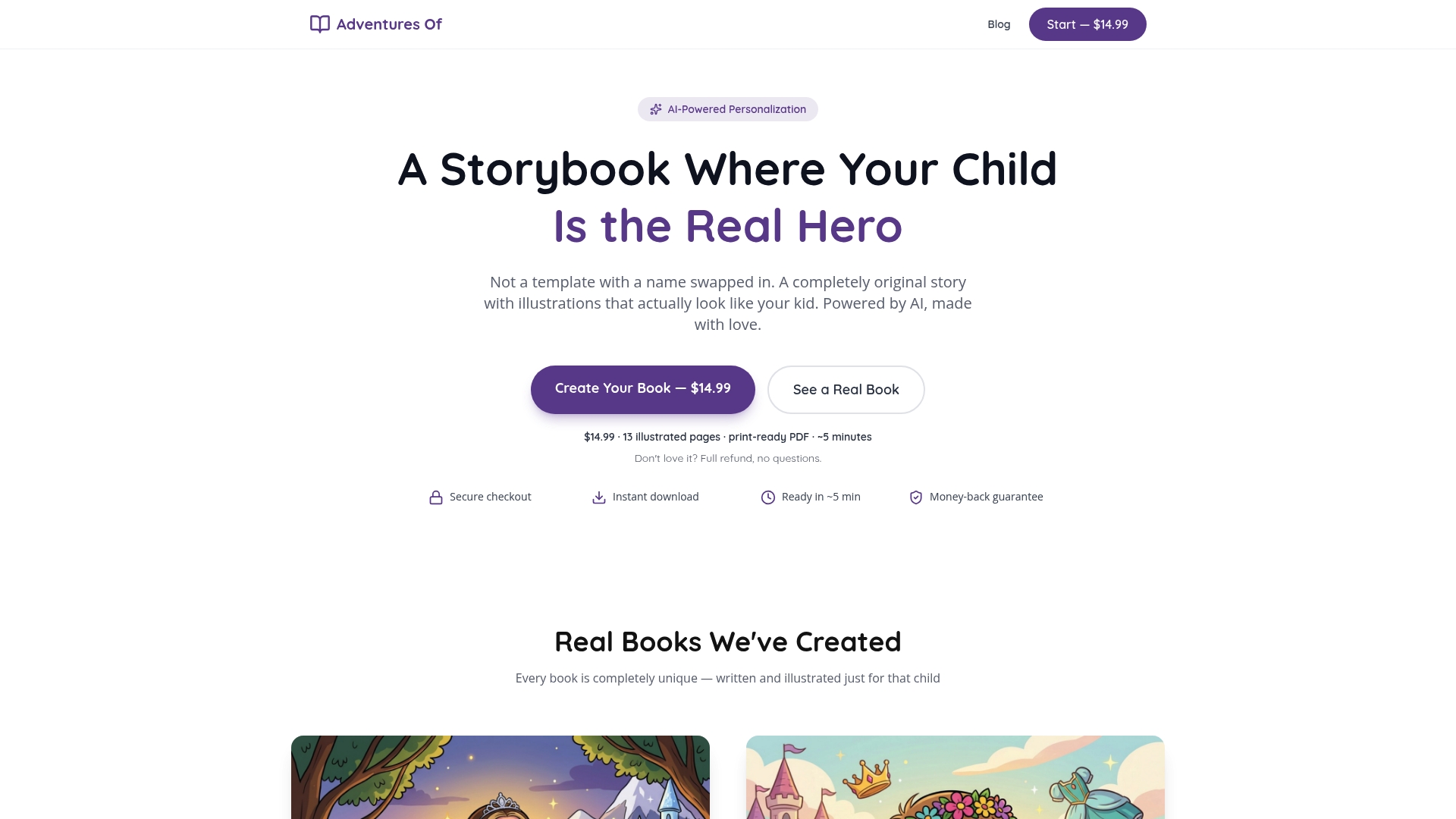
Upload a photo of your child, add their name and a few details, and Adventuresofbook generates an original story with AI-created illustrations that resemble your child specifically. The result is a 13-page, 8.5x8.5 print-ready PDF book for $14.99, delivered in about five minutes. There are no templates and no generic characters. Every story is written from scratch for that one child. A 7-day refund policy covers you if the result does not meet your expectations. For parents who want a meaningful, one-of-a-kind book without a months-long production process, start creating here.
FAQ
What is the standard word count for a children's picture book?
The industry standard for picture books is 500–1,000 words across a 32-page format with 12–14 text spreads. Exceeding 1,000 words crowds out illustrations and disrupts pacing for young readers.
How much does it cost to self-publish a children's book?
Self-publishing a children's book typically costs between $2,000 and $10,000, with illustration and formatting as the largest expenses. Timeline runs at least two months from manuscript to published book.
Do I need my own ISBN to publish a children's book?
Purchasing your own ISBN from Bowker is recommended if you want credibility with bookstores and libraries. KDP's free ISBN lists Amazon as the publisher, which limits distribution options outside Amazon.
What file format does Amazon KDP require for children's books?
KDP requires print files at 300 DPI in CMYK color mode with a minimum of 24 pages for paperback. Fixed-layout EPUB or Kindle KF8 format is required for picture book ebooks.
How do I make my children's book discoverable on Amazon?
Use metadata that includes specific age ranges, themes, and use cases rather than generic keywords. Accurate BISAC category selection and a cover that reads clearly at thumbnail size both drive discoverability significantly.