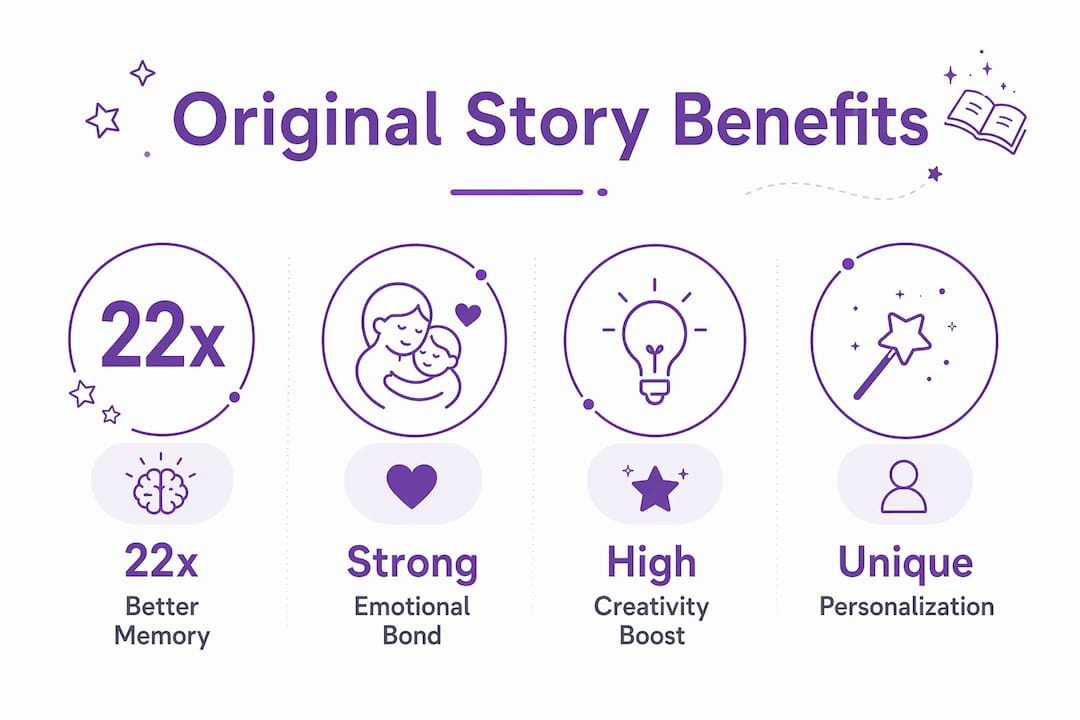
Original story content is defined as narrative material created specifically for a child, featuring unique characters, arcs, and outcomes that no other child receives. Research from Ipsos confirms that story-driven content is remembered 22 times better than factual or feature-focused material. For parents choosing books that genuinely stick with their kids, that gap is not a small detail. It is the whole point. The benefits of original story content go well beyond entertainment. They shape how children think, feel, and grow as readers.
What are the benefits of original story content vs. generic stories?
Original story content and template-based books solve different problems. A template book swaps a child's name into a pre-written plot. An original story builds the entire narrative around that child's personality, appearance, and world. The difference in how children respond is measurable.
The World Federation of Advertisers found that stories using unexpected, illogical narrative elements boost memory encoding 2.7x compared to predictable formats. Children who encounter a story that surprises them stay mentally active throughout. They are not just following along. They are predicting, reacting, and remembering.
Pro Tip: When evaluating a children's book, ask whether the story could belong to any child or only to yours. If it could belong to anyone, it is a template.
Here is a direct comparison of the three main formats parents encounter:
| Format | Memorability | Personalization | Originality |
|---|---|---|---|
| Template book (name swap) | Low | Surface level | None |
| AI-generated with real photo | High | Deep, visual and narrative | Full |
| Classic picture book (e.g., Goodnight Moon) | Medium to high | None | High for its era |
The table shows that originality and personalization together produce the strongest result. A classic picture book like Goodnight Moon by Margaret Wise Brown is original but not personalized. A name-swap book is neither. A book built from your child's actual photo and specific details hits both marks.
How do original stories affect children's brains and emotions?
Original storytelling triggers a biochemical response in children that generic content simply does not. Storytelling releases oxytocin, the same chemical associated with trust and bonding. That response deepens emotional connection to the story and to the person reading it aloud.
Research presented at the Bologna Book Fair confirmed that narratives with characters, arcs, and outcomes help children internalize lessons and improve creativity in ways that static facts cannot. Stories let children safely try out different actions and outcomes in their imagination. That is how problem-solving skills develop before a child ever faces a real challenge.
The cognitive benefits stack up across several areas:
- Memory retention: Story structure gives the brain a framework to hang information on, making recall far easier than memorizing isolated facts.
- Emotional intelligence: Characters who face real dilemmas teach children to name and process emotions they have not yet experienced themselves.
- Creative thinking: Unexpected plot turns, the kind the World Federation of Advertisers calls the "Misfits Mindset," invite active participation from young readers rather than passive listening.
- Language development: Rich, original narratives expose children to vocabulary in context, which is the most effective way to build word knowledge.
"Consumers and children alike prioritize stories where they feel personally seen and inspired, boosting long-term engagement and trust." — Sprout Social
That quote applies directly to children's books. A child who sees themselves in a story, literally and figuratively, stays engaged longer and asks to hear it again.
How can parents find and use truly original story content?
Identifying genuinely original story content takes a few specific checks. Most books marketed as "personalized" are template books with a name field. Truly original content, as defined by content researchers at Aysa.ai, must be based on proprietary inputs such as unique data, anecdotes, or first-hand observations. For children's books, that means the child's actual appearance, personality traits, and interests, not just their name.
Here is a practical process for parents:
- Check the illustration source. Does the child in the book look like your child, or like a generic cartoon with a name label? Real photo-based illustrations are the clearest sign of genuine originality.
- Read the plot summary before buying. A truly original story has a specific arc built around the child's details. A template story has a generic adventure with a name inserted at key moments.
- Ask about the story generation process. Services that use uploaded photos and personal details to generate the narrative from scratch produce original content. Services that fill in blanks do not.
- Test for reusability. If the same book could be given to a different child with a minor edit, it is not original. Original content is non-transferable by design.
- Balance novelty with familiarity. Children need some familiar story structures, like a clear beginning, middle, and end, to feel safe in a narrative. The best original stories use a proven story structure as a scaffold while filling it with completely new content.
Pro Tip: A good test for originality is to remove the child's name from the book and see if it still makes sense. If it does, the story was never really about your child.
Incorporating original story content into your child's reading routine does not require a major overhaul. Reading one original story per week alongside familiar favorites is enough to see a difference in engagement. Children who hear stories built around them ask more questions, make more connections, and remember more details the next day.
Original story content vs. popular children's book formats
Parents have more options than ever, and the differences between formats matter more than most product descriptions admit. The three main categories are classic published picture books, template personalized books, and fully original AI-generated books built from real child photos.
92% of consumers prefer narrative communication over feature-based content. That preference is even stronger in children, who have not yet developed the patience for abstract information. Content marketing research shows that stories achieve 67% higher conversion rates than feature-benefit messaging. Applied to children's books, this means a story that connects emotionally will be requested again far more often than one that simply delivers information.
Here is how the three formats compare on the metrics that matter most to parents:
| Metric | Classic Picture Book | Template Personalized Book | Original AI-Generated Book |
|---|---|---|---|
| Memorability | High | Low | High |
| Child sees themselves | No | Name only | Yes, visually and narratively |
| Story originality | High | None | Full |
| Reread request rate | Variable | Low | High |
| Production time | N/A | Minutes | ~5 minutes |
Classic picture books like those published by Scholastic or Candlewick Press offer genuine literary originality and are worth keeping in any child's library. Their limitation is that they are written for every child, not yours specifically. Template books solve the personalization problem on the surface but sacrifice the story quality that makes a book worth rereading. Fully original AI-generated books, when built from real photos and personal details, combine both strengths.
You can explore AI-illustrated content safety if you have questions about how AI-generated illustrations are produced and whether they are appropriate for children.
Key takeaways
Original story content is the single most effective format for building children's engagement, memory, and creativity because it combines emotional resonance, personal relevance, and narrative surprise in one experience.
| Point | Details |
|---|---|
| Originality drives memorability | Story-driven content is remembered 22x better than factual or feature-focused material. |
| Oxytocin deepens engagement | Original storytelling triggers biochemical responses that build trust and emotional connection in children. |
| Template books are not original | Name-swap books lack genuine story originality and produce lower reread rates than fully custom narratives. |
| Unexpected elements boost retention | Narratives with surprising arcs increase memory encoding 2.7x compared to predictable formats. |
| Personalization requires real inputs | Truly original children's books are built from a child's actual photo, traits, and details, not just their name. |
Why i think parents underestimate the originality gap
I have spent a lot of time looking at what separates the children's books kids ask to hear again from the ones that sit on the shelf after the first read. The answer is almost always the same: the child felt like the story was theirs.
Template books are not bad. They are a reasonable gift and a quick solution. But I have noticed that children clock the difference faster than adults expect. A five-year-old who sees a character that looks like them, acts like them, and faces a problem they recognize will lean in. A five-year-old who hears their name in a story about a generic adventure will smile once and move on.
The research backs this up, but honestly, you do not need research to see it. Watch a child's face when a story mirrors their actual life versus when it just uses their name. The engagement is not even close.
My caution to parents is this: do not let the word "personalized" do too much work. Most products that use that word mean "customized at the surface." Real originality means the story could not exist without your specific child. That is a much higher bar, and it is the bar worth holding to.
— Jason
Give your child a story that is actually theirs
If you want to see the difference original story content makes in practice, Adventuresofbook is worth trying. It generates a completely original story and illustrations based on your child's uploaded photo and personal details. No templates, no generic characters. Your child is the actual hero, drawn to look like them, in a story written for them alone.
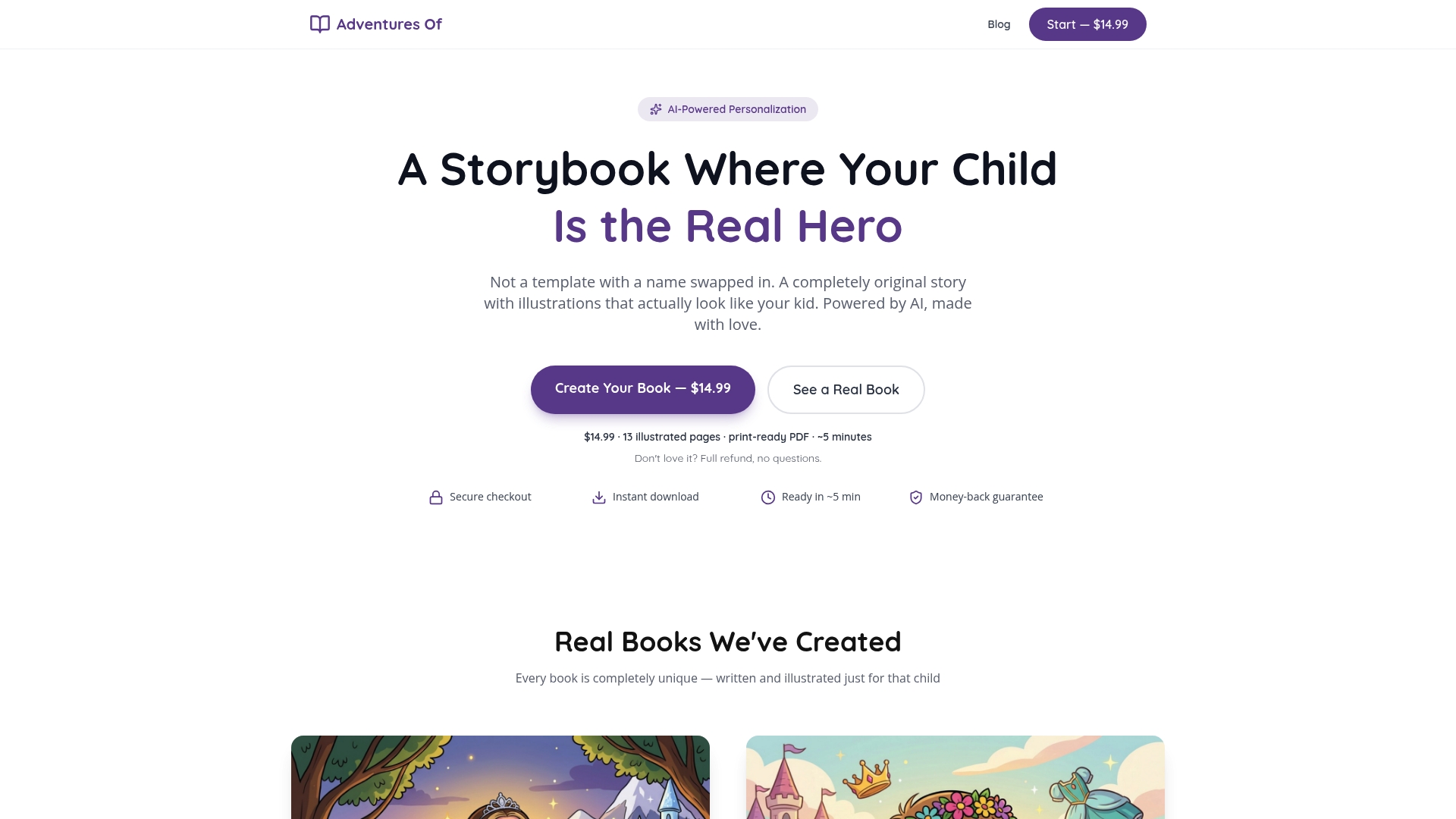
The process takes about five minutes. You get a 13-page, 8.5x8.5 print-ready PDF for $14.99, with a 7-day refund if you are not satisfied. You can browse examples of personalized storybooks to see what a fully original book looks like before you commit. When you are ready, create your child's book and see how differently they respond to a story that was built for them.
FAQ
What makes a children's book truly original?
A truly original children's book features a unique story arc, characters, and illustrations built specifically for one child, not a template with a name inserted. Original content requires real inputs like a child's photo, personality, and interests to generate a narrative that could not belong to anyone else.
How does original story content help children learn better?
Stories with characters, arcs, and outcomes help children internalize lessons and build creativity more effectively than static facts. The narrative structure gives the brain a framework for memory, making information easier to recall and apply.
Are ai-generated children's books considered original content?
AI-generated books are original when they are built from unique inputs like real child photos and personal details rather than filling in blanks on a pre-written template. The originality comes from the inputs, not the technology itself.
Why do children engage more with stories than with facts?
Storytelling releases oxytocin, which builds emotional connection and trust, making the content more memorable and engaging. Children who feel personally seen in a story ask more questions and request rereads far more often than with information-only formats.
How often should parents use original story content with their children?
One original story per week alongside familiar favorites is enough to build a noticeable difference in engagement and creativity. Consistent exposure to original storytelling compounds over time, building vocabulary, emotional intelligence, and a genuine love of reading.