
Five categories of AI tools are actively reshaping how children's books get made: text-generation models like ChatGPT/OpenAI for idea-to-draft speed, image models like DALL·E and Midjourney for illustration generation, specialized story systems like Google's Gemini Storybook for continuity and safety layers, editorial assistants like Grammarly and ProWritingAid for language polish, and distribution platforms like PublishDrive for metadata and marketing automation. Together, they touch every stage of the book lifecycle, from the first character sketch to the retailer product page.
Three use-cases deliver the clearest early wins:
- Ideation and outlines: generating character profiles, plot arcs, and age-appropriate vocabulary lists in minutes
- Illustrations and character art: producing concept images and style references that a human artist refines
- Metadata and marketing automation: drafting BISAC categories, keywords, and back-cover copy from a manuscript summary
Table of Contents
- How creators and publishers are using AI tools today
- Concrete AI tools worth trying, organized by use-case
- Copyright, disclosure, and child-safety: what US creators must know
- Pilot checklist and realistic costs for a first AI-assisted children's book
- How Adventuresofbook uses AI to produce a personalized children's book
- Your next three actions as an author, illustrator, or publisher
- Key Takeaways
- The gap between what AI promises and what children's books actually need
- Adventuresofbook: a working example of AI personalization done right
- FAQ
How creators and publishers are using AI tools today
The children's book value chain has eight natural stages, and AI fits differently into each one.
Ideation and outlines. Text models like ChatGPT can generate a full story outline, a cast of named characters with personality notes, and a reading-level word list in a single session. The output is raw material, not a finished manuscript, but it cuts the blank-page problem down to a prompt-writing problem.
Draft writing. AI drafts move fast, but children's books demand precise word choice, rhythm, and age-appropriate sentence length. Human authors still need to rewrite heavily. Think of the AI draft as a first-pass scaffold, not a deliverable.
Editing and language polish. Tools like Grammarly and ProWritingAid flag passive voice, inconsistent tense, and readability issues against a target grade level. This step is close to fully automated for surface-level checks, though a developmental editor remains necessary for story structure and emotional resonance.
Illustration and visual design. DALL·E and Midjourney generate concept art and style references quickly. Character consistency across 13 or more spreads is the hard part; that still requires a human illustrator or a carefully maintained prompt library. Research on AI-generated illustrated storybooks confirms that human refinement is non-negotiable at this stage.

Layout and formatting. AI-assisted tools can auto-flow text into page templates and flag bleed or margin issues, but print-ready file preparation for a specific trim size (say, 8.5x8.5) still benefits from a human production check.
Accessibility and audio. Text-to-speech models can generate narration tracks for digital editions, and AI can flag contrast ratios for visually impaired readers.
Metadata and discoverability. This is one of the most automatable steps. AI drafts BISAC subject codes, age-range tags, and keyword strings from a manuscript summary. Publishers who expose richer ONIX metadata fields get better results from downstream recommendation systems.
Marketing automation. AI writes first drafts of press releases, social captions, and retailer descriptions. Human review before publishing is still the standard.
Concrete AI tools worth trying, organized by use-case
Text generation: ChatGPT / OpenAI
ChatGPT is the most accessible entry point for authors. Its main strength for children's books is rapid iteration: you can test five different story angles in the time it used to take to write one. Its limitation is that it has no memory of your character across sessions unless you paste in a character bible each time.
Example prompt: "Write a 200-word opening scene for a picture book about a 5-year-old named Maya who discovers a hidden garden. Use simple sentences, present tense, and a curious, warm tone."
Image generation: DALL·E and Midjourney
DALL·E (built into ChatGPT Plus) is the faster option for quick concept sketches. Midjourney produces more stylistically consistent results when you invest time in a detailed style reference prompt. Neither tool reliably maintains a character's face across multiple images without significant prompt engineering, which is why AI illustration workflows still depend on human artists for final spreads.
Example prompt (Midjourney): "Watercolor children's book illustration, a curious 5-year-old girl with brown curly hair and a red raincoat, standing at the entrance of a lush secret garden, soft morning light, warm palette, --ar 1:1 --style raw"
Specialized story systems: Google Gemini Storybook
Google's Gemini-based Storybook features are designed specifically for narrative generation with child-appropriate content filters built in. The safety layer is the key differentiator: outputs are screened for age-appropriate language and imagery before they reach the author. It is less flexible than raw ChatGPT prompting but more appropriate for teams without a dedicated content-safety reviewer.
Editorial assistants: Grammarly and ProWritingAid
Both tools integrate directly into Google Docs and Microsoft Word. Grammarly is faster for real-time surface edits; ProWritingAid goes deeper on style consistency, overused words, and readability scores. For children's books, ProWritingAid's readability report (which targets Flesch-Kincaid grade levels) is particularly useful for matching text to the intended age range.
Distribution and self-publishing: PublishDrive
PublishDrive automates distribution to over 400 retailers and libraries, handles EPUB conversion, and generates metadata fields from your manuscript data. For self-published authors, it removes the manual work of submitting to each retailer separately. The surge in self-published titles to roughly 3 million of the 4 million US titles published in 2025 makes automated distribution tools like PublishDrive increasingly practical.
Workflow fit: where each tool type belongs
| Stage | Best tool type | Human oversight level |
|---|---|---|
| Ideation and outlines | Text models (ChatGPT) | Light review |
| Draft writing | Text models | Heavy rewrite |
| Editing and polish | Editorial assistants (Grammarly, ProWritingAid) | Moderate review |
| Illustration concepts | Image models (DALL·E, Midjourney) | Full artist refinement |
| Story safety screening | Specialized systems (Gemini Storybook) | Spot-check |
| Metadata and distribution | Distribution platforms (PublishDrive) | Final approval |
Copyright, disclosure, and child-safety: what US creators must know
The legal and ethical priorities for US creators using AI in children's books are: verifying training data provenance, disclosing AI use where required, protecting child data under COPPA when uploading photos, and screening outputs for bias and unsafe content.
Here is a practical checklist:
- Author/publisher disclosure: the Committee on Publication Ethics (COPE) recommends explicit disclosure of AI tools used in the creation process; many publishers now require this in submission guidelines
The NPR analysis of AI-authored books notes that detection tools are unreliable at identifying AI-generated text, which makes voluntary disclosure the only credible path to editorial accountability right now.
Pro Tip: Before testing any image model with a child's photo, read the platform's data retention policy. If it does not specify a deletion timeline or parental consent process, treat it as non-compliant with COPPA best practice and choose a different tool.
This one-sentence disclosure, placed in your copyright page or author's note, satisfies most current publisher and library requirements.
Pilot checklist and realistic costs for a first AI-assisted children's book
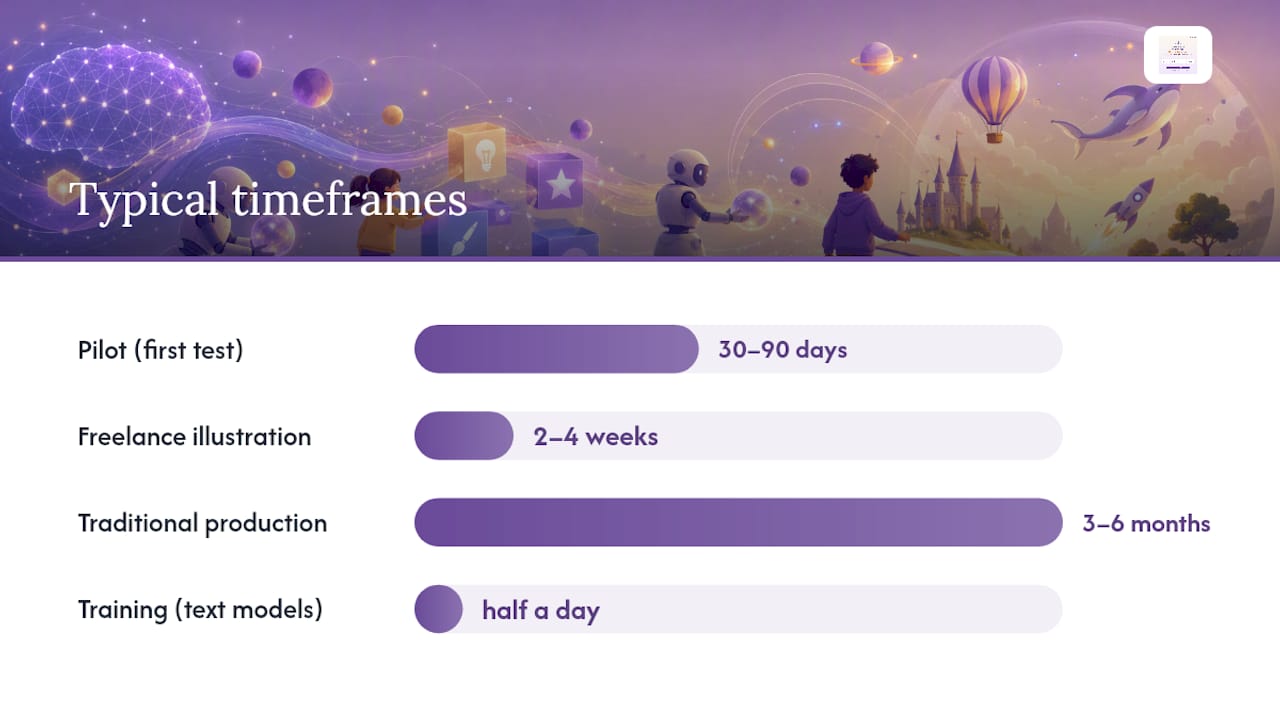
A 30–90 day pilot is the right scope for a first test. Here is a concise checklist:
- Define one specific goal (faster illustration concepts, better metadata, or quicker first drafts).
- Pick one use-case and one or two tools.
- Set measurable success criteria before you start (time-to-first-draft, illustration revision cycles, metadata completeness score).
- Run a privacy review if the project involves any child photos or personal data.
- Train the team on the chosen tools (half a day is usually enough for text models).
- Run the pilot on a single title, not your full catalog.
- Review results against your criteria and decide whether to expand.
Publishing reported the lowest AI uptake among creative industries at approximately 6%, which means most teams are starting from scratch. Set realistic expectations.
| Item | Typical cost range | Time |
|---|---|---|
| ChatGPT Plus (text generation) | — | Ongoing |
| Midjourney (image generation) | — | Ongoing |
| Grammarly Business | $15/month per seat | Ongoing |
| PublishDrive distribution | — | Ongoing |
| Freelance illustration refinement | $500 per book | 2–4 weeks |
| Traditional production (no AI) | $3,000 per book | 3–6 months |
Costs are approximate market rates; confirm current pricing directly with each provider.
KPIs worth tracking: time-to-first-draft, number of illustration revision rounds, editorial defect rate per 1,000 words, and metadata completeness percentage across required ONIX fields.
How Adventuresofbook uses AI to produce a personalized children's book
Adventuresofbook runs a fast, privacy-aware pipeline that shows what a production-ready AI workflow looks like at the single-title level. The product: a fully original children's storybook starring one specific child, generated in about five minutes, with 13 illustrated pages in an 8.5x8.5 print-ready PDF.
The pipeline works in five steps:
- Photo upload: the parent uploads a photo of their child along with the child's name, age, and interests
- Likeness processing: the AI extracts visual characteristics to generate illustrations that actually resemble the child, not a generic avatar
- Prompt-driven story generation: an original story is written from scratch around the child's details, with no template characters or swapped-in names
- Editorial QA: automated content checks screen for age-appropriateness before the file is assembled
- Print-ready PDF output: the finished 8.5x8.5 file is available for immediate download at $14.99, with a 7-day refund policy
Three things other creators can replicate from this model:
- Keep the data footprint small: collect only what you need to generate the book, and delete it after delivery
- Build QA into the generation step, not as an afterthought
- Deliver a print-ready file format from day one so the customer can go straight to a local printer or print-on-demand service
For a deeper look at how AI-driven personalization works at the illustration level, the Adventuresofbook blog covers the mechanics in plain language.
Your next three actions as an author, illustrator, or publisher
Start small, measure honestly, and expand only what works.
-
Authors: run a single-chapter pilot with ChatGPT. Write your character bible first, then prompt for a 500-word opening scene. Measure how long the rewrite takes compared to writing from scratch. If it saves you more than 30 minutes, the workflow is worth formalizing. For a step-by-step walkthrough, the AI-powered story creation guide is a good starting point.
-
Illustrators: test DALL·E or Midjourney on concept art, not final spreads. Use AI to generate three to five style options for a new project before committing to a direction. Track how many rounds of human refinement each concept needs. That number tells you where AI saves time and where it costs it.
-
Small publishers: automate metadata first. Feed your next manuscript summary into ChatGPT and ask it to generate BISAC codes, age-range tags, and a 150-word retailer description. Compare the output to what your team would have written manually. Metadata is low-risk, high-volume, and the easiest place to prove AI's value to leadership before touching editorial or illustration workflows.
Key Takeaways
AI tools are most valuable in children's publishing when they speed up specific, well-defined tasks and a human editor reviews every output before it reaches a child reader.
| Point | Details |
|---|---|
| Start with metadata and outlines | These are low-risk, high-volume tasks where AI saves the most time with the least editorial risk. |
| Human oversight is non-negotiable | Illustration consistency, developmental editing, and child-safety review must stay with a human at every stage. |
| Disclose AI use explicitly | COPE guidelines and most publishers now require disclosure of AI tools used in creation; one sentence on the copyright page is the standard. |
| US book output hit 4 million titles | Self-published titles reached roughly 3 million of the 4 million US titles in 2025, making AI-assisted production tools increasingly practical for independent creators. |
| Adventuresofbook as a live example | The Adventuresofbook pipeline (photo upload, original story, 13 illustrated pages, $14.99, ~5 min) shows what a production-ready single-child AI workflow looks like. |
The gap between what AI promises and what children's books actually need
There is a version of the AI-in-publishing conversation that treats every children's book as a metadata problem waiting to be solved. Faster drafts, cheaper illustrations, automated distribution. All true, all useful. But children's books are not metadata problems.
What makes a picture book work is rhythm. A sentence a 4-year-old will ask to hear again. An illustration that makes a shy kid feel seen. Those things do not come from a prompt. They come from a writer who has read the book aloud fifty times and cut the word that broke the cadence.
The tools covered here are genuinely useful, and the AI adoption data suggests most publishers are still early enough that getting the basics right now puts you ahead. But the teams seeing real results are not the ones who handed the manuscript to a model. They are the ones who used AI to clear the low-value work so a human could spend more time on the sentence that matters.
Leadership buy-in and cross-functional coordination between editorial, legal, and product teams are what separate a successful pilot from a silo experiment that never scales.
Adventuresofbook: a working example of AI personalization done right
If you want to see what a production-ready AI children's book pipeline looks like without building one from scratch, Adventuresofbook is worth a close look. For $14.99, you get a fully original 13-page story starring one specific child, with illustrations generated from an uploaded photo, delivered as an 8.5x8.5 print-ready PDF in about five minutes. There is no template, no generic character with a name swapped in. The story and the illustrations are built around that child.
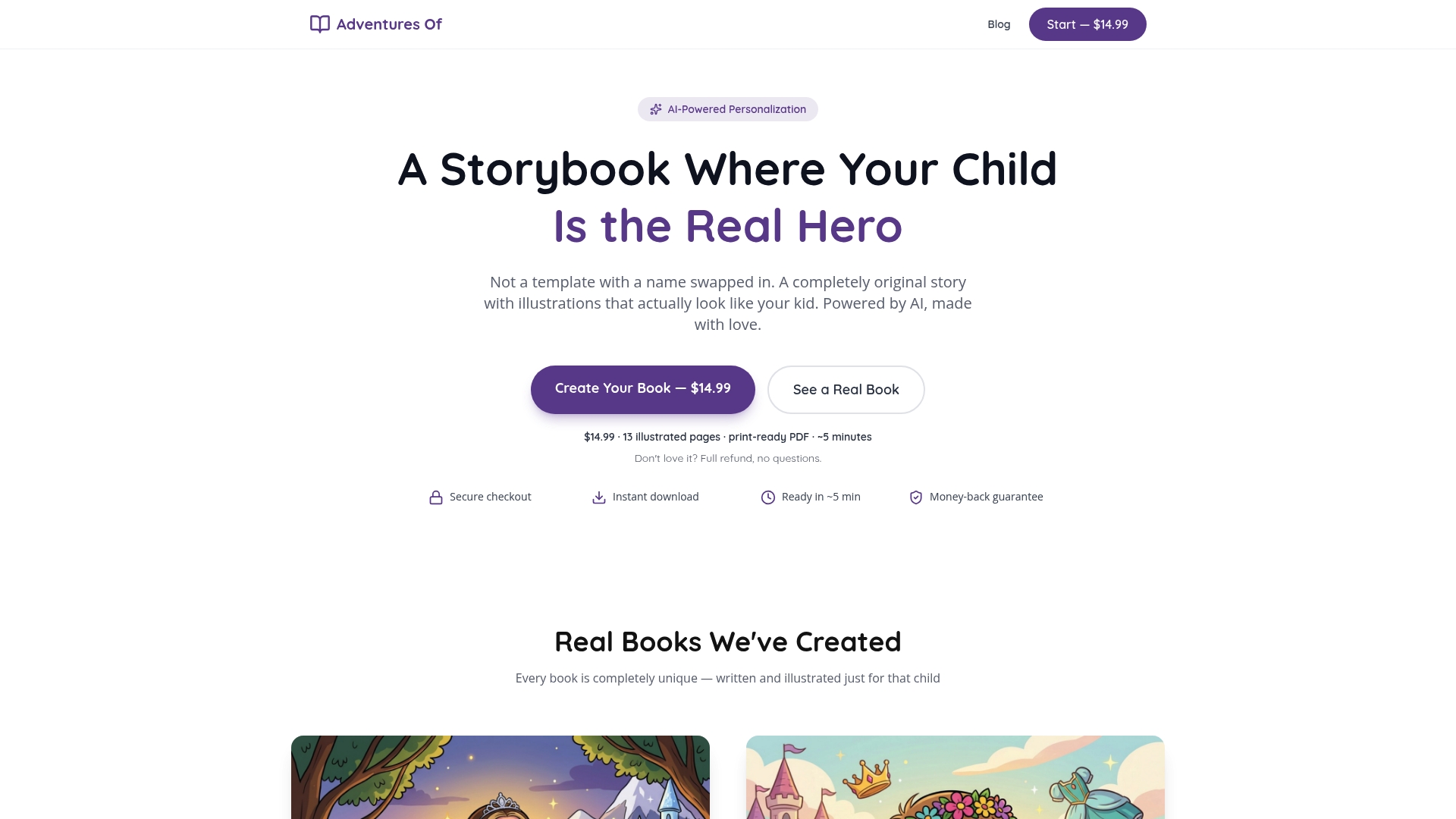
It is a good fit when you need a single-child personalized story with a fast turnaround and clear privacy safeguards. It is not the right tool for multi-child stories or classroom sets. The 7-day refund policy means the risk of a first test is low.
Try it at adventuresofbook.com/personalized-childrens-books and see the output before committing to anything larger.
FAQ
What AI tools are most useful for children's book authors?
ChatGPT is the most accessible starting point for story outlines and drafts; Grammarly and ProWritingAid handle editorial polish. For illustrations, DALL·E and Midjourney generate concept art, though human refinement is still required for character consistency across spreads.
Most publishers now require disclosure of AI use, and the Committee on Publication Ethics recommends explicitly naming any AI tools used in the creation process. One sentence on the copyright page is the accepted standard.
How does COPPA apply when using AI tools with children's photos?
COPPA requires verifiable parental consent before collecting personal data from children under 13. When uploading a child's photo to an AI tool, use only platforms with a clear data deletion policy and parental consent process, and minimize the data you share to what is strictly necessary.
How long does it take to produce an AI-assisted children's book?
A pilot using AI for drafting and illustration concepts can compress a traditional 3–6 month production timeline significantly. Adventuresofbook's pipeline generates a 13-page personalized book in about five minutes, though that reflects a purpose-built system rather than a general-purpose tool workflow.
Is publishing actually adopting AI at scale?
Not yet. A 2026 report found publishing has the lowest AI uptake among creative industries at approximately 6%. Most teams are still in early pilot stages, which means there is a real first-mover advantage for authors and publishers who get their workflows right now.