AI generated illustrations are artworks produced by text-to-image AI models that transform random visual noise into coherent images through a process called diffusion. Tools like Midjourney, DALL-E 3, and Adobe Firefly have made this technology accessible to parents, educators, and digital artists who want to create original visual content without traditional drawing skills. Understanding how these images actually form, what makes them different from generic AI art, and where copyright law currently stands gives you a real foundation for using them responsibly. This article covers the AI art generation process from the ground up, in plain terms.
How AI generated illustrations are created from text prompts
The AI art generation process starts with a model that has learned patterns from billions of images. When you type a prompt, the model does not search a database or stitch together existing pictures. Instead, it begins with a field of random noise and progressively removes that noise over dozens to hundreds of steps, guided by the meaning encoded in your words.
Here is how the process works, step by step:
- Text embedding. Your prompt is converted into a numerical representation using a model like CLIP (Contrastive Language-Image Pretraining). This turns language into a mathematical guide the AI can use.
- Noise initialization. The model starts with a random, static-like image in a compressed space called latent space.
- Iterative denoising. Over many steps, the model removes noise while steering the image toward what your text embedding describes. Each step refines the image further.
- Decoding. A variational autoencoder (VAE) translates the compressed latent representation back into a full-resolution pixel image.
- Output. You receive a finished image that reflects the concepts in your prompt, though not always exactly as you imagined.
The key technical detail here is that prompt influence is statistical, not precise. Changing a single word shifts the probability distribution the model uses, which means small wording changes can produce noticeably different results without guaranteeing an exact output. This is why two people can type nearly identical prompts and get different images.
Parameters like guidance scale and the number of diffusion steps directly control the balance between creative variation and fidelity to your prompt. A higher guidance scale pushes the image closer to your description but can reduce natural-looking variety. Fewer denoising steps produce faster but rougher results.
Pro Tip: When using Midjourney or DALL-E 3, describe the mood, setting, and action in your prompt before adding style references. "A curious girl reading a glowing book in a forest at dusk, soft watercolor style" produces more coherent results than "watercolor girl with book."
What makes AI illustrations different from general AI art
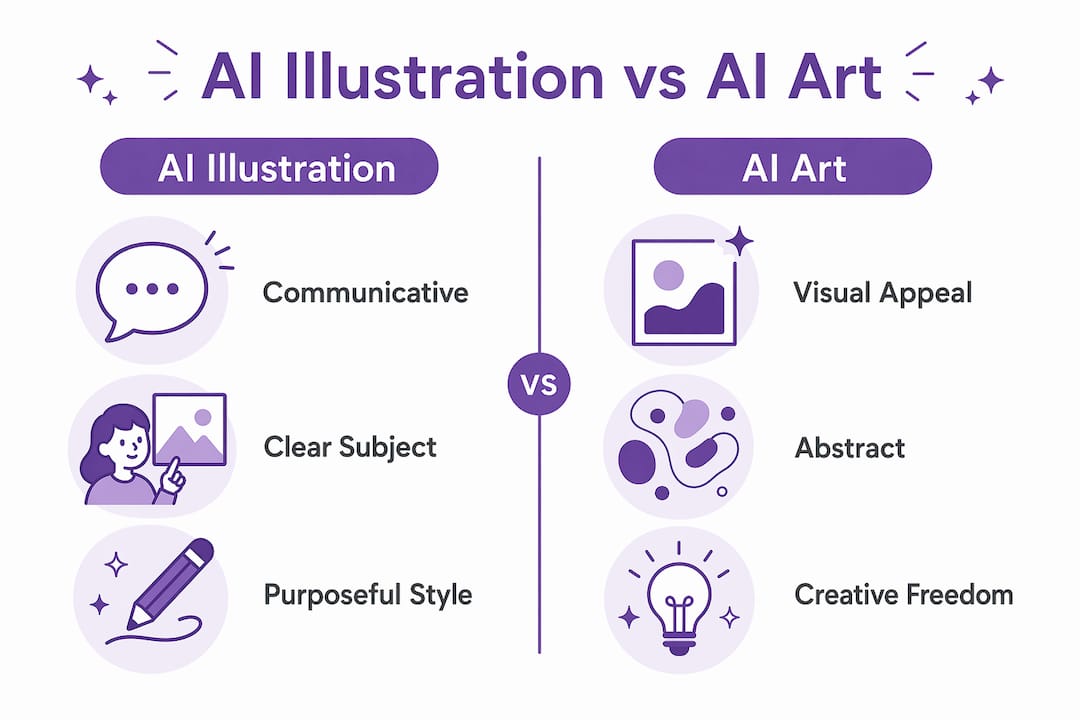
AI illustrations differ from generic AI art because they carry a communicative intent. A piece of AI art might be visually striking without meaning anything specific. An illustration must convey a concept, support a narrative, or explain something clearly. That distinction changes how you write prompts and which tools you reach for.
Here is where the practical differences show up:
- Prompt engineering focus. For general AI art, you might describe a mood or aesthetic. For illustration, you specify what the image must communicate. "A child looking scared as a shadow appears on the wall" is an illustration prompt. "Dramatic shadow play, moody lighting" is an art prompt.
- Structural control. Tools like ControlNet allow you to feed in depth maps, edge maps, or pose references to constrain the layout of the generated image. This is critical for illustration work where composition must match a specific narrative beat.
- Consistency requirements. Illustration series, such as a children's book, require the same character to look recognizable across multiple scenes. Generic AI art has no such constraint.
- Application types. AI illustration techniques serve children's books, technical diagrams, editorial spreads, and educational materials. Each demands clarity over pure aesthetics.
| Feature | General AI art | AI illustration |
|---|---|---|
| Primary goal | Visual appeal | Communicative clarity |
| Prompt focus | Style and mood | Concept and narrative |
| Consistency need | Low | High |
| Structural control | Optional | Often required |
Pro Tip: Describe what the image must communicate first, then add style. "Show a child sharing a toy with a friend, warm and inviting, flat illustration style" outperforms "cute flat illustration of two kids" every time.
How professionals use AI illustrations in children's content
AI has made affordable, consistent illustration accessible for children's book creators and self-publishers who previously needed to hire a professional illustrator at significant cost. The workflow looks different from simply typing a prompt and accepting the first result.
Practical steps professionals use include:
- Character sheets first. Before illustrating any scene, generating multiple views of the main character (front, side, three-quarter, different expressions) creates a reference library. This is the single most effective way to maintain visual consistency across a 13-page book.
- Structural locking before style iteration. The recommended workflow is to lock layout via ControlNet or reference images first, then iterate on style prompts. Changing style after layout is set reduces rework significantly.
- Vectorization for print. AI models output raster images (PNG or JPEG). For print-ready files, these are often converted to vector SVG format using Adobe Illustrator's Image Trace or Adobe Firefly's Text to Vector feature. Vectorization allows clean scaling to any print size without quality loss.
- Text rendering awareness. Models like Ideogram have specialized training for rendering text clearly within images, while Midjourney and Stable Diffusion often struggle with legible text and require post-processing fixes.
For parents and educators creating personalized content, the practical takeaway is that AI illustration is not a one-click process for professional results. It rewards a structured approach: define the character, lock the layout, then refine the style. Adventuresofbook handles this entire pipeline automatically, generating original illustrations from a child's uploaded photos so the character in the book actually looks like your kid, not a generic template.
Pro Tip: If you are creating a multi-scene story, save your seed number or reference image from the first successful character generation. Using it as a ControlNet input in subsequent scenes keeps your character recognizable without starting from scratch each time.
What are the legal and ethical considerations for AI illustrations in 2026
Copyright law as it applies to AI-generated images is still catching up with the technology, and the current rules have real consequences for anyone publishing AI illustrated content.
The key points every creator should know:
- No automatic copyright for pure AI output. Under US law, works created solely by AI currently lack copyright protection. A human creative contribution is required to secure rights over the final work.
- Document your process. Saving your prompts, editing records, and any manual adjustments you made to the output creates evidence of human authorship. This documentation is your best protection if a copyright question arises.
- UK policy is also evolving. The UK government's report on AI and copyright confirms that licensing frameworks for AI-generated works are still being defined, with transparency and enforcement as the central concerns for creative industries.
- Training data questions remain open. Many AI models were trained on images scraped from the web, some of which were copyrighted. Using these models does not automatically expose you to liability, but it is a legitimate ethical concern, particularly for commercial children's publishing.
- Originality still matters. Even with human prompting, a generated image that closely resembles a specific artist's style or a recognizable character from another work creates risk. Specificity in your prompts and a focus on original concepts reduces that exposure.
For parents creating a one-off personalized book, the legal risk is minimal. For educators producing materials for distribution or creators publishing commercially, understanding AI copyright and keeping thorough records of your creative process is the practical standard right now.
Key takeaways
AI illustrations are produced through diffusion models that require structured prompting, layout control, and human creative input to deliver consistent, communicative results with legal standing.
| Point | Details |
|---|---|
| Diffusion drives image creation | AI starts with noise and removes it iteratively, guided by your text prompt's numerical encoding. |
| Illustration requires communicative prompts | Describe what the image must convey, not just the visual style, for better illustrative results. |
| Structural control improves consistency | ControlNet and reference images lock layout before style iteration, reducing rework across a series. |
| Human input is legally necessary | Purely AI-generated images lack US copyright protection; document your prompts and edits. |
| Vectorization enables professional print | Convert raster AI outputs to SVG via Adobe Illustrator or Firefly for scalable, print-ready files. |
Why I think most people are asking the wrong question about AI illustration
People often ask whether AI illustrations are "as good as" human-made ones. That is the wrong comparison. The more useful question is whether they communicate what you need them to communicate, to the audience you are trying to reach.
From working closely with AI illustration tools, the biggest shift is recognizing that prompt specificity focused on communicative goals consistently outperforms vague style descriptions. Most beginners describe what they want an image to look like. Experienced illustrators describe what they want the image to do. That mental shift produces better results faster than any technical trick.
The other thing worth saying plainly: AI illustration is not a shortcut around creative thinking. It is a different kind of creative work. Writing a prompt that reliably produces a consistent, emotionally resonant character across 13 scenes takes real skill. Parents and educators who approach it that way, rather than expecting magic from a single text box, get genuinely useful results.
The tools will keep improving. Structural control, character consistency, and text rendering are all getting better with each model generation. For children's content specifically, the combination of photo-based character generation and narrative-aware prompting is already producing books that kids recognize themselves in. That is not a small thing.
— Jason
How Adventuresofbook uses AI illustrations to create personalized storybooks
Adventuresofbook applies the AI illustration process described in this article to create storybooks where your child is the actual main character, illustrated from photos you upload.
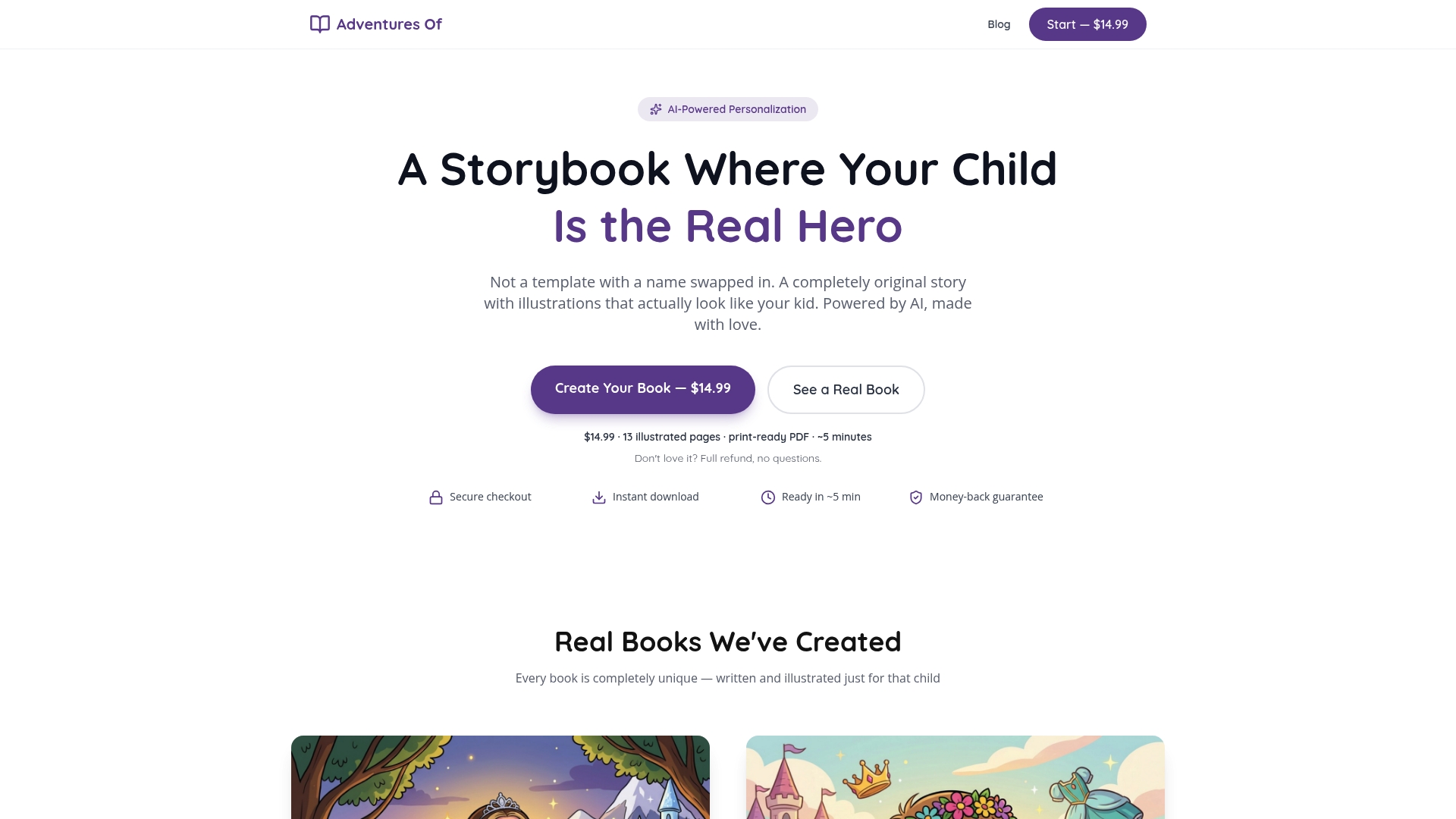
The service generates 13 illustrated pages with an original story written around your child's name, interests, and likeness. No templates, no generic characters with a name swapped in. The entire process takes about five minutes and produces an 8.5x8.5 print-ready PDF for $14.99 one-time, with a 7-day refund guarantee. If you want to see what AI illustration looks like when it is built around a real child rather than a stock character, explore personalized storybooks or browse the storybook library to see examples before you commit.
FAQ
What are AI generated illustrations?
AI generated illustrations are images created by text-to-image diffusion models that convert written prompts into visual output through iterative noise removal. Unlike general AI art, illustrations are designed to communicate a specific concept or narrative rather than simply look appealing.
How does the AI art generation process actually work?
The model encodes your text prompt into numerical embeddings, starts with random noise in a compressed latent space, and removes that noise over dozens of steps until a coherent image forms. A variational autoencoder then decodes the result into a full-resolution image.
Can AI illustrations be used in children's books legally?
Under current US law, purely AI-generated images lack copyright protection, but works with documented human creative input, such as crafted prompts and manual edits, can qualify for rights. Keeping records of your prompts and any post-processing steps is the recommended practice for commercial publishing.
What tools are best for creating AI illustrations?
Midjourney, DALL-E 3, Adobe Firefly, and Stable Diffusion are the most widely used platforms in 2026. For structural consistency across a series, ControlNet integration with Stable Diffusion gives the most layout control. Ideogram is the strongest option when your illustration needs legible text within the image.
How do AI illustrations stay consistent across multiple scenes?
Consistency comes from creating a character sheet before illustrating any scenes, then using ControlNet or a reference image to lock the character's structure across generations. Iterating on style prompts after the layout is fixed reduces variation and keeps the character recognizable throughout a story.