
Reputable personalized AI children's-book services can moderate content safely, but only when they stack multiple safeguards rather than relying on a single "kid-safe" switch. Before you buy or gift one, here is what you should expect to see in place:
- Age-tuned prompts that encode vocabulary, conflict level, and themes per age band
- Automated moderation API checks run on generated text before it reaches you
- Input photo screening that removes metadata and checks images before use
- Human-in-the-loop review for any output that triggers a borderline flag
- Preview-before-print so you approve the book before it goes to the printer
- A clear refund policy if something slips through
If a service cannot confirm all six, keep looking. If it can, preview the book yourself before wrapping it.
Table of Contents
- How does a personalized AI storybook actually get made?
- What does a solid AI content moderation setup look like?
- Why "kid-safe" needs to mean something specific to your child's age
- Questions to ask before you buy — and red flags to watch for
- How Adventuresofbook handles moderation, privacy, and safety
- How to review a generated book before printing or wrapping
- What I actually think about AI safety in children's books
- Adventuresofbook creates one original book for your child
- Where to read more
- FAQ
How does a personalized AI storybook actually get made?
The pipeline is shorter than most parents expect. You enter a child's name, age range, interests, and optionally upload a photo. That input feeds into a prompt-engineering layer that shapes the AI's instructions. The model then generates the story and illustrations. After generation, automated checks scan the text for safety and reading-level fit. Anything that triggers a flag goes to a human reviewer rather than straight to your download queue.
The data collected at the start typically includes the child's first name, age range, a short list of interests, and one or more photos. Responsible data handling means each element is collected only for the purpose of generating the book, stored with encryption in transit and at rest, and deletable on request. Photos carry EXIF metadata (GPS coordinates, device model, timestamps) that should be stripped before the file touches any AI model.
Where delays happen: human review queues. When a generation is flagged, the platform should regenerate silently and only surface the clean result to you. You should never see a flagged story as an error message, and your child should never see it at all.
What does a solid AI content moderation setup look like?
Safe-by-design story systems combine five distinct layers. Each one catches what the previous layer misses.
Layer 1 — Input filtering. Keyword blocklists and photo screening run before generation starts. Explicit terms are blocked immediately. Uploaded photos are checked for inappropriate imagery and stripped of EXIF data.

Layer 2 — Age-tuned prompt engineering. The AI receives hard constraints: permitted vocabulary range, maximum conflict intensity, prohibited themes, and target reading length. These are encoded per age band, not applied as a single global filter.
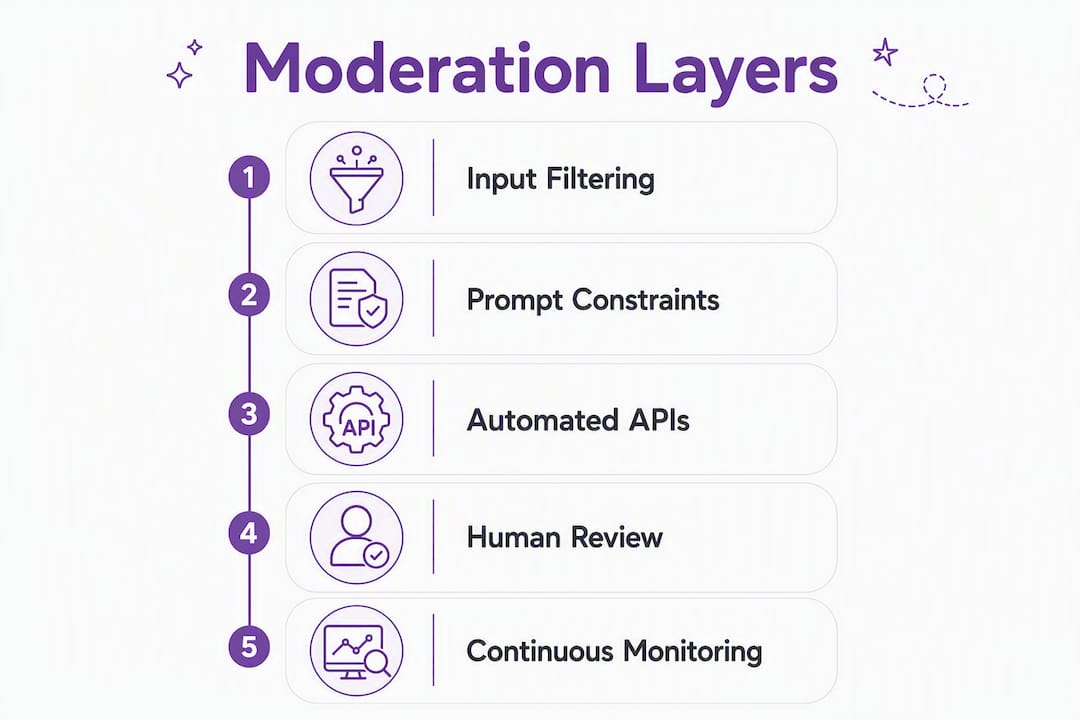
Layer 3 — Automated moderation APIs and readability checks. After generation, the text passes through moderation APIs such as OpenAI Moderation, Perspective API, or Azure Content Safety. Combining multiple APIs with weighted scoring gives higher confidence than any single tool. Reading-level formulas like Flesch-Kincaid or SMOG confirm the output actually fits the target age.
Layer 4 — Human-in-the-loop review. Outputs that score near a threshold go to a trained reviewer, not to the customer. An audit trail logs every decision. Ordering checks by computational cost — fast pattern matching first, then heavier API calls, then human review — keeps latency low while preserving safety.
Layer 5 — Delivery controls. You get a preview. You approve before printing. If something looks wrong, there is a report or edit route and a refund path.
A "mostly safe" AI model is not good enough for children's content. LLMs are non-deterministic, which means the same prompt can produce safe output most of the time and a problematic result occasionally. Layered checks exist precisely because no single filter catches every edge case.
Keyword-only blocklists miss contextual age-appropriateness, and over-zealous classifiers flag harmless content. Both failure modes matter: false negatives let inappropriate content through; false positives frustrate parents with unnecessary rejections. Layered moderation reduces both.
Pro Tip: Ask any provider whether they regenerate silently on a failed check or surface the flagged output as an error. Silent regeneration is the right answer.
Why "kid-safe" needs to mean something specific to your child's age
A single safety setting cannot serve a three-year-old and a ten-year-old. Practitioners who build AI story systems encode separate prompt constraints for at least three age bands:
- Preschool (ages 3–5): simple sentences, no conflict beyond mild misunderstanding, animals and familiar settings, 200–400 word stories
- Early elementary (ages 6–8): slightly longer sentences, low-stakes adventure, friendship challenges, 400–700 words
- Late elementary (ages 9–10): richer vocabulary, moderate conflict with clear resolution, 700–1,000 words
The same theme plays out very differently across bands. A dragon in a preschool story is friendly and a little clumsy. In a late-elementary story, that dragon might guard a treasure and pose a real challenge. Neither version is inappropriate, but swapping them would be. Age-tuned prompts prevent that swap from happening accidentally.
Systems enforce these bands through prompt templates that prohibit specific themes per band, vocabulary controls that cap word complexity, and separate moderation thresholds so a word acceptable at age nine does not slip into a story for a five-year-old.
Pro Tip: Ask the provider directly: "Is age encoded as a hard constraint in your prompts, and do you validate reading level with a formula like Flesch-Kincaid?" A yes to both is a meaningful trust signal.
Questions to ask before you buy — and red flags to watch for
Preview and human review steps are standard practice among responsible platforms. Use this checklist in a support chat or on the FAQ page before you check out:
Must-ask questions:
- Do you use age-tuned prompts with hard constraints per age band?
- Which moderation APIs do you run on generated text?
- Is there human review for borderline or near-threshold outputs?
- Can I preview the full book before it goes to print?
- How long do you retain my child's name, photos, and personal details?
- Are uploaded photos used to train any public AI model?
Red flags:
- No preview available before printing
- Vague or missing privacy policy for uploaded photos
- No mention of human review anywhere in the documentation
- No explicit refund or remediation path if content concerns arise
What to request in writing:
- Data deletion timeline and process
- List of third-party AI providers the service uses
- Confirmation that photos are not used for public model training by default
Look for named trust signals: a linked privacy policy, a stated refund guarantee, explicit mention of human review, and an audit log for moderation decisions. Vague reassurances ("we take safety seriously") are not the same thing.
How Adventuresofbook handles moderation, privacy, and safety
Adventuresofbook generates an original story and original illustrations for one child per book, built from uploaded photos and the details you provide. No templates, no swapped-in names.
The safety architecture includes age-tuned story generation, automated moderation checks on generated text, photo screening with EXIF removal, and human quality control for any flagged output. The AI illustration process uses uploaded photos to generate a likeness, not to store or share a child's image beyond what the book requires.
On privacy: Adventuresofbook collects only what is needed to generate the book. Child data is not used to train public AI models by default. You can request deletion of your data after purchase.
When a generation is flagged, Adventuresofbook regenerates silently. You receive a clean book or a clear explanation of what to resubmit — never a flagged story as your output.
Product facts for buying decisions: $14.99 one-time, 13 illustrated pages, 8.5x8.5 print-ready PDF, approximately five minutes from submission to download, and a 7-day refund policy. One child per book. If you have a concern after delivery, the report and resubmission route is available through support, and the refund policy covers cases where the content does not meet your expectations.
The safety of AI-illustrated content is covered in more detail on the blog for parents who want to go deeper on the illustration side specifically.
How to review a generated book before printing or wrapping
You have the PDF. Here is a five-minute check before you send it to print or hand it over as a gift.
- Scan every page for theme issues. Look for mentions of death, violence, romantic content, or sensitive family topics that do not belong in the age band you selected.
- Check the illustrations. Does the character look like the child? Are there any background details that could identify a real location or include other people?
- Read two or three pages aloud. Tone problems show up faster when spoken. Listen for anything that feels off for the child's age.
- Confirm character behavior. The main character should model positive choices appropriate to the story's age band.
- Look for unexpected real-world references. Street names, school names, or adult figures the child knows should not appear unless you entered them intentionally.
If you find something that needs fixing, use the platform's edit or regeneration route. If the issue is not resolvable, request a refund within the stated policy window.
Pro Tip: View the PDF on a tablet at full size and read a short section aloud with the child before you finalize the print order. Their reaction tells you more than any checklist.
What to expect on price, turnaround, and refunds
- Price: The cost is $14.99 as a one-time payment with no subscription or hidden fees.
- Turnaround: Approximately five minutes from submission to downloadable PDF. Human review for flagged content may add a short delay; the platform regenerates silently when possible so the wait is minimal.
- Format: 13 illustrated pages, 8.5x8.5 print-ready PDF. Custom turnaround details are covered on the blog if you need specifics for a tight gifting deadline.
- Refund: 7-day policy. If the content does not meet your expectations, contact support within seven days for a resolution or full refund.
Key Takeaways
Reputable AI personalized children's-book services require layered moderation, age-specific prompt constraints, and human review — not a single "kid-safe" toggle.
| Point | Details |
|---|---|
| Layered moderation is required | Input filters, moderation APIs, and human review together catch what any single layer misses. |
| Age tuning must be specific | Separate prompt constraints for preschool, early elementary, and late elementary prevent age-band mismatches. |
| Preview before printing | Always review the full PDF yourself before gifting or sending to print. |
| Ask for named trust signals | Look for a linked privacy policy, stated refund guarantee, human review, and data deletion option. |
| Adventuresofbook's approach | $14.99, 13 pages, 7-day refund, one child per book, with age-tuned generation and human quality checks. |
What I actually think about AI safety in children's books
The conversation around AI moderation tends to focus on the technology: which APIs, which thresholds, which models. That matters. But the thing parents underestimate is how much the design intent of a service shapes safety outcomes before any API is even called.
A service built around one child per book, with age encoded as a hard constraint from the first prompt, is structurally safer than one that generates at scale and applies filters afterward. The architecture reflects a choice about who the product is for. When a company says "your child is the real hero," that is not just marketing copy. It describes a product decision: generate one original story for one specific child, not a template with a name dropped in. That decision limits the blast radius of any single moderation failure.
The honest caveat: no system is perfect. LLMs are probabilistic, and a human reviewer is not infallible either. What you are looking for is a provider that has thought carefully about failure modes and built a path for you to report, request a fix, and get your money back if needed. That combination, more than any single technical feature, is what makes a service trustworthy for children.
Adventuresofbook creates one original book for your child
Every book Adventuresofbook generates is built from scratch for one child, using their uploaded photos and the details you provide. The story is original, the illustrations match their likeness, and the content passes through age-tuned generation, automated moderation checks, and human quality review before it reaches you.
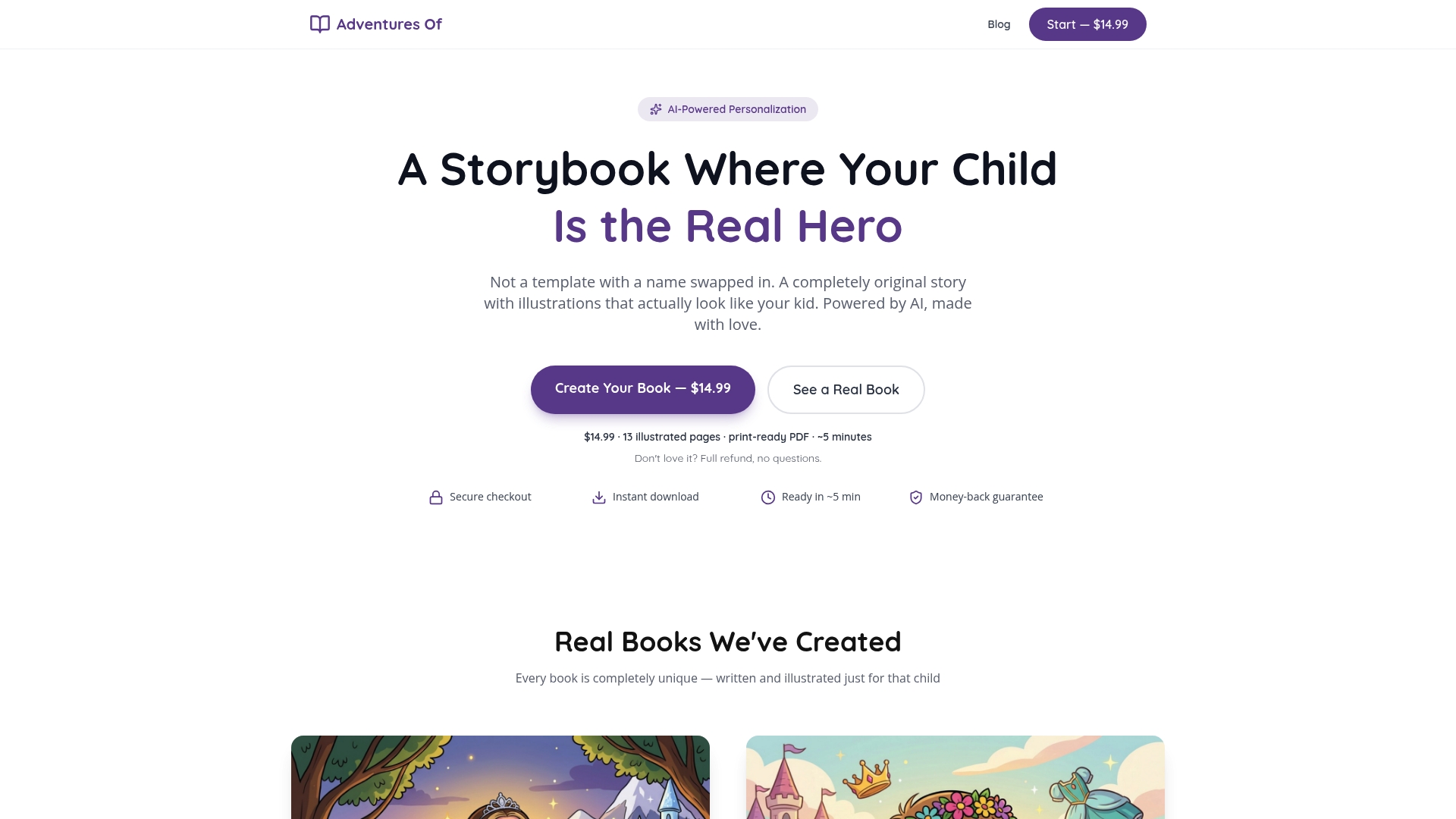
At $14.99 for a 13-page, 8.5x8.5 print-ready PDF, with a 7-day refund and a preview before you commit to print, the risk is low and the result is specific to your child in a way no template book can match. One child per book, by design. If anything in the generated content does not look right, support is available to request an edit or process a refund.
Start your child's personalized book and preview it before you print or gift it.
Where to read more
- Is AI-Illustrated Content Safe for Kids? — Adventuresofbook's own breakdown of safety considerations for AI-generated illustrations, written for parents.
- How AI Illustration Actually Works (Plain English) — explains how photos become illustrations and what happens to the image data.
- How to Make a Personalized Children's Book — step-by-step walkthrough of the creation and preview process.
- Data Privacy in Personalized Children's Books — practitioner checklist covering data minimization, retention, and deletion for personalized book services.
FAQ
What is AI content moderation in a children's book service?
It is the set of automated and human checks a service runs on AI-generated text and illustrations to confirm the content is age-appropriate and free of harmful material before the book reaches a parent or child.
Does Adventuresofbook use human review for generated content?
Yes. Adventuresofbook routes borderline or flagged outputs to human quality control rather than delivering them directly. The 7-day refund policy also gives parents a remediation path after delivery.
What personal data does a personalized book service typically collect?
Most services collect a child's first name, age range, interests, and optionally photos. Responsible platforms strip EXIF metadata from photos, store data with encryption, and offer a deletion request process after the book is generated.
Why is a single "kid-safe" setting not enough?
Because appropriate content differs significantly between a three-year-old and a ten-year-old. Age-tuned prompt constraints and separate moderation thresholds per age band are needed to prevent age-band mismatches in vocabulary, conflict level, and themes.
What should I do if I find something inappropriate in a generated book?
Use the platform's edit or regeneration route first. If the issue cannot be resolved, request a refund within the stated policy window. Adventuresofbook's 7-day refund policy covers content concerns.