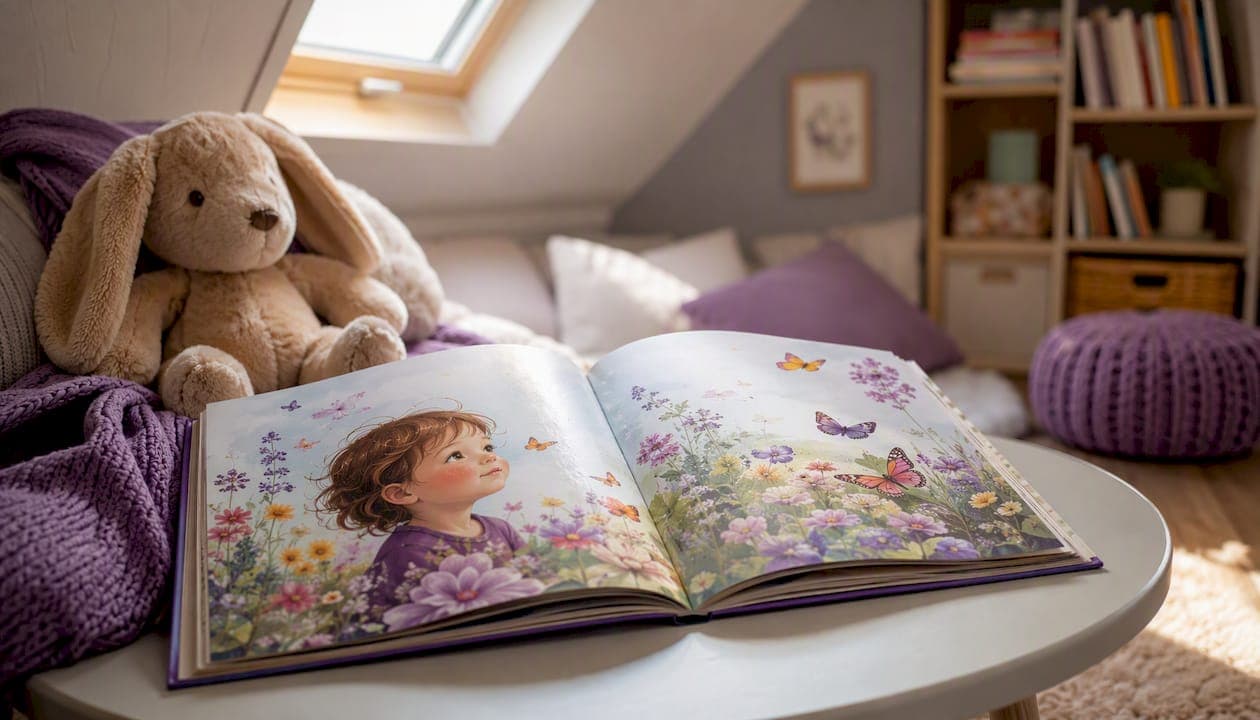
Yes, you can adapt a single personalized storybook to a child's sensory processing needs. The core recommendation: choose photo-based personalization over name-only, limit each page to one focal sensory element, and order a print-ready PDF so you control paper stock and finish. Here's where to start:
- Identify whether the child is hypersensitive (easily overwhelmed) or hyposensitive (needs more input)
- Pick one or two sensory formats to prioritize (visual contrast, tactile paper, or read-aloud audio)
- Gather a clear, well-lit headshot photo before you order
Key Takeaways
Meaningful personalization (photo + realistic setting) reduces sensory anxiety more than name-only books because familiarity lowers the cognitive effort of processing an unfamiliar character.
| Point | Details |
|---|---|
| Choose photo-based personalization | Photo plus realistic setting produces stronger engagement than name-only, per 2024 and 2025 research. |
| Limit sensory events per page | One focal sensory element per spread prevents cognitive overload for hypersensitive children. |
| Test before full print run | Print 2–3 sample pages first; watch for avoidance signals and reduce intensity by half if needed. |
| Control paper and finish | Order an 8.5x8.5 print-ready PDF so you choose matte stock, weight, and finish yourself. |
| Adventuresofbook fits this approach | $14.99 one-time, 13 illustrated pages, AI-generated from your child's photo, seven-day refund, one child per book. |
Table of Contents
- Two-minute planning checklist before you order
- Does personalization level actually change how a child engages?
- Concrete story edits that match a child's sensory profile
- Choosing formats and materials by sense
- What production specs do you actually need?
- How to trial pages with the child before finalizing
- Safety, allergy, and privacy checklist
- Why we build books around one real child
- A sensory-adapted book your child will actually sit with
- Sources
- FAQ
Two-minute planning checklist before you order
Before you fill out a single form, spend two minutes on these decisions:
- Personalization level: Name-only is quick but produces the weakest engagement. Photo plus interests plus a realistic setting is the stronger choice for most children with sensory preferences (more on why below).
- Primary sensory profile: Hypersensitive children do better with calm palettes, short scenes, and matte paper. Hyposensitive children often respond to bolder colors, repetitive refrains, and heavier page weight.
- One or two sensory adaptations only: Trying to address every sense at once creates cognitive overload. Pick visual contrast or tactile paper as your first priority, then add one more if the child handles it well.
- Production constraints: Adventuresofbook produces one child per book, formatted as an 8.5x8.5 print-ready PDF. Have your photo ready at the highest resolution your phone allows.
Pro Tip: Write your child's sensory preferences on a sticky note before you open the order form. Something like "calm colors, short sentences, no loud characters" takes 30 seconds to write and prevents you from forgetting mid-order.
Does personalization level actually change how a child engages?
It does, and the research gap between name-only and photo-based personalization is wider than most parents expect.
A 2024 integrative review found that personalization paired with realistic scenarios consistently produced larger engagement and learning effects than nominal personalization (name-only). A 2025 experimental study confirmed that matching a child's name and physical appearance produced significant improvements in story retelling, text comprehension, and behavioral involvement, with the largest gains for children of color.
The practical rule is straightforward:
- Name-only: Fine when time or privacy limits photo use. Raises affective engagement modestly but rarely reduces sensory anxiety.
- Photo + interests: The child recognizes themselves, which reduces the cognitive effort of "who is this character?" That freed-up attention can go toward processing the story instead of the unfamiliar face.
- Photo + realistic setting: Best for children whose sensory anxiety is tied to unfamiliar environments. A bedroom or backyard they recognize on the page is far less activating than a fantasy castle.
For children with sensory processing differences, familiarity is a genuine calming tool, not just a nice-to-have.
Concrete story edits that match a child's sensory profile
Adapting story content is separate from adapting format. These are the specific edits that matter most.
For hypersensitive children (easily overwhelmed by noise, crowds, or unexpected events):
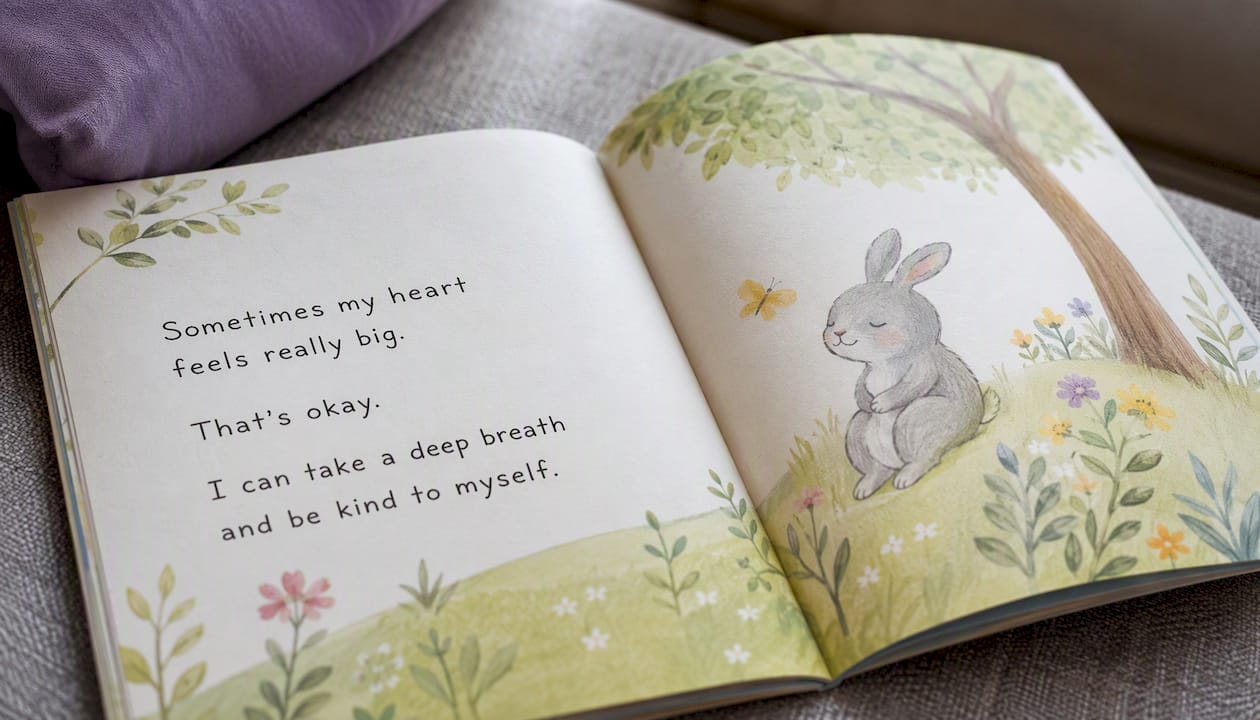
- Keep sentences short: 8–12 words per sentence is a practical ceiling.
- Limit sensory events per page to one. A page where the character hears music, smells cookies, and feels rain is three sensory triggers at once.
- Use predictable refrains ("And then Maya took a deep breath…") so the child knows what's coming.
- Choose calm, familiar settings: a kitchen, a garden, a bedroom. Avoid crowds, loud celebrations, or chaotic scenes.
For hyposensitive children (need more input to stay engaged):
- Add sensory-rich language: "the rough bark," "the loud crunch," "the bright orange."
- Build in repetition and rhythm. A refrain that repeats every two pages gives the child something to anticipate and join in on.
- Slightly longer scenes with more sensory detail hold attention better than sparse, minimal pages.
Pro Tip: When submitting a custom order, paste a two-sentence note in the instructions field: "Please keep scenes calm and familiar, one sensory detail per page" or "Please use rich sensory language and a repeating phrase." Most AI-generation platforms read these notes directly into the story prompt.
Choosing formats and materials by sense
Prioritize one or two senses and keep the rest low-intensity. Here's how each sense maps to practical choices:
Visual
High contrast between text and background (dark text on white or cream) is the most accessible default. For hypersensitive children, avoid saturated neon palettes; soft blues, greens, and warm neutrals tend to be calming. Font size of at least 18pt with generous line spacing reduces visual crowding. Research on picture-book sensory design identifies color and texture as the two strongest attractiveness factors shaping children's reading behavior.
Auditory
A QR code linking to a recorded read-aloud is the most practical audio addition for a print book. Keep narration under 90 seconds per page. A calm, steady voice at moderate pace works better than dramatic character voices for hypersensitive listeners.
Tactile
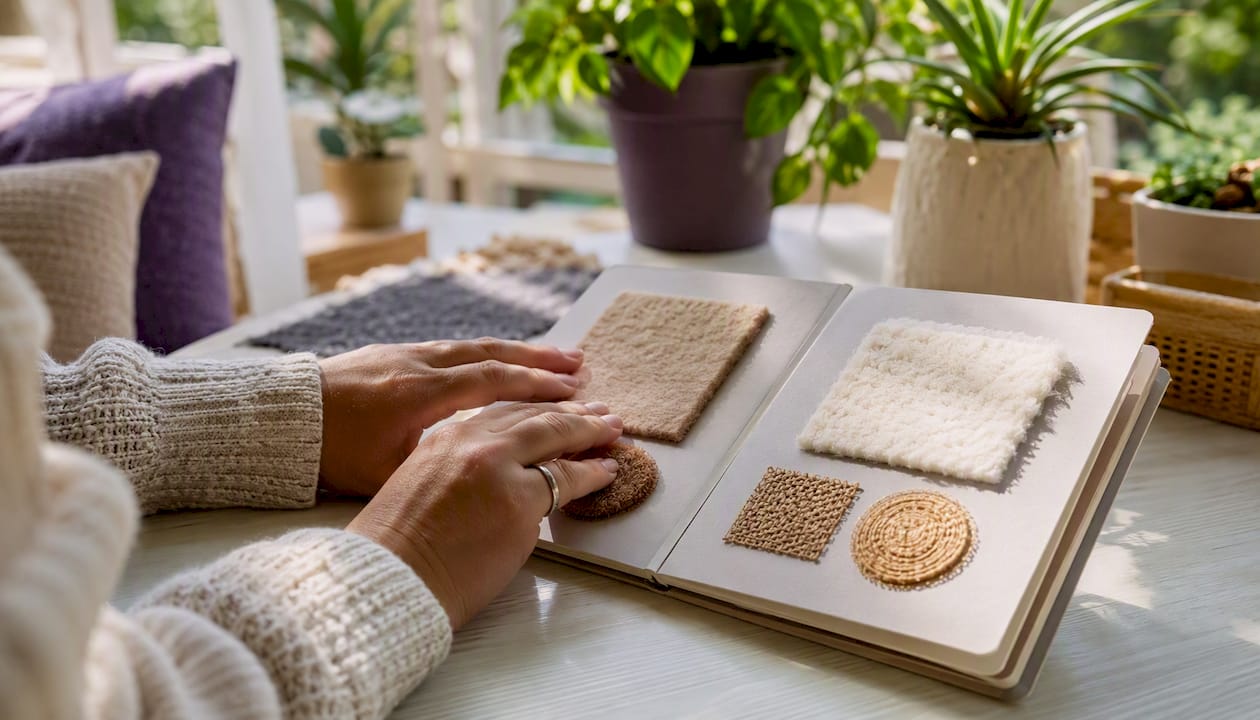
Matte lamination feels softer and less slippery than gloss, which many children with tactile sensitivity prefer. Heavier paper stock provides more grounding tactile feedback. If you add texture elements (fabric swatches, foam stickers), confirm they are securely adhered and sized above choking-hazard thresholds (larger than 1.25 inches in any dimension for children under 3).
Smell and taste
Scented inks and edible companion activities are possible but carry real allergy and hygiene risks. The multisensory reading literature identifies olfactory and gustatory inputs as promising but under-studied, with limited empirical evidence for print books specifically. If you want to add a scent element, use an ambient approach (a lightly scented bookmark, not ink on the page) and confirm no fragrance allergies first.
Proprioception
Pull-tabs and fold-out pages add physical engagement and can help hyposensitive children stay present. Avoid them for children who tear pages under stress. Heavier paper weight alone provides mild proprioceptive feedback without the tear risk.
What production specs do you actually need?
Order a print-ready PDF at an appropriate resolution suitable for quality home or local printing. That resolution ensures illustrations print crisply at home or at a local print shop without pixelation.
- Photo quality: Use the sharpest, most recent headshot you have. Natural lighting, a neutral background, and a straight-on angle give the AI the clearest facial features to work from.
- Color profile: sRGB is the safe default for home printing. If you're sending to a commercial printer, ask whether they need PDF/X-1a.
- Safe area: Keep text and key illustration elements at least 0.125 inches inside the trim edge to avoid content being cut during binding.
- Turnaround: AI-generated books like Adventuresofbook produce a complete file in about five minutes. Printed copies ship separately and take longer depending on the printer you choose.
Pro Tip: If you're printing at home for a sensory trial, print one or two pages first on your intended paper stock before printing the full 13-page book. That way you can check contrast, color, and feel before committing to the full print run.
How to trial pages with the child before finalizing
Run two or three quick micro-tests before you commit to a final print run. Here's a simple protocol:
- Print two or three sample pages (different sensory intensities if possible).
- Sit with the child in a low-distraction space. Keep the session under five minutes.
- Watch for: leaning in (positive), pushing the book away (negative), covering ears or eyes (too intense), or flat disengagement (too low-stimulation).
- If the child shows avoidance or distress, reduce sensory input on the next version by roughly half: fewer colors, shorter text, quieter scene.
- Note what worked in writing. Something like "liked the blue pages, avoided the page with the crowd scene" is enough to guide the final order.
Red flags that mean you should simplify before printing the full book:
- Repeated page-turning without looking
- Covering eyes or ears
- Asking to stop before page 5
- Physical distress (rocking, hand-flapping as avoidance, not engagement)
Participatory research with young children shows children naturally regulate sensory intensity by moving materials closer or pushing them away. Trust those signals.
Safety, allergy, and privacy checklist
Always run this check before you finalize any sensory additions or submit personal photos.
Physical safety:
- Any added texture element must be larger than 1.25 inches in all dimensions for children under 3.
- Confirm adhesives are non-toxic and fully cured before the child handles the book.
- Avoid scented inks if the child has fragrance sensitivities or asthma.
Allergy check:
- Confirm no latex, fragrance, or dye allergies before adding any physical material.
- If using an edible companion activity, check for the child's full allergen list (tree nuts, gluten, dairy).
Photo privacy:
- Confirm the platform deletes uploaded photos after generation. Adventuresofbook handles photos with privacy-focused data practices and does not use them for purposes beyond generating the book.
- Never upload photos to a platform that does not clearly state a deletion or limited-use policy.
- Use a photo that shows only the child, not other family members, to limit data exposure.
Meaningful personalization requires a real photo, but that photo deserves the same care as any personal data. Check the platform's privacy policy before you upload, confirm deletion timelines, and keep a copy of the original photo yourself.
Why we build books around one real child
The template approach has always bothered me. Swapping a name into a pre-drawn character and calling it "personalized" misses the point entirely. What actually moves a child is seeing themselves in the story: their face, their interests, their backyard. That's the design philosophy behind Adventuresofbook. Every book is generated from scratch around one child's uploaded photo and details. The 8.5x8.5 format was chosen because it prints cleanly at home or at any local print shop, giving parents full control over paper stock and finish. The five-minute generation time means you can iterate: order, test a printed page, adjust the prompt, and reorder if needed. The seven-day refund exists because we know a book that doesn't fit a child's needs is no gift at all.
A sensory-adapted book your child will actually sit with
A single personalized storybook built around your child's real face and interests costs $14.99 at Adventuresofbook. You get 13 illustrated pages, an 8.5x8.5 print-ready PDF generated in about five minutes, and a seven-day refund if it's not right.
The PDF format is the key sensory advantage here: you choose the paper weight, finish (matte or gloss), and print size. Add a QR-linked audio file yourself, or print on heavier stock for proprioceptive feedback. The illustrations are drawn from your uploaded photos, so the character looks like your child, not a generic stand-in. One child per book, always.
Create your child's personalized book at Adventuresofbook and use the instructions field to paste your sensory notes directly into the order.
Sources
- Personalization effects on child involvement during shared book reading: Do children of color benefit most? | European Journal of Psychology of Education | Springer Nature Link
- The Distance Between the Story Character and the Reader: Evidencing the Impact of Familiarity in Children’s Storybooks
FAQ
Does name-only personalization help children with sensory needs?
Modestly.
How many sensory adaptations should one book include?
One or two. Layering too many sensory elements (bold colors, textures, audio, pull-tabs) at once risks cognitive overload, especially for hypersensitive children.
Can I specify sensory preferences when ordering from Adventuresofbook?
Yes. Use the instructions field during the order process to note preferences like "calm scenes, short sentences, one sensory detail per page," and the AI generation incorporates those notes into the story.
What photo works best for a sensory-adapted personalized book?
A clear, well-lit headshot with a neutral background and natural lighting gives the AI the most accurate facial features, which produces illustrations the child is more likely to recognize and respond to.
Is a print-ready PDF better than a pre-printed book for sensory customization?
For most sensory adaptations, yes. A PDF lets you choose paper weight, matte or gloss finish, and print size yourself, which is the most direct way to control tactile and visual sensory input.